Easy English Books for Beginners: Choose Your First Book by Word Count, Genre and Who It Was Written For
For your first English book, first decide on a length you can finish in one or two sittings. Then choose by genre and by who the book was written for. This guide compares easy English books for beginners by word count and helps junior high school students and adults pick a first book, with examples such as Oxford Bookworms Library and Magic Tree House.
Key takeaways
- Compare short English books by word count, not by number of pages. For a first book, aim for a few thousand words at most, so you can finish it in one or two sittings
- Two books can be equally short but feel very different: graded readers for learners and books for children in English-speaking countries are written for different readers
- For junior high school students, start with a short book where the story moves fast. Good choices are the Starter level of Oxford Bookworms Library, Nate the Great and Magic Tree House
- For adults, choose a book that stays short but has grown-up content, such as graded readers for learners or nonfiction
- For your second book, change only one thing: the length, the genre or the type of book
For your first English book, first decide on a length you can finish in one or two sittings. Then choose a genre you like and a book written in a way that fits your age. If you do this, you will want to pick up a second book. A common mistake is to buy a book you really wanted to read, stop after a few pages, and put it back on the shelf. Often the cause is not your English level. It is that you did not check the length of the book or who it was written for.
In this guide, we compare the length of easy English books by "word count" (the number of English words in one book). Then we show how junior high school students and adults can each choose a first book, with real series as examples. How to find the level that is easy for you, and how to read without a dictionary, are covered in Learn English with stories for beginners. Here we focus only on which book to pick up.
Compare easy English books for beginners by word count, not by pages
Two books may look equally thin, but the amount of English inside can be very different. Books with big pictures, big letters or wide margins have fewer words, even if they have many pages. So the best way to judge the length of an English book is its word count.
The SSS Extensive Reading Association (a Japanese group that has helped spread extensive reading in English) publishes a list of word counts for each series. From that list (a table made in 2007), here are some well-known series and books.
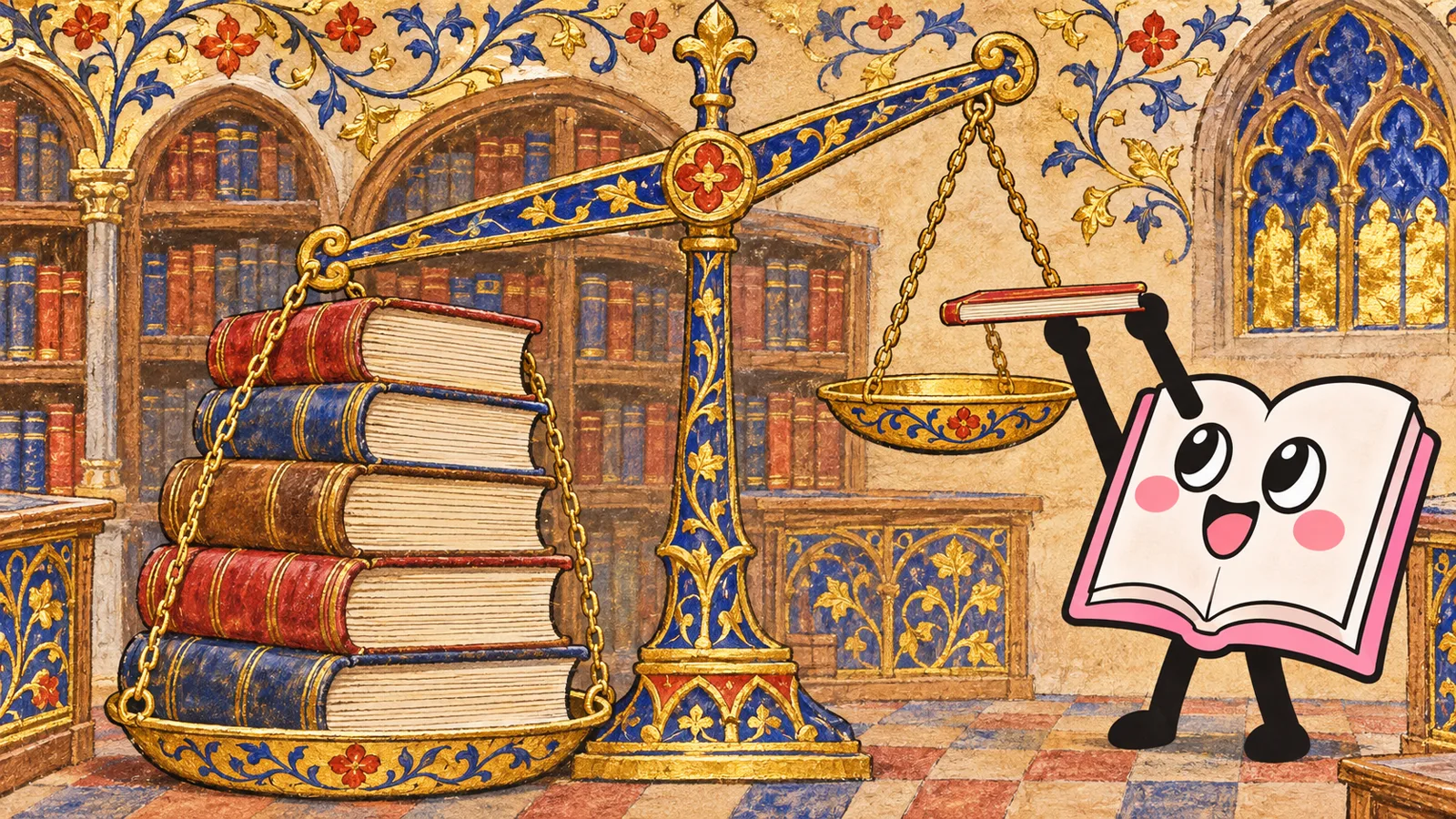
Each step on the scale is 10 times bigger, so the differences are bigger than they look. Even the shortest Harry Potter book (about 76,000 words) has more than 200 times as many words as an ORT Stage 5 book, the shortest in the chart.
It helps to turn length into time. For example, if you read 100 words per minute, a 1,000-word book takes 10 minutes, a 5,000-word book takes 50 minutes, and a 30,000-word book takes about 5 hours. (Reading speed is very different from person to person, so this is only an example.) For your first book, a good guide is a book of a few thousand words at most, which you can finish in one or two sittings, such as on the way to and from school or work, or before bed.
Note that this list was made in 2007, and the books in some series may have changed. Before you buy, also check the word count on the publisher's website or on the back cover of the book.
Equally short books can feel different, depending on who they were written for
Figure 1 shows two kinds of books in two colors. Pink is for books written for people learning English, with a limited vocabulary and simple grammar (graded readers). Green is for books written for children in English-speaking countries. Both kinds include short books, but because they were written for different readers, they feel different to read.
| Type of book | Example | Who it is written for (from the publisher) | What you may notice when you read it |
|---|---|---|---|
| Graded readers for learners | Oxford Bookworms Library | For learners from teenagers to adults. Seven levels | Includes retold classics, modern stories and nonfiction. The Starter level has exercises and pages that explain words |
| Books that help children in English-speaking countries learn to read | Oxford Reading Tree | A series that supports children from learning how sounds and letters go together (phonics) to reading stories | The lower stages have very few words per book (Figure 1), and you read through picture-heavy books |
| Reading books for children in English-speaking countries | Magic Tree House | For children who have just started reading chapter books | An adventure series in which two ordinary children, Jack and Annie, travel through time and to other countries in a magic tree house |
Neither type is better. If you are not sure, ask yourself one question: does childish content bother you? If not, children's books, where you can follow the story through the pictures, are a friendly way in for people who find English hard. If it does, a graded reader with an adult or teenage main character will keep you reading, even if it is short.
The first book for junior high school students: short, with a story that moves fast
For junior high school students (ages about 12 to 15), a short book where the story starts moving from the first page works well. What matters is not studying, but having the experience of reading on because you want to know what happens next. That experience leads to a second book.
Here are three choices. If you want to start as short as possible, try the Starter level of Oxford Bookworms Library. In its guidance for Japan, the publisher (Oxford University Press) calls it a "250-word level" that people who have just started learning English can enjoy. For example, Drive into Danger is a 48-page book.
If you want to enjoy a real story with twists and turns, try Nate the Great, about Nate, who calls himself the world's greatest detective (1,600–2,000 words in Figure 1; the publisher describes it as a mystery for children who are starting to read), or Magic Tree House (4,700–6,000 words in Figure 1). Both are for children in English-speaking countries and have children as main characters, but the stories move fast and each book is short.
When junior high school students choose, it is a good idea to look first at the English book shelves of the school library or local library. Some libraries have whole series of graded readers. Pick up a few books, and choose one where the cover and the first page make you think, "I want to read this."
The first book for adults: short, but with grown-up content
A common problem for adults is that the easier the English, the more childish the story feels, so they lose interest. That is why adults should look for a book that stays short but has content for adults.
The best match is graded readers for learners. The publisher says Oxford Bookworms Library is for learners from teenagers to adults. Besides retold classics and modern stories, it has nonfiction books for learning about the world (Factfiles, which introduce topics such as cities, sports and environmental problems with photos). If you do not enjoy stories, you can also start with nonfiction on a topic close to your work or hobbies. In Figure 1, the Starter level has 700–1,500 words per book, and the next level (Stage 1) has 4,800–7,300 words. So if you read two or three Starter books before you move up, the jump in length will be less of a shock.
If you want to feel that you finished a "real" English book, not one made for study, short books that famous English-language authors wrote for children are also good choices. For example, Roald Dahl's The Magic Finger has about 3,600 words in the SSS list. It is much shorter and quicker to finish than Charlie and the Chocolate Factory (about 30,000 words) by the same author. If you choose a story you already know from a film or a translation, it is easier to guess new words from the words around them.
4 things to check before you buy or borrow
When you have a book in mind, check these 4 things before you get it. This way, you are less likely to start reading and think, "This isn't what I expected."
- Word count: Check the words per book on the publisher's website, on the back cover, or in a list such as the one from the SSS Extensive Reading Association. If it is not given, guess from the number of pages and the amount of text on each page
- Sample pages: Use the "look inside" feature on the publisher's page, or read the first page in a bookshop or library. If you keep stopping because of new words, choose a shorter, easier book
- Audio: Oxford Bookworms Library also has versions with audio (Audio Pack). If you want to listen to English while you read, choose a version with audio
- Paper or digital: Many series also come as e-books or apps. If you read on your way to work, choose a version you can read on your phone. If you want to write in the book, choose paper
For your second book, change just one thing
When you finish your first book, the trick is to choose a second book that is similar to the first. If you change the length, the genre and the type of book all at once, and the new book is hard to read, you will not know why. Change just one thing and keep everything else the same as your first book.
If your first book was a mystery and you enjoyed it, read another mystery at the same level of the same series, or move to a slightly longer book in the same genre. On the other hand, if your first book was easy to read but you did not like the story, keep the length the same and change only the genre. If a book feels boring, it is fine to switch to another book at the same level. (How to let go of a book that is not right for you is explained in Learn English with stories for beginners.)
Before you buy a book, try one short chapter
The fastest way to learn how long a book you can read to the end is to actually read something. Of the stories on Original Novel, 41 out of 55 can also be read in English (counted on November 14, 2026). In learning mode, the number of words you read and the number of days in a row you have read are recorded. You can also choose how much English to mix in, from 0 to 100%. Read one chapter with only a little English first, and raise the share of English as you get used to it. This will help you decide how long your first book should be.
Short stories you can also read in English
See more: Short stories you can also read in English ›These are stories on this site. On the page for finding stories, set the text language to English to see only stories you can read in English. You can try them from Chapter 1.
 The Only Voice I Can't HearFor teens · Showbiz & idolsThe Jingjok Behind the BlackboardFor kids · SchoolHeir to a Noodle CartFor adults · Comedy
 CompletedThe Sea WallFor adults · Fantasy
 CompletedI Want to Count Your Gray HairsFor adults · Romance
 The Boy Who Couldn't Lie and the Girl Without a VoiceFor teens · Fantasy
Sources (date checked)
- YL Tables for Graded Readers and Other BooksSSS Extensive Reading Association / Japanese / Checked Nov 18, 2026
- Oxford Reading TreeOxford University Press Southern Africa / Checked Nov 18, 2026
- Nate the GreatPenguin Random House / Checked Nov 18, 2026
- Magic Tree HousePenguin Random House / Checked Nov 18, 2026
- Oxford Bookworms LibraryOxford University Press Japan / Japanese / Checked Nov 18, 2026
- Oxford Bookworms Library Starter: Drive into DangerOxford University Press Japan / Japanese / Checked Nov 18, 2026
- Oxford Bookworms Library Factfiles Level 2 Climate ChangeOxford University Press Japan / Japanese / Checked Nov 18, 2026
- The Secret of the Chocolate Factory (Japanese edition)National Diet Library, Japan (NDL Search) / Japanese / Checked Nov 18, 2026
FAQ
Is an e-book or a paper book easier for beginners?
Either is fine. With some e-book readers you can look up a new word right away or make the text bigger, so e-books are good for reading on your phone on the way to work. A paper book shows you how many pages are left, so you can feel that you are almost done, and finishing it feels great. If you look up too many words and the story keeps stopping, try a paper book and put the dictionary away.
Can my first English book be the original of a book I read as a child in my own language?
Yes, it can be a good choice. But be careful: even a book for children in translation can have tens of thousands of words in the English original. Check the word count, and if it is too long, look for a version of the same story rewritten for learners.
Should I read English books out loud?
For your first book, it is better to read to the end without stopping than to read aloud. When you read aloud, you may pay so much attention to saying each sentence correctly that it is hard to follow the story. If you also want to get used to the sound of English, choose a version with audio and follow the text with your eyes while you listen.
I only know the translated title. How can I find the English original?
In Japan, the most reliable way is to search for the Japanese translation in the National Diet Library Search (Japan's national library catalog) and look at the "original title" field in the record (the Japanese label reads "gen-taitoru"). For example, the record for the 2005 Japanese edition of Charlie and the Chocolate Factory from the publisher Hyoronsha lists the original title as Charlie and the chocolate factory. A translated title is not always a direct translation of the English title, so search for the English book by both the original title and the author's name.