Mystery Books for English Learners: Climb Level by Level from Graded Readers to the Originals
If you're using mystery books for English learners in your extensive reading, an easy path is to follow one famous detective, step by step, from versions rewritten for learners to the originals. This article covers the Holmes ladder with word counts, how to tell which authors you can read free in the original (it depends on your country's copyright rules), and how to read a mystery.
Key takeaways
- In a mystery, the question "who did it?" pulls you forward, so it's easier to keep going even when there are words you don't know
- Holmes has graded readers at several levels, so you can climb from Stage 1 (5,925 words) to the original short stories (6,973–9,937 words each)
- Under a life-plus-70 rule such as the EU's, the originals by Doyle, Chesterton and Poe are free to read, but Christie is still protected, so buy or borrow graded editions and other editions of her books; check your own country's rule
- A suspect memo of characters and clues, and looking up words instead of titles, prevent mix-ups and spoilers
You hit one unknown English word after another, yet somehow you couldn't stop turning the pages. Maybe you simply had to know what would happen next. A mystery is a kind of story built around exactly that feeling.
If you want to use mysteries for extensive reading in English, an easy path is to follow one famous detective and climb step by step, from versions rewritten for English learners to the original stories. Many works whose authors died long ago, such as the Sherlock Holmes stories, can be read free in the original on Project Gutenberg. Agatha Christie's works, on the other hand, are still protected by copyright in countries that use a term of the author's life plus 70 years, such as the EU member states, so readers there buy or borrow graded editions and other editions of her books. This article shows how to choose a book for each step, and how to read a mystery in the way that suits the genre.
"Whodunit?" carries you past the words you don't know
In extensive reading, you keep going even when you don't understand everything (how to get started is explained in our article on starting extensive reading in English for free). What keeps you going is wanting to know what happens next. A mystery is a story that keeps the answers to "who" and "how" hidden until the solution scene. Because you read with that question in mind, a paragraph full of unknown words becomes just part of the road to the answer, and it's easier to get through.
Mysteries have other strengths for extensive reading, too.
- Each story is a complete unit: in a short story, the crime happens and is solved within the same story, so it's easy to finish at a natural break in one or two sittings
- It gets easier from the second story: in a series about the same detective, the detective, the sidekick, their home and so on come back again and again, so you move on to the next story already used to the names and phrases
- You reread without trying: when the solution reveals that "that one sentence was the clue", you want to flip back. You read the same English twice and notice what you missed the first time
One thing to watch out for: a clue is sometimes tucked into a small detail of a single sentence. Trying to understand every sentence will wear you out, so decide in advance that on the first read you'll focus on following the plot, and come back for the details after you've read the solution.
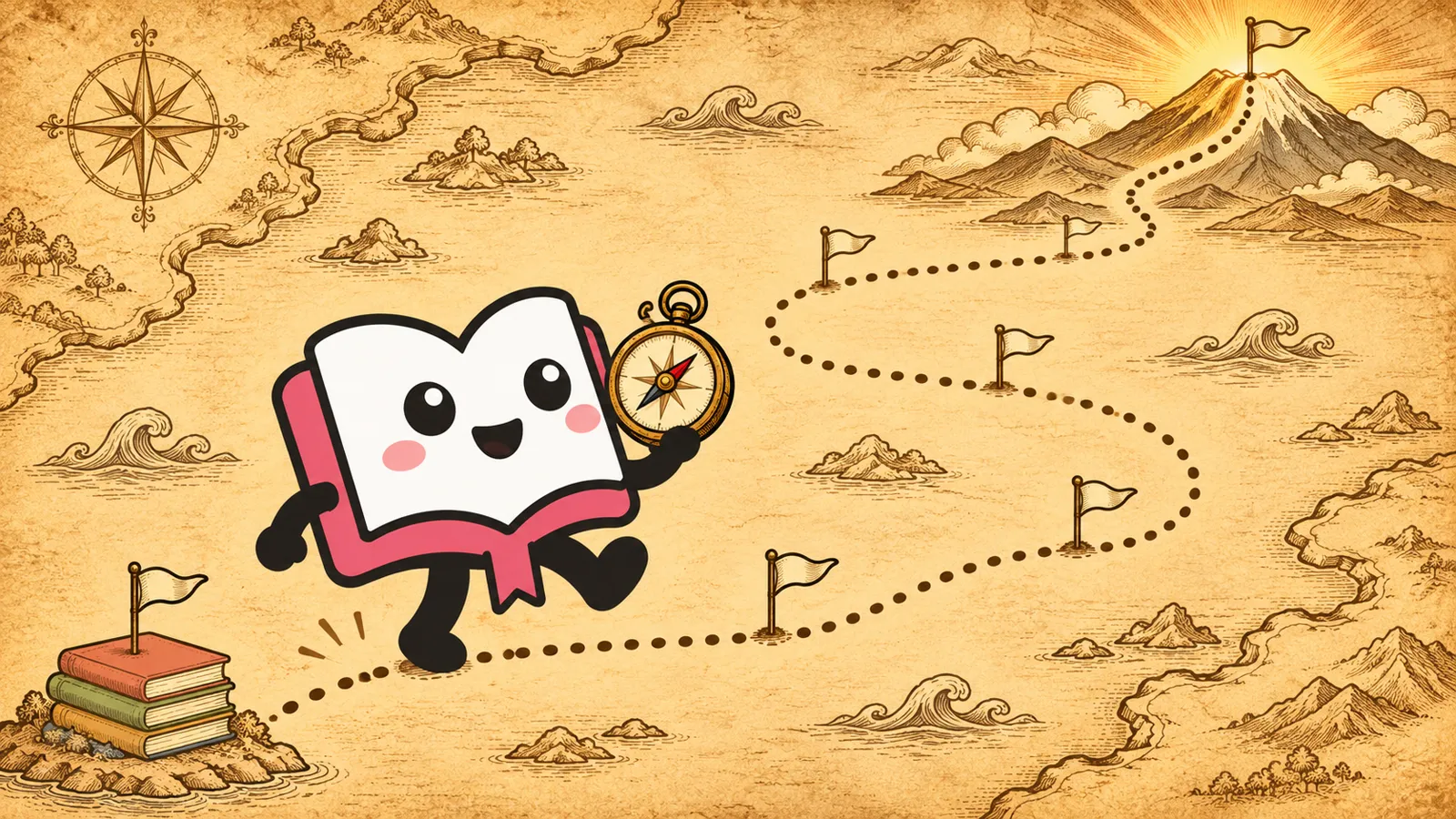
Mystery books for English learners: climb with one detective, from graded readers to the originals
If you raise the level with stories about the same detective, you already feel at home in the story's world while only the English gets a little harder each time. Sherlock Holmes suits this well, because versions rewritten for English learners are available at several levels.
Oxford University Press's graded reader series, the Oxford Bookworms Library, has Holmes stories at several stages. Here are four books we checked on the publisher's pages, plus the length of the original short stories, from easiest to hardest. CEFR is a common scale of foreign-language ability created in Europe; in the four books listed here, the higher the stage, the higher the level, from A to B and then C.
- 1Stage 1 (A1–A2) "Sherlock Holmes and the Sport of Kings" 5,925 words
- 2Stage 2 (A2–B1) "Sherlock Holmes Short Stories" 3 stories, 6,280 words
- 3Stage 3 (B1) "Sherlock Holmes and the Missing Jewels" 2 stories, 11,133 words
- 4Original collection "The Adventures of Sherlock Holmes" 6,973–9,937 words per story
- 5Stage 6 (B2–C1) "Sherlock Holmes: The Sign of the Four" retelling of the novel, 30,635 words
Steps 1 and 2 are close in length, and the step-2 book contains three stories. One book gives you three rounds of "a crime happens and gets solved", which is a good way to get used to reading mysteries. At step 3 a book becomes nearly twice as long, so if you stall there, it's fine to read another book at the same stage first and then come back.
Once graded readers of around 10,000 words feel easy, the original short stories are the next step. For this article we counted each of the 12 stories in the original collection "The Adventures of Sherlock Holmes" on Project Gutenberg: the shortest, "A Case of Identity", is 6,973 words, and the longest, "The Copper Beeches", is 9,937 words. A single original story is longer than the whole step-2 book. For your first one, pick one of the shorter stories; you'll be more likely to reach the end.
On to the originals: authors you can read free, and authors still under copyright
Once you're used to the original Holmes, you can branch out to other authors' detectives. One thing to check here is whether the original text can be read free. Under a life-plus-70 rule, the deciding factor is the year the author died; in the United States, other factors such as the year of publication also matter.
Project Gutenberg is a free digital library, and nearly all the works in it are in the public domain in the United States. The beginning of each ebook says that if you are not located in the United States, you have to check the laws of your country before using it. Copyright terms differ from country to country. In the European Union, the rights in a literary work run for the author's life and 70 years after their death (Directive 2006/116/EC, Article 1); other countries may set a different term. The table below judges each author by this life-plus-70 rule. If you live outside the EU, check your own country's rule as well.
| Author (main detective) | Year of death | Typical length | Original free to read? (life + 70 years) |
|---|---|---|---|
| Arthur Conan Doyle (Sherlock Holmes) | 1930 | 6,973–9,937 words per short story | Yes (Project Gutenberg) |
| G. K. Chesterton (Father Brown) | 1936 | 5,040–7,617 words per short story | Yes (same) |
| Edgar Allan Poe (Dupin) | 1849 | "The Murders in the Rue Morgue" about 14,000 words | Yes (same) |
| Agatha Christie (Poirot) | 1976 | Level 3 graded readers: 11,000–20,000 words per book (publisher's description) | No. Still protected under a life-plus-70 rule, so buy the book or e-book, or borrow it from a library |
We counted the words of each short story in the Project Gutenberg texts. The 12 stories in Chesterton's "The Innocence of Father Brown" are shorter than the Holmes stories, but some sentences are elaborately worded, so they can feel hard for their length. Poe wrote much earlier and his sentences are long, so he fits best as the last step among these authors.
Christie's books, such as "The Mysterious Affair at Styles", are also on Project Gutenberg. That reflects their status in the United States; as Project Gutenberg's own notice says, readers elsewhere go by their own country's law, and where the term is life plus 70 years, as in the EU, they can't be used as "free originals". If you want to read her in English, a good place to start is the series that the publisher Collins rewrote for English learners (Agatha Christie ELT Readers). According to the publisher, Collins's readers for learners (Collins ELT Readers) are divided into seven levels, and this series includes Level 3 (B1) books such as "Death on the Nile". A Level 3 book is 11,000–20,000 words and comes with explanations of the more difficult words. If you've finished step 3 of the Holmes ladder (11,133 words), you'll already have a feel for that length.
Reading tips for mysteries: a suspect memo and spoiler-free lookups
When you read mysteries in English, what trips you up is often not vocabulary but mixing up the characters. In English novels, the same person may be called by surname in one scene and by a role, such as "the doctor", in another. Once you lose track of who's who, the clues stop looking like clues. So keep a short memo as you read.
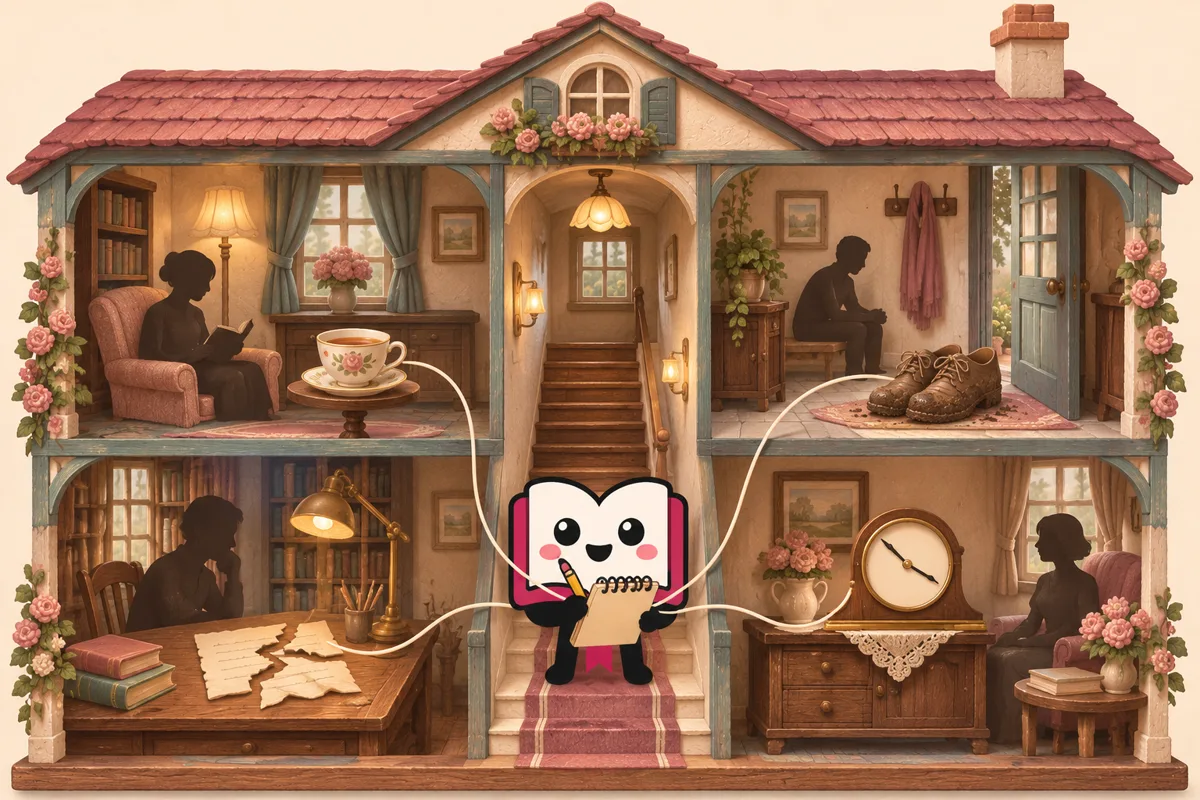
Use the memo in these four steps.
- When you start, write one line for each character who appears (name, and their connection to the detective or the case)
- Mark any sentence that feels "off" and keep going (don't stop even if you don't understand it)
- Before the solution scene, write your own theory in one line
- After reading the solution, go back to the sentences you marked and reread them
Write in your own words; short is fine. You can copy this format.
[Book and story title]
[Case] When, where and what happened (1 line)

[Characters]
- Name (what they're called) / connection to the case / what caught my eye
- Name (what they're called) / connection to the case / what caught my eye
- Name (what they're called) / connection to the case / what caught my eye

[Possible clues] Page or chapter / rough meaning of the sentence

[My theory before the solution] Who, how, why (1 line)
[After finishing] What I got right / clues I missed
The other thing to watch out for is spoilers. If you search for the book's title to look something up, plot summaries and commentary pages sometimes give away the ending. Look up only the words, in a dictionary. If you lose the thread of the story, read only the back cover or the publisher's description; that way you won't run into the ending.
In Original Novel's learning mode, tapping a paragraph you don't understand opens the text in the other language right below it, so you can check what a possible clue means without the risk of seeing the ending in a search.
Try mysteries you can read in English, starting with one chapter
Of the 55 works published on Original Novel, 12 have mystery among their genres and 9 have suspense (counted on 14 November 2026; a work can have more than one genre). On the page for finding works, choose the genre and the language of the text to narrow the list down to puzzle stories you can read in English. They're also handy for reading just one chapter and trying out the suspect memo.
Puzzle stories you can also read in English
See more: Puzzle stories you can also read in English ›Mystery and suspense stories on this site, listed by popularity.

 Completed
When you finish a story, whether your theory was right or wrong, if you catch yourself thinking "next time I'll get it", that's your reason to reach for the next book.
Sources (date checked)
- The Adventures of Sherlock HolmesProject Gutenberg / Checked Nov 18, 2026
- Sherlock Holmes and the Sport of KingsOxford University Press España / Checked Nov 18, 2026
- Sherlock Holmes: Short StoriesOxford University Press España / Checked Nov 18, 2026
- Sherlock Holmes and the Missing JewelsOxford University Press España / Checked Nov 18, 2026
- Sherlock Holmes: The Sign of the FourOxford University Press España / Checked Nov 18, 2026
- Directive 2006/116/EC of the European Parliament and of the Council on the term of protection of copyright and certain related rightsEUR-Lex (European Union) / Checked Nov 18, 2026
- About Agatha Christie - The world's best-selling novelistagathachristie.com / Checked Nov 18, 2026
- Death on the Nile: B1 by Agatha ChristieCollins / Checked Nov 18, 2026
FAQ
Can I listen to English mysteries with free audio while I read?
For works out of copyright, you can look on LibriVox, which publishes recordings read by volunteers for free. It has recordings of "Adventures of Sherlock Holmes" and "Innocence of Father Brown". However, LibriVox's recordings are based on the works' status in the United States, and people outside the US are advised to check the work's status in their own country before using them.
Can I read Project Gutenberg's mysteries on my phone?
Yes. For example, "The Adventures of Sherlock Holmes" is available to read directly in the browser, as well as in EPUB, Kindle and plain-text formats. For an e-book app, choose EPUB or the Kindle format; to try it right away, opening it in the browser is easiest.