How to Worldbuild for a Novel: 6 Questions That Grow a World from One Rule, Plus a Worldbuilding Template
Here is how to worldbuild for a novel quickly and with the fewest contradictions: pick one rule that differs from our world and keep asking "if that's true, then what?" This article answers six questions in order for one invented world, then shows how to reveal the rules in scenes, what to decide when you draw your world, and a prompt that has an AI interview you and turn your answers into a worldbuilding template.
Key takeaways
- A world is easiest to build when you pick one rule that differs from ours and spread outward from it
- Work outward through 6 questions: rule, limits and cost, daily life, who gains and who loses, history, places
- For magic or technology, decide first what it can't do and what it costs, so your characters can get into trouble
- Don't explain the rules; show them through characters' gestures and belongings
- Copy every fact you put in the text back into your world bible to keep it consistent
How to worldbuild: start with one rule
The fastest way to build a world for a novel, with the fewest contradictions, is to pick one rule that differs from our world, then spread outward by asking "if that's true, then what?" If you start with country names, a timeline or a map, the notes tend to pile up while the story itself doesn't get a single line further.
The Japanese dictionary Digital Daijisen explains sekaikan (literally "world view", the everyday Japanese word for a story's world), when used informally about literature and other works, as the atmosphere and setting a work has. In other words, what readers pick up on is not how thick your notes are but the texture of "so this is how things work here." That texture appears when one rule reaches all the way into people's daily lives.
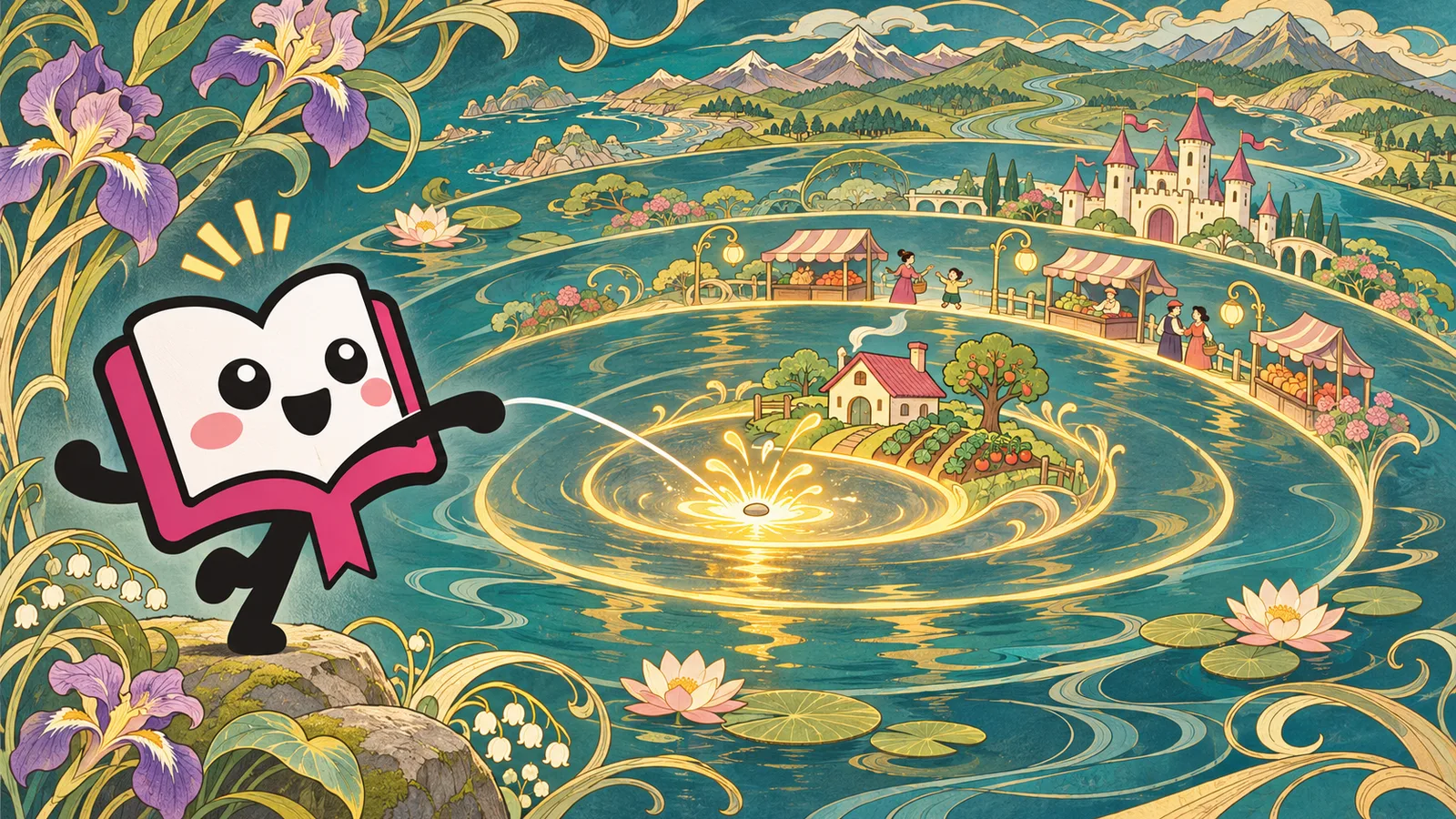
Throw one stone into a pond and the ripples spread outward. A world works the same way: if the one rule at the center is solid, daily life, society, history and places fall into place naturally as its ripples.
Worldbuilding questions: 6 steps that grow a world from one rule
From here on, we'll use a world invented for this article and answer the questions from the inside out. The rule at its center is: "Break a promise you said out loud, and a permanent black line appears on the back of your hand."
- What's different? (the rule) Break a spoken promise, and a black line is left on the back of your hand.
- What can't it do, and what does it cost? (limits and cost) The line never fades. Promises only written on paper don't count. The line appears only on the person who made the promise.
- How does daily life change? People avoid saying "I promise," and "probably" and "if I can" become everyday habits of speech. Gloves become an ordinary household item.
- Who gains, and who loses? A hand with no lines becomes proof of trust, so merchants trade bare-handed. People with many lines get turned away for work. Glove makers who hide the lines do well, but scenes where someone is told "take off your gloves" become more common too.
- How did it come to be? (history) All the story needs is roughly how the townspeople tell the tale of "when the lines started appearing."
- Where does it happen? (places) Narrow it down to three settings at most. In our example: a port town with lots of trade, its street lined with glove shops, and the market across the way where people trade bare-handed.
By the time you've answered question six, you can see several story seeds, even though you haven't decided on a single character. A glove maker's daughter is pressed by a merchant to show her bare hands. The one person in town with no lines at all is the one everyone suspects most. Scenes like these exist because the rule reached daily life and society.
The order of the questions matters. If you move on to question 3 without settling the limits in question 2, things like "does a paper promise leave a line too?" and "does it work the same for children?" will shift from scene to scene, and you'll end up fixing all of it later.
Magic and technology get interesting through "what it can't do" and "what it costs"
If magic or future gadgets can do anything, you can't write scenes where your hero is in trouble. Fantasy author Brandon Sanderson wrote in an essay on writing on his website that "limitations are more interesting than powers" (2011), and has also said that the better readers understand a magic system, the more an author can let that magic solve problems (2007). Put another way, showing readers the edges of the rule early, rather than its contents, is what makes them accept it when you use it at the climax.
This isn't only about magic. You can check any rule with the same three yardsticks.
| Example rule | What it can do | What it can't do | Cost |
|---|---|---|---|
| Magic: you can make fire | Produce fire from your palm | Only burn things you can see | Your body temperature drops by as much as you use |
| Future technology: you can save memories | Take out one day's worth of memories and review them | You can't see other people's memories | The days you save fade from your own mind |
| Invented law: at 18 you may change your name once | Start over under a new name | You can't change it a second time | You give up every promise and all property tied to your old name |
A cost can also be too heavy. If every use takes years off a character's life, characters will hardly ever use it, and the rule will stop showing up in the story. "A bit of a hardship, but worth paying when it really counts" is a good weight for building scenes.
Society and history: go only as far as the conflict shows
Try to decide everything about government, religion, money and social class, and you'll never finish. It's enough to go as far as you need to explain the conflict in your story. In our example, what arguments or rules exist between "those who trade bare-handed" and "those who hide behind gloves"? Once that's settled, the details of the town office or the guilds can be added when they appear in a scene.
History is the same. How people today talk about the past is more useful in the text than a thousand-year timeline. If the legend and what actually happened don't match, that gap becomes a mystery in its own right.
Even a modern or real-world setting needs worldbuilding
Even a story without magic is easier to write once you've decided on its world. When we reread the story requests sent to Original Novel (22 requests from November 6 to 7, 2026), two asked for the feel of a period, such as "an old downtown neighborhood at the end of the Showa era" (Japan's era that ended in 1989), and two asked for detailed depictions of medical scenes in a historical setting. The numbers are still small, so treat this as a rough sign, but the closer a setting is to reality, the more readers notice small inconsistencies. For a real-world setting, check these "rules of that time and place" first:
- How people get in touch (a home phone, a cell phone, letters)
- Money and prices (how much a snack costs, or a ride of one train stop)
- How long it takes to get around (walking to the next town, or taking a bus)
- Customs and ways of speaking unique to that place
- The rules of work (a school timetable, hospital night shifts, store opening hours)
On this site, four of author Kazu's stories are set in Southeast Asia. As in "The Jingjok Behind the Blackboard", where a tokay (a large gecko) turns up in a Thai classroom, the place itself becomes material for the story. Read them and see how much of the feel of the real place each story writes in.
Read worlds with their own rules
See more: Read worlds with their own rules ›Stories written by AI on this site. We picked fantasy, science fiction, historical and other works whose worlds run on rules of their own.
 CompletedThe Sea WallFor adults · Fantasy
 CompletedI Want to Count Your Gray HairsFor adults · Romance
 The Boy Who Couldn't Lie and the Girl Without a VoiceFor teens · FantasyCompletedAny Questions?For adults · Comedy
Show your world in scenes instead of explaining it
It's tempting to explain all your rules in the first few pages, but readers don't know the characters yet, and a run of explanation tends to get skimmed. Show the rules through what characters do and what they carry.
Told as explanation, it looks like this:
In this country, breaking a promise you said out loud leaves a black line on the back of your hand. So people avoided making promises, and it was normal to hide your hands in gloves.
Shown in a scene, it looks like this:
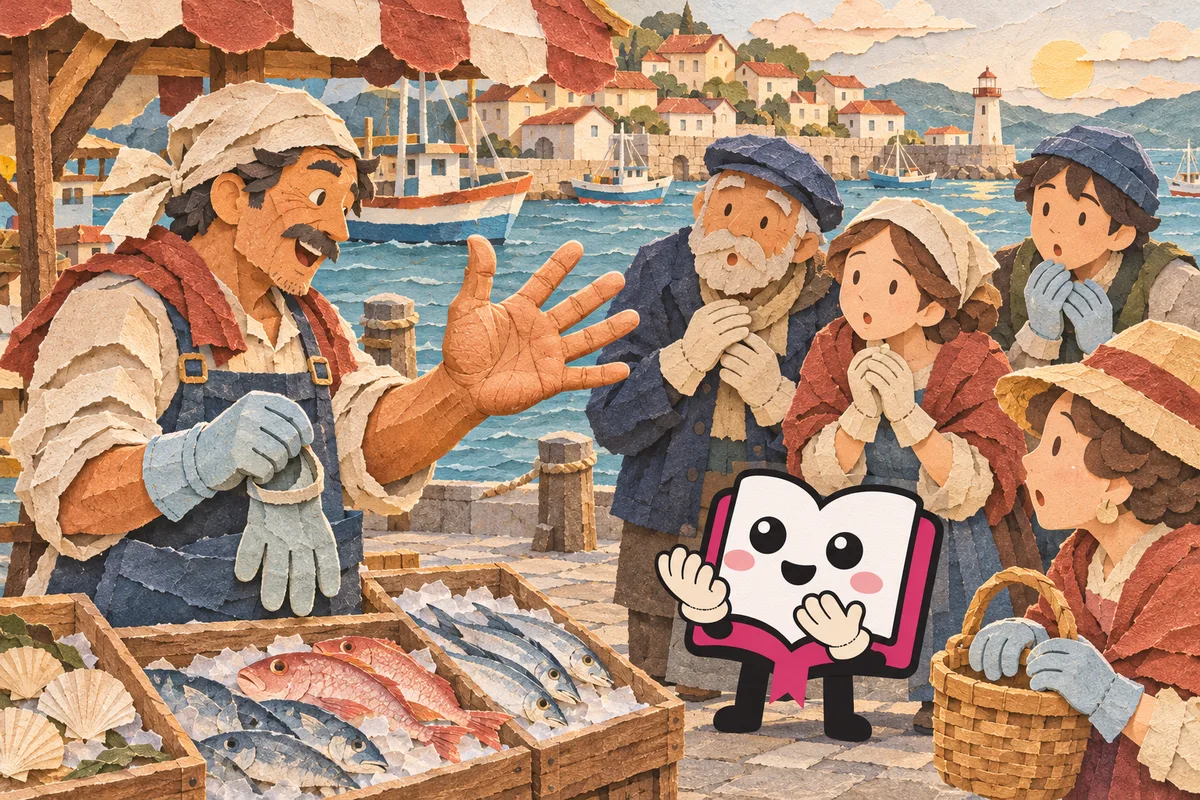
Before taking the money, the fishmonger pulled off his right glove and held his sun-browned bare hand out to the customer. "See? Clean as anything. Same price tomorrow, too."
The second version never explains the rule in words, yet from the gloves, the gesture of showing a bare hand, and the weight of the promise in "tomorrow, too," readers realize that "in this world, promises seem to stay on your hands." Readers who have figured that out will hold their breath the next time someone makes a promise out loud.
When you do need to explain something, have a character who doesn't know the world (a newcomer, a child) ask about it, and it comes across naturally in conversation.
What to decide when you build your world in illustrations
When you show a world in pictures, you still start from the rule at the center. The difference is that you turn the rule into "things you can see." Decide these five things before you start drawing, and every picture will look like the same world, however many you make.
- Up to three base colors (colors you use again and again for that world's sky, buildings and clothes)
- Materials for buildings and tools (stone, wood, metal or cloth)
- Light sources (the sun, candles, glowing stones, electricity)
- Shapes that repeat (the shape of windows, crests, patterns on the edges of clothes)
- Where the rule shows in how things look (in our example world, the gloves and the lines on the backs of hands)
The last item matters most. Colors and materials alone stop at "a pretty fantasy world," but when the rule shows on the surface, a single picture lets viewers imagine a story. When you have an AI draw for you, giving it the same notes on the rule and the look, in the same words every time, also helps the pictures match.
A worldbuilding template, plus a prompt that has AI ask you one question at a time
If answering the six questions yourself is hard work, make the AI the one asking the questions. When AI builds a whole world for you, it tends to fill it with settings you feel you've read somewhere before, but when it only asks, every answer is your own. The AI asks the questions in order, then copies your answers into a world bible and points out contradictions.
I'm building the world for a novel. Your role is to ask the questions.
Ask me the following 6 questions, one at a time. After I answer, move on to the next question.
Only suggest ideas for the setting when I ask for them.

1. What rule is different from our world? (in one sentence)
2. What can't this rule do, and what do people pay when they use it? (limits and cost)
3. How does people's daily life (clothes, food, homes, language) change?
4. Who gains, and who loses?
5. How do people tell the story of how this rule began?
6. Where does the story take place? (up to 3 places)

When I've answered all 6, put my answers into a world bible in the format below.
Leave any field I haven't answered blank. Don't fill it in yourself.

[WORLD BIBLE]
■ The central rule:
■ What it can't do (limits):
■ What people pay to use it (cost):
■ What changed in daily life:
■ Who gains / who loses / the biggest conflict:
■ What people say about the past:
■ Places where the story happens (up to 3):
■ Facts already written in the text (I add these chapter by chapter):

Finally, if any of my answers contradict each other, list them as bullet points.
If you're not using AI, copy just the [WORLD BIBLE] heading and the eight fields under it, and you have a template to fill in by hand.
The most important part of the finished world bible is the last field. Always copy what you've written in the text back into it, and you'll avoid contradictions between parts of the text itself, which stand out more than settings you only decided on. Behind the scenes, every story on Original Novel also has its own world bible gathering its blueprint, foreshadowing and established facts, and it's handed to the AI each time a chapter is written.
How to choose books that teach worldbuilding
If you want to learn from books, choosing by purpose keeps you from getting lost. Introductory books on creative writing are good for learning the order of thinking, like in this article. When choosing, check the table of contents or a preview for whether it has plenty of examples in the genre you want to write (fantasy, science fiction, contemporary) and whether it has questions or exercises you can actually write in.
Another useful kind is illustrated guides and reference books on history, architecture, clothing, geography and living things. Even in an invented world, modeling details on real towns and tools makes them convincing. The more diagrams and photos a book has, the more you can use it for both pictures and prose. You can also compare a few at the library before deciding which one to keep at hand.
Sources (date checked)
- Sekaikan (worldview): meaning and usageKotobank (Shogakukan Digital Daijisen and other reference works) / Japanese / Checked Nov 18, 2026
- Sanderson's Second LawBrandon Sanderson (author's official website) / Checked Nov 18, 2026
- Sanderson's First LawBrandon Sanderson (author's official website) / Checked Nov 18, 2026
FAQ
Is there a right way to build a world?
There is no fixed right answer. A useful test is whether readers can understand the world's rules and whether the story ever breaks them. Even a rule far from reality is easy to accept when its limits and cost are clear and it shows up in daily life and in how the characters act.
What can I do when my world feels generic?
Take a familiar world as it is and change just one rule. Add "the king's words lose their power once they are written down" to a medieval-style kingdom, for example, and letters, laws and records all work differently, so the world stops looking like any other. Thinking hard about how far one rule reaches into daily life usually gives more personality than adding more rules.
How should I name countries and towns?
Place names from the same country sound like one world when they share a similar sound and length. Keep the main names short (two or three syllables) so readers remember them, and don't make them too close to your characters' names. Keep a list of every name in your world bible so the spelling doesn't drift.
Can I change my world while I'm still writing?
Before you publish, yes. When you do, check the "facts already written in the text" section of your world bible, list every scene that no longer fits the changed rule, and fix them all together. If you are serializing and chapters are already public, it confuses readers less to add to the rules in a way that doesn't contradict earlier chapters (as an exception, or as a fact nobody knew).