Want to Write but Have No Story Ideas? 4 Methods and Story Prompts by Genre
When you want to write but have no story ideas, it's faster to apply a set method to everyday material than to wait for inspiration. This article covers 4 methods you can use right away, story ideas by genre plus a romance idea table, how to get the most out of idea generators and AI, and how to save the ideas that come to you in a 3-line note.
Key takeaways
- Don't wait for inspiration: come up with ideas by applying a method to everyday material
- The 4 methods are “what if,” “combine two things,” “shift an everyday event,” and “job × place × problem”
- Use idea generators and AI as a starting point, and mix in your own experiences so your material is less likely to overlap with everyone else's
- Save ideas as they come in a 3-line note: what you saw, what if, who's in trouble
Want to Write a Story but Have No Ideas? Here's Why
When you want to write but have no story ideas, the shortcut is to stop waiting for inspiration and come up with ideas by applying a method to everyday material. You see plenty of events that could become stories in your daily life. What's missing is a process for shaping them into a story.
Think of cooking: even if all you have in the fridge is eggs and green onions, you can make a dish if you know how to stir-fry or make soup. The well-known idea from James Webb Young's book on creative thinking, “A Technique for Producing Ideas,” that an idea is a new combination of existing elements, says the same thing.
How to Come Up With Story Ideas: 4 Methods You Can Use Now
Here are the 4 methods. All you need is paper and a pen, and it takes about 5 minutes.
| Method | What you do | Good for |
|---|---|---|
| 1. What if…? | Change just one thing everyone takes for granted | Strange tales, sci-fi, fantasy |
| 2. Combine two things | Join two things that have nothing to do with each other | Breaking away from familiar stories |
| 3. Shift an everyday event | Change the role, the era or the scale | Realistic stories, tearjerkers |
| 4. Job × place × problem | Pick one of each and combine them | When you just need one idea, any idea |
Method 1: “What if…?”
Change just one thing the world takes for granted. “What if there were a town where telling a lie made you lose your voice?” “What if umbrellas chose their owners?” Change several things and readers can't keep up. From a single “what if,” you can get several different ideas just by switching the genre.
walked back home to their owners?
You can't stop wondering about the person the same glove goes back to every morning
One lost item never comes back
Even things you threw away come back
Method 2: Combine two things
On the left side of a sheet of paper, write 10 jobs or tools; on the right, 10 places or seasons. Then draw lines to connect them. “A traditional Japanese sweets shop” × “a moon base” becomes the story of a confectioner opening the first Japanese sweets shop on the Moon. The more unrelated the two things are, the less likely your idea is to resemble anyone else's.
Method 3: Shift an everyday event
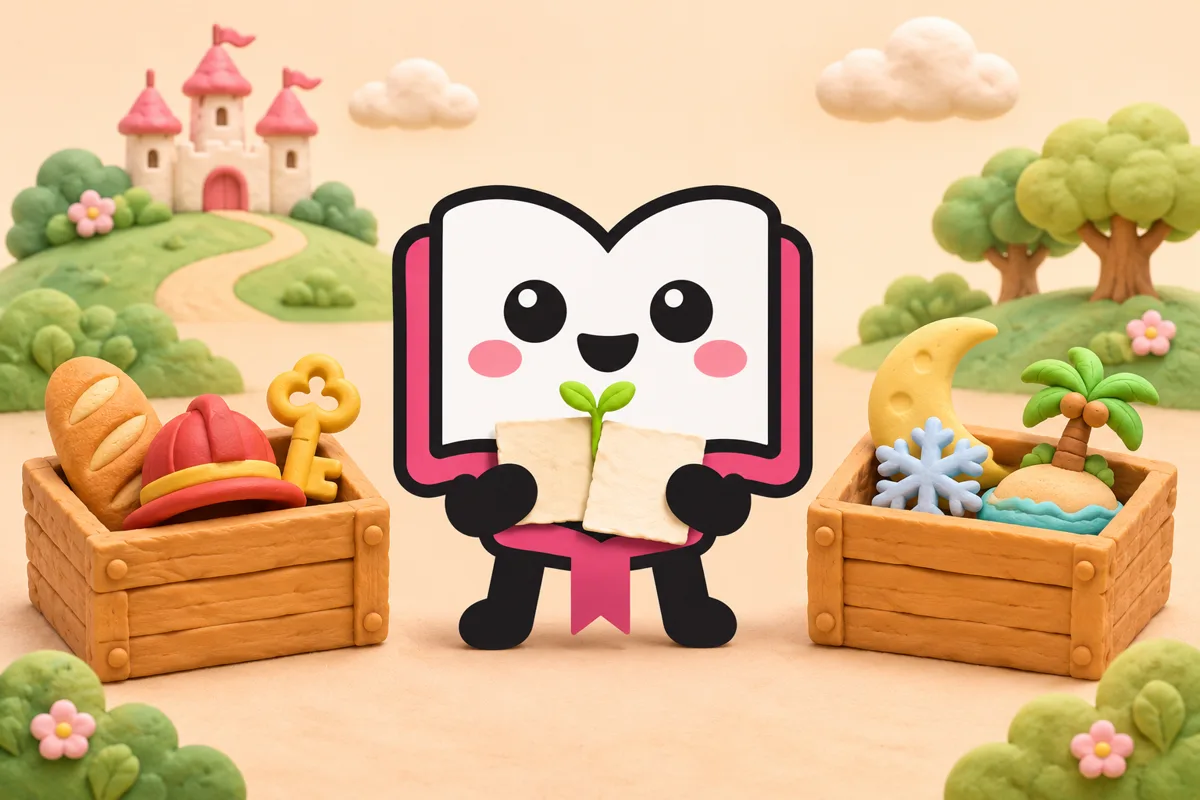
Pick one small thing that happened today and shift the “role,” the “era” or the “scale.” Take “I ended up alone in an elevator with a stranger.” It can grow like this:
- Shift the role: the stranger was you, 10 years from now
- Shift the era: two sworn enemies end up alone together on a river ferry in Edo-period Japan
- Shift the scale: these two are the only people left on Earth
Because it starts from your own experience, the small details of the scene are easier to write.
Method 4: Job × place × problem
On days when nothing comes, roll a die three times and pick one item from each column of the table below. That's an idea. It's the simplest story idea generator you can make yourself.
| Roll | Job | Place | Problem |
|---|---|---|---|
| 1 | Baker | A remote island | Customers come only in the middle of the night |
| 2 | Firefighter | A hospital basement | Has lost one important thing |
| 3 | Middle school teacher | An amusement park just before closing | Has learned a secret they can't tell anyone |
| 4 | New hire at a funeral home | A hot-spring inn cut off by snow | The deadline is tomorrow morning |
| 5 | Mover | A space station | An ex shows up as a customer |
| 6 | Zookeeper | A convenience store late at night | Is the only one who can't lie |
For example, rolling “2, 1, 6” gives you “a firefighter on a remote island who is the only one who can't lie.”
Story Ideas to Write About: Prompts by Genre
Here are prompts we wrote for this article, sorted by genre. Start writing from one as it is, or recombine it with your own material.
| Genre | Prompts |
|---|---|
| Romance | • Someone drops a book at the same station every morning. Each time you pick it up, the bookmark has moved further along • The main character runs a service that takes on other people's heartbreak, but no one can take on theirs |
| Mystery | • Every week, a page cut out of a diary turns up in the library's book drop • One person who isn't on the residents' list took part in the town's disaster drill |
| Horror | • Photos of you asleep that you don't remember taking keep appearing on your phone • Only on the floor of your new apartment does the elevator have one extra button |
| Fantasy | • A kingdom where only people who have never told a single lie can use magic • A new hire at a delivery service that looks after dragon eggs |
| Sci-fi | • In an age when you can sell exactly one day of your memories, someone opens a shop that buys people's “worst day” • The first child born on a spaceship wants to know what “rain” means |
| Coming-of-age / school | • Every member joined the nearly defunct astronomy club for a different reason, and every reason was a lie • An empty fourth-floor classroom that opens only on graduation day |
| Workplace | • The day before retirement, someone is put in charge of training a new hire for the first time • A young systems engineer ends up taking over the last public bathhouse on the local shopping street |
| Tearjerker | • Your late grandmother's household account book shows the same “mystery expense” every month • A singer who has lost her voice and a piano tuner who is losing his hearing |
| Comedy | • All 4 members of a family plan a surprise birthday party for the same person, each on a different day • A cat is elected head of the neighborhood association, and the main character is asked to be its interpreter |
For Romance Story Ideas, Start With What Stands Between the Two
When you can't think of a romance idea, decide on what stands between the two people before you decide how they meet. The heart of a love story is the time when they want to get closer but can't. Pick one item from each of the three columns and you have a stand-in for a romance idea generator.
| Roll | Their relationship | The obstacle | What brings them closer |
|---|---|---|---|
| 1 | Senior and junior coworkers | An age gap | Working late, just the two of them |
| 2 | Childhood friends | One is about to move away | Searching for the same lost item |
| 3 | Owners of rival shops | Family disapproval | A night with a power outage |
| 4 | A teacher and a former student (now an adult) | An old promise | Reaching for the same book at the same moment |
| 5 | Two people who both said no after an arranged matchmaking meeting | One of them has a secret | A pet escapes |
| 6 | Someone you only talk to online | They live in different countries | Running into each other on a trip |
Ideas Readers Want: What People Asked for on This Site
If you can't decide on an idea, you can also work backward from how readers want to feel. We counted the wishes written in 22 story requests (from 11 people) sent to Original Novel on November 6–7, 2026. One request can contain several wishes, and the sample is small, so treat these as a rough guide.
| Most common wishes | Requests | Method to use |
|---|---|---|
| Romantic butterflies (age-gap romance, grown-up love, etc.) | 8 | Decide “the obstacle” from the romance table first |
| A big twist or an unexpected turn | 8 | Keep the “what if” from Method 1 hidden from the reader until the end |
| A really good cry | 6 | Use Method 3 and shift the “role” in an everyday farewell |
| The death of a loved one or a life-or-death crisis | 5 | Put a “deadline” into the problem in Method 4 |
| Truly scary horror | 3 | Use Method 1 to break just one everyday certainty |
| Laughs and feel-good warmth | 3 | Use Method 2 to pair a serious job with a laid-back place |
| A working adult as the main character | 3 | Start from the job in Method 4 |
What stands out is that most wishes describe how the reader wants to feel at the end rather than the plot. Decide first whether you're writing for butterflies, tears or chills, and it becomes easier to choose the material for your method.
On the other hand, 3 requests asked for a twist in a short story meant to end in a single chapter. Cram too much in and everything ends up shallow. For a short story, stick to one idea.
5 Steps to Turn an Idea into a Story
Grow your idea into a “story seed” (one sentence with a main character and a problem) in these 5 steps.
- 1Come up with 3 ideas using the 4 methods
- 2Pick the one where you most want to know what happens next
- 3Decide on a main character and their problem
- 4Decide the direction of the ending (upbeat, bittersweet, or a twist)
- 5Write it as one sentence: “A ___ main character who ___ in order to ___”
Try it with the Method 4 idea “a firefighter on a remote island who is the only one who can't lie.” The problem: “while preparing for the festival, they see through the islanders' little lies.” The ending: “bittersweet” (an ending where they can still look ahead). As one sentence: “A young firefighter who can't lie looks for a way to go along with the islanders' kind lies in order to protect the island festival.”
If you're torn at step 2, choose based only on whether you want to read what happens next. If an idea doesn't excite the writer, the writing tends to stall halfway.
How to find story ideas
- What if ___?Change just one everyday certainty
- Combine two thingsThe more unrelated, the more original
- Shift an everyday eventChange the role, era or scale
- Job × place × problemRoll a die 3 times, pick one of each
- Write it as one sentenceA ___ hero who ___ in order to ___
- Keep a 3-line noteWhat you saw, what if, who's in trouble
Story Idea Generators and AI: How to Use Them, and Their Limits
Idea generators that give you a prompt at the press of a button, and AI tools like ChatGPT, Claude and Gemini, can help too. Use both as tools that give you a starting point, and do the choosing, shifting and deciding yourself.
Story idea generators and random prompt tools
They randomly combine words and settings, so you come across combinations you'd never choose yourself. But they don't tell you who is in trouble or why, so add the “problem” from Method 4 yourself. The rules for using a generated prompt in your own work differ from site to site, so check that site's guidelines.
Asking AI for ideas
AI is good at producing lots of ideas at once when you give it conditions. But there's a study worth knowing about. In a paper in the journal Science Advances (Doshi and Hauser, July 2024), 293 people wrote short stories, and those who could draw on ideas from GPT-4 got higher ratings for “novelty” and “usefulness” (the effect was largest for writers who had been rated as less creative to begin with). On the other hand, stories that used AI ideas tended to be more similar to one another than stories written by people alone.
In other words, if you use AI ideas as they are, your story may end up similar to other people's. If you ask with something from your own life as material, as in the template below, your material is less likely to overlap with anyone else's.
Please give me 10 story ideas.

Genre: ___
How I want readers to feel: e.g., a little teary at the end
Format: “What if ___?”
Condition: For each idea, add one sentence on what the main character struggles with
Material: Something that happened to me recently: ___ (be sure to use this somewhere)
Avoid: Overused setups like amnesia or being reborn in another world, and the names of real works or people
Finally: Mark the most unexpected of the 10
How to Save Story Ideas: Notes and Apps
The way to prepare for days when no ideas come is to save ideas on the days they do. Long notes don't last, so keep each idea to 3 lines.
- What you saw: e.g., Every morning, a single flower is left on the same bench at the station
- What if: e.g., What if the person leaving it is a station attendant who died 10 years ago?
- Who's in trouble: e.g., The new station attendant whose job is to clear the flowers away
An idea that makes it to line 3 can go straight to step 3. Don't throw away the ones that don't; look back once a week and try combining two notes with Method 2.
The best note tool is whatever you always have with you (features checked against each company's official help pages on November 11, 2026).
| Tool | How to organize | Best for |
|---|---|---|
| iPhone Notes app | Type # followed by a word, like “#romance,” to make a tag, then filter by tag | People who don't want more apps |
| Google Keep | Filter by color or label. See the same notes on your phone, computer and tablet | People who write on their phone and review on a computer |
| Paper notebook | Mark the genre at the edge of the page | People who think better writing by hand |
Give each note two kinds of tags or labels, genre (#romance #horror) and progress (#rawidea #seed), and you can find what you need the moment you want to write. Features can change, so check the official help pages.
Start by Reading Other Stories
Reading other people's stories is also a way to gather material. Read while asking yourself, “How would I shift this setting?” and you're practicing Method 3. Below are stories written by AI on Original Novel.
Stories you can read on Original Novel
See more: Stories you can read on Original Novel ›Stories written by AI on this site, sorted by how often they're read.
Summary
When you want to write but have no story ideas, the shortcut is to stop waiting for inspiration and come up with ideas by applying a method to your material. Come up with ideas using the 4 methods, pick one, decide on the main character, the problem and the direction of the ending, and sum it up in one sentence. Use idea generators and AI as a starting point and mix in things from your own life. Save the ideas that come to you in 3-line notes.
Sources (date checked)
- Generative AI enhances individual creativity but reduces the collective diversity of novel contentScience Advances (PubMed Central) / Checked Nov 18, 2026
- Google Keep: online note-taking for businessGoogle Workspace / Japanese / Checked Nov 18, 2026
FAQ
I want to write a story but have no ideas. What should I do?
Instead of waiting for inspiration, use a method to come up with ideas. That's the shortcut. Take something you saw today or something around you and apply one of 4 methods to it: “what if,” “combine two things,” “shift an everyday event,” or “job × place × problem.” Pick one of the ideas you get, decide on a main character and their problem, and sum it up in one sentence. Then you can start writing.
Is it OK to use a story idea generator?
Using one to get yourself started is a good approach. But what it gives you is a combination of words or settings, so you still have to decide who is in trouble, why, and how it ends. The rules for using a generated prompt in your own work differ from site to site, so check that site's guidelines.
Can I ask AI to come up with story ideas for me?
AI is good at producing lots of ideas when you give it conditions. However, a 2024 study in Science Advances found that stories written with AI ideas tended to resemble each other. Include something from your own life as material when you ask, then shift the ideas yourself before using them, and your material will be less likely to overlap with other people's.
What if I can't think of any romance story ideas?
Decide what stands between the two people before deciding how they meet. That gets you there faster. Pick one item each for “their relationship,” “the obstacle (age gap, a move, a secret, etc.),” and “what brings them closer,” and you have a romance idea.
How should I write down story ideas?
Write each idea in 3 lines: what you saw, what if, who's in trouble. That makes it easier to grow into a story later. The best tool is whatever you always carry. With tags in the iPhone Notes app or labels in Google Keep, you can find ideas by genre. It also helps to look back once a week and combine two notes.