How to write foreshadowing: where to plant it and when to pay it off
Learn how to write foreshadowing by planting details readers barely notice, recalling them once in a different form, and changing their meaning through a character's actions at the climax. Follow a short story about a high-school girl visiting her grandfather in hospital to explore types of foreshadowing, placement, distance to the payoff, and subtlety.
Key takeaways
- Think of foreshadowing as a set: plant it, recall it once along the way, then pay it off at the climax.
- It differs from suggestive details with no payoff and contrived developments with no setup.
- Combine short and long distances to the payoff; recall distant setups once in a different form.
- Keep the narrator from anticipating the future, and show the payoff through action rather than explanation.
- When writing with AI, supply foreshadowing notes for every chapter so details aren't forgotten.
How to write foreshadowing: how many clues are hidden here?
Start with the opening of a short story written for this article. This is chapter 1 of a story about Haru, a high-school girl who visits her grandfather in hospital.
On the bench at the bus stop, Haru checked the time three times on the watch she had borrowed from her grandfather. Seven minutes until the bus to the hospital. A dog at the house opposite was barking at the empty sky. Dark clouds had gathered in the west, but it wouldn't rain anyway, Haru thought. This would be her sixth visit to her grandfather that week. The bus arrived on time.
Of these six sentences, two contain foreshadowing: the watch borrowed from her grandfather and Haru's habit of thinking “anyway”. Both return with a different meaning at the climax in chapter 5. The barking dog and the dark clouds create atmosphere; they have no payoff.
It's fine if you didn't notice them on a first reading. The key to writing foreshadowing is to plant it without drawing attention to it, give readers just one reminder along the way, and pay it off at the climax by changing its meaning. Make it too obvious and readers will predict what happens; let them forget it and the payoff won't land. Let's follow Haru's story to the end to see how to strike that balance.
What foreshadowing means, and three things often confused with it
The Japanese dictionary Digital Daijisen defines foreshadowing as hinting early in a novel, play or similar work at something connected to a later development, in preparation for it. Another Japanese dictionary, Nihon Kokugo Daijiten, cites Nansō Satomi Hakkenden by Takizawa Bakin as an early example of the term being used for a writing technique.
The crucial part is “in preparation for a later development.” It becomes foreshadowing only when it pays off later. Without that distinction, it can get confused with these three things.
| Term | Is it planted earlier? | Does its meaning change later? | In Haru's story |
|---|---|---|---|
| Foreshadowing | Planted unobtrusively | Yes. On rereading, you see it was there all along | The watch in chapter 1 gets Haru running in chapter 5 |
| Suggestive detail with no payoff | Introduced as though it matters | No. It raises expectations and leaves them unmet | Writing “Haru kept wondering why the dog had barked,” only for nothing to happen by the end |
| Contrived plot development | Not planted | Appears suddenly when needed | Only revealing in chapter 5 that the watch is actually five minutes fast, so she can make it in time |
| Red herring (false clue) | Planted | Yes, but it is planted to steer readers toward a different answer | Not used in this story (common in mysteries) |
A suggestive detail with no payoff is “planted but never paid off”; a contrivance is “paid off but never planted.” They are mirror images. Red herrings are covered in more detail in how to come up with mystery story ideas.
The principle “if you introduce it, use it” is known as Chekhov's gun. It originates in a letter the Russian writer Chekhov sent to the writer Lazarev, whose pen name was Gruzinsky, on 1 November 1889. Commenting on a manuscript of a light comedy, he called a monologue—a long speech by a character speaking alone—unnecessary because it promised the audience a great deal but had no connection to the story. He wrote that one should not put a loaded gun onstage if nobody intends to fire it: one should not make that promise. The famous line about a pistol hung on the wall in the first act having to be fired in the last comes from a conversation in the summer of 1889, recorded by his acquaintance Gurlyand in 1904.
This concerns elements that “promise” the audience something, not a requirement to pay off every detail. Atmospheric details such as the dog and the dark clouds are fine. If the narration—the narrator's prose outside dialogue—pauses to promise “this will matter later,” fulfil that promise. If you won't fulfil it, stop writing the detail as though it were a promise. That is the dividing line between foreshadowing and a suggestive detail with no payoff.
Objects aren't the only things that can foreshadow
Anything introduced earlier whose meaning changes later can serve as foreshadowing; it needn't be a prop. Here are the different kinds we could plant in Haru's story.
| Type | Example of the setup | What changes at the payoff |
|---|---|---|
| Object (prop) | In chapter 1, Haru repeatedly checks the watch borrowed from her grandfather | An ordinary borrowed object becomes what gets Haru running at the end |
| A character's habit or personality | In chapter 1, she looks at the sky and thinks “It won't rain anyway” | Haru, who jumps to conclusions with “anyway,” finally swallows that word |
| Dialogue | In chapter 3, her grandfather tells her the watch's secret as a funny anecdote | An old story she barely listened to comes back to her at the climax |
| Setting or established rules | In chapter 2, a nurse says the last bus to the hospital leaves early | This underpins the tension of whether she'll make it in time at the climax |
| Title | Call the story “Grandfather, Five Minutes Early” | The title's meaning becomes clear once you've finished reading |
You don't need to use all of them. A scene can become stronger if you pay off two different types of foreshadowing at the same climax. With just the watch (an object), the scene would end at “I'm glad she made it.” Add the payoff to “anyway” (a habit), and it becomes a scene about Haru changing. Foreshadowing in a title adds no lines to the story itself, making it useful for short fiction (how to title a novel).
Where to plant it, and how long to wait for the payoff
Foreshadowing works differently depending on the distance to its payoff. If it is close, readers immediately connect it to what they just saw. If it is far away, the surprise arrives just as they are starting to forget—but without a reminder along the way, they may only wonder whether it was ever mentioned. Here is how three setups fit across the five chapters of Haru's story.
The potted plant has the shortest distance. In chapter 2, Haru waters a wilting plant on the hospital-room windowsill; in chapter 3, it has buds. Without an explanation, we see that her care on those repeated visits has borne fruit. The watch gains the detail “I've set it five minutes fast” through her grandfather's dialogue in chapter 3, then pays off in chapter 5. “Anyway” returns once in a different form in chapter 4. Haru starts to say, “You won't get better anyway, will you?” Her grandfather laughs. “Your grandmother used to say she wouldn't make it anyway, but she always ran.” The word that was Haru's thought now comes from her grandfather.
Character counts make this distance easier to grasp. Among the Japanese-language chapters published on Original Novel—227 chapters counted on 14 November 2026—the median chapter length was 3,806 Japanese characters. At that length, foreshadowing planted in chapter 1 and paid off in chapter 5 has more than 10,000 Japanese characters between setup and payoff. With that much distance, one reminder along the way helps readers make the connection. For a short story that ends in a single chapter, limiting yourself to one piece of foreshadowing with a nearby payoff leaves more space for both the setup and the payoff.
Among requests for new stories submitted to this site on 6–7 November 2026, seven answered the question about when foreshadowing should pay off. Four chose a mix of elements paid off quickly and elements held back until the end (the sample is small, so take this only as an indication). This combines short and long distances, as in Figure 1.
How to keep a setup subtle but memorable
The hard part is judging the emphasis. Write about the same watch like this, and you're announcing that it will matter later.
Haru stared at the watch she had borrowed from her grandfather. Something about its worn face troubled her. Little did she know that this watch would one day save her.
Compared with the opening scene, there are three differences.
- Don't let the narration get ahead of the story: Phrases such as “one day” or “little did she know,” which suggest the narrator knows the future, point straight at the foreshadowing.
- Don't have characters give it special treatment: In the opening, Haru only checks the watch to see how many minutes remain before the bus. If a character studies something meaningfully, readers will too.
- Don't put it at the end of a paragraph: Ending a paragraph on the setup creates a pause that draws the eye. Work it into the ongoing action instead.
To keep readers from forgetting, it helps to bring it back once, in a different form. The watch that is “something Haru looks at” in chapter 1 becomes “something her grandfather talks about” in chapter 3.
“That watch—I've set it five minutes fast.” Her grandfather looked at her wrist and chuckled. “Your grandmother was always late getting out of the house.”
Readers take this as a memory of his wife, without thinking ahead to what the watch might do. Yet “five minutes” stays with them. Introduce the same object through another character, as part of a different topic, and you can reinforce the memory without drawing attention to it. Repeat it too often and you're effectively announcing it, so once is usually enough.
Writing the payoff: let the character act
Chapter 5. Told that her grandfather's condition has changed, Haru is running through the rain to catch the last bus to the hospital.
The watch on her wrist showed two minutes until the last bus left. At the foot of the hill, Haru almost stopped. She wouldn't make it anyway. Then her grandfather's laughter came back to her. I've set it five minutes fast. Haru began to run again.
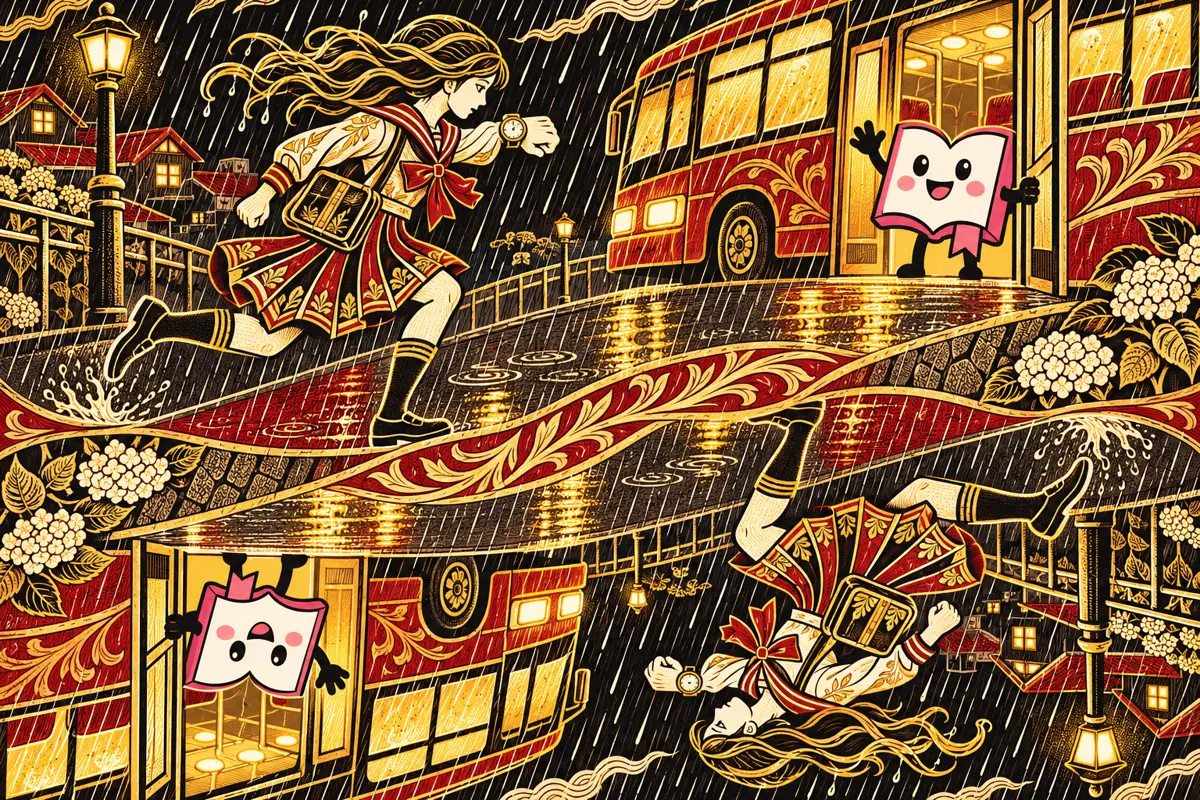
The narrator never says, “This is what the watch in chapter 1 was for.” Haru swallows her “anyway” and starts running: that action alone pays off both setups.
First, show the payoff through the character's actions. Write “She realised the watch was five minutes fast. That meant she still had seven minutes,” and the narrator takes away readers' pleasure in making the connection themselves.
Next, keep the callback brief. Just “I've set it five minutes fast” is enough to recall the dialogue in chapter 3. Preferences differ over how much to revisit. Of seven requests on this site that answered whether earlier scenes should be shown again after the payoff, five chose yes and two chose no. For clarity, show a brief reminder; for a lingering effect, leave it to readers.
Finally, make the payoff happen during the climax. If she recalls the watch being five minutes fast on a leisurely walk home, nothing happens. Foreshadowing drives the story because its meaning changes at the moment of greatest pressure.
When writing with AI, keep supplying foreshadowing notes
When you write a story with AI such as ChatGPT or Claude, foreshadowing can disappear. It may miss details from early in a long conversation and forget the chapter 1 watch by chapter 5. Or it may pay off a sentence intended as foreshadowing as soon as the next chapter.
To prevent this, keep foreshadowing notes and supply them every time you ask for a chapter. Record the chapter where you planted each element, what it is, and when and how it should pay off. Paste the notes at the start of the prompt. A request for chapter 3 could look like this.
Write chapter 3, following these foreshadowing notes.

[Foreshadowing notes]
1. Watch (planted in chapter 1): In this chapter, have the grandfather say “I've set it five minutes fast” while sharing a memory. Do not mention how it will help with the bus. Payoff: chapter 5.
2. Haru's habit of thinking “anyway” (planted in chapter 1): Do not include it in this chapter. Have the grandfather use it in chapter 4. Payoff: chapter 5.
3. Potted plant on the hospital-room windowsill (planted in chapter 2): Pay it off in this chapter by showing that it has buds.

[Rules]
- Do not explain in this chapter any foreshadowing whose payoff is scheduled for later. Do not have the narrator say “one day” or “little did she know.”
- Do not make characters react to foreshadowing as though it has special significance.
- If you add new foreshadowing not in these notes, separately list what you planted and where at the end of the chapter.
The final line looks modest, but it helps. If the AI adds an unrequested, suggestive sentence, you can decide whether to put it in the notes and pay it off or remove it.
Original Novel uses the same approach to create its stories. Behind the scenes, each work has a record of its outline, foreshadowing and established facts. This is supplied to the AI for every chapter. Before publication, AI also checks each chapter for contradictions with earlier chapters and mistakes in names or numbers.
Reread to learn how the setups work
You learn to write foreshadowing by rereading chapter 1 after you know the ending. If a sentence you passed over now looks different, check what job it did in its scene, whether it was recalled along the way, and whose action delivered the payoff.
On Original Novel, you can read AI-written stories and, for ongoing stories, create a continuation or a different turn of events from any chapter you choose. Looking through a completed story to see how an early sentence matters in later chapters is also good practice.
Read with an eye for foreshadowing
See more: Read with an eye for foreshadowing ›These mystery, suspense and drama stories were written by AI on this site. Once you've finished, try rereading chapter 1.
 The Only Voice I Can't HearFor teens · Showbiz & idolsCompletedMay We Begin With a Lie?For adults · Romance
Sources (date checked)
- Fukusen (foreshadowing): meaning and usageKotobank (Digital Daijisen; Nihon Kokugo Daijiten, concise edition) / Japanese / Checked Nov 18, 2026
- Чехов — Лазареву (Грузинскому) А. С., 1 ноября 1889A. P. Chekhov, Complete Works and Letters in 30 volumes (chehov-lit.ru) / Checked Nov 18, 2026
FAQ
How does foreshadowing differ from laying the groundwork?
Both prepare for what comes later. The Japanese terms for foreshadowing and groundwork are listed as synonyms in dictionaries. Foreshadowing means hinting early in a novel or play at something connected to a later development. Fuseki, the Japanese term closest to laying the groundwork, originally referred to the opening placement of stones in Go and is used more broadly for preparations for the future (the Japanese dictionary Digital Daijisen).
How does foreshadowing differ from a plot twist?
A plot twist is a reversal in the story, the situation or someone's position, as described in the Japanese dictionary Digital Daijisen: it is an event within the story. Foreshadowing is the setup planted ahead of that event. When the reversal arrives, earlier foreshadowing helps readers think back and find it convincing.
Should I rewrite foreshadowing if readers spot it early?
Not necessarily. Even if readers predict what will happen, they can still enjoy seeing how the character acts when the payoff arrives. If you're concerned, start with small changes: move the setup into a busier scene or cut one explanatory sentence, rather than removing it. That helps preserve the plot.
Can I add foreshadowing to earlier chapters after finishing?
Yes. Writing the climax first and then going back to plant the objects or words that matter there can make it easier to choose their placement. After adding them, reread from the beginning to check that the narrator isn't anticipating the future and the details aren't too conspicuous.