How to Write Dialogue in a Novel: Fixing Flat Lines and Giving Each Character a Voice
Learning how to write dialogue in a novel starts with the marks on the page, but those rules differ by language. Japanese novels, for example, wrap speech in 「」 brackets and leave out the full stop before the closing bracket, a publishing custom rather than an official rule. This article first sorts the Japanese case into rule and custom, then takes one draft scene that follows the rules yet still reads flat, and fixes it step by step: exposition, voice, and the balance between dialogue and narration.

Key takeaways
- In Japanese novels, leaving out the full stop before a closing bracket and doubling …… and ―― are publishing customs. Japan's official style guide for government writing makes the full stop the default, while noting it is often left out in everyday writing
- If a contest or publisher specifies a style, follow it; if not, follow common novel conventions, and never mix styles within one work
- Spot exposition dialogue by asking whether the listener already knows what is being said, and move that information into action or narration
- Tell characters apart through catchphrases, sentence endings and what they leave unsaid, then test by hiding the names and guessing who is speaking
Dialogue marks in Japanese novels: official rules and publishing custom are different things
In Japanese novels, dialogue is enclosed in 「」 brackets, with no full stop (。) before the closing bracket. The ellipsis (……) and the dash (――) are doubled, and a quotation inside the brackets uses double brackets 『』. This is the style most often shown in guides to writing Japanese novel manuscripts.
However, this is a custom of the Japanese publishing world, not a law or an official rule. Japan's style guide for government documents, "Thinking on Writing Official Documents" (Council for Cultural Affairs, January 2022), makes it the default to put a full stop before the closing bracket when a sentence ends inside the brackets, and its commentary adds that the full stop is often left out in everyday writing. The 1946 draft "How to Use Separation Marks", compiled by the Ministry of Education, also put a full stop at the end of a sentence even inside brackets. Some guides to writing Japanese novel manuscripts say "this full stop is not needed", but that applies to novel manuscripts. In other settings, such as government documents, the default is to use it. Punctuation rules differ by language, so check the style guide for your own language.
| Question | Thinking on Writing Official Documents (2022) | How to Use Separation Marks (1946, draft) | Common custom in Japanese novels |
|---|---|---|---|
| Full stop before the closing bracket | Used (e.g. 「○○。」). The commentary adds that it is often left out in everyday writing | Used (e.g. 「○○。」) | Not used (e.g. 「○○」) |
| Brackets inside brackets | Basically 「」 again inside 「」. 『』 may be used in commentary, public relations materials and similar texts | 『』 inside 「」 | 『』 |
| Ellipsis | "…", or doubled "……" | "……" or "…" | Doubled "……" |
| Dash | "―", or doubled "――" | "――" or "―" | Doubled "――" |
When in doubt, the choice is simple. If you are entering a new-writer contest, follow the contest's submission guidelines if they specify a style. If they don't, following common novel conventions keeps readers from stumbling. Whichever you choose, the most important thing is not to mix styles within one work. If one chapter puts a full stop before the closing bracket and the next chapter leaves it out, readers notice the shifting marks more than the story.
Line breaks and indents: show who is speaking through the lines
Line breaks in dialogue are there so readers never have to wonder who is speaking right now. This article recommends these three habits.
- Start a new line when the speaker changes (never put two people's lines on one line)
- In Japanese manuscripts, lines of dialogue start with the opening bracket 「 and are not indented, while narrative paragraphs (everything other than dialogue) are indented by one character
- Put a character's action right before or right after that character's line (don't mix it with someone else's action)
The second point, that lines beginning with a bracket need no indent, is also often introduced in guides to writing Japanese novel manuscripts.
With the third point, readers know who is speaking even without "she said". For example, if the line "I'm heading home first." is followed by "Misaki slung her bag over her shoulder.", it is clear that Misaki is the one going home. The same works when the action comes first: the line after "Ryo looked out the window." is read as Ryo's. On the other hand, if you don't break the line when the speaker changes, readers have to recount the speakers line by line.
Dialogue that follows the rules but still reads flat
Getting the marks and line breaks right does not bring dialogue to life on its own. Read the draft below. It is a scene where two childhood friends meet again after six years.
"Long time no see," Misaki said. "It really has been a long time, right?" Ryo said too.
"Ryo, you moved to a school in a faraway town six years ago, right? We were in the same class from third grade, and we walked home together every day, right?"
"Right. Back then I moved away without saying a word, so you were angry, right. . ."
"I was angry, you know. But I'm not angry anymore, you know."
"Good. It's been on my mind this whole time, you know-"
The problems with the marks can be fixed with the rules above. In the Japanese original these were a full stop before the closing bracket, an ellipsis typed as a row of dots, a single dash, and two people's lines on one line. But even with all of that fixed, the scene is still flat. The cause is in the content. The two of them say out loud, just to confirm it to each other, a past they both already know. They speak the same way, so if you hide the names you can't tell whose line is whose. And there is nothing but dialogue, so you can't see where the two of them are or what they are doing.
Fixing the content goes most smoothly if you start with the biggest problems.
- Cut exposition dialogue, or move it into action or narration
- Tell the two characters apart through the way they talk
- Put narration between the lines to build the scene and create pauses
- Read with the names hidden and check whether you can guess the speaker
If you polish the way they talk before cutting, you end up deleting the lines you polished. And you can't judge how much narration you need until the amount of dialogue is settled.
Fixing exposition dialogue: let characters say only what the listener doesn't know
Exposition dialogue is a line a character says only so that the reader learns the background. There is one way to spot it: check whether the character is telling the listener something the listener already knows. In the draft, "We were in the same class from third grade" is something Ryo knows too. In real conversation, nobody reads out a memory the other person shares as if it were a timeline.
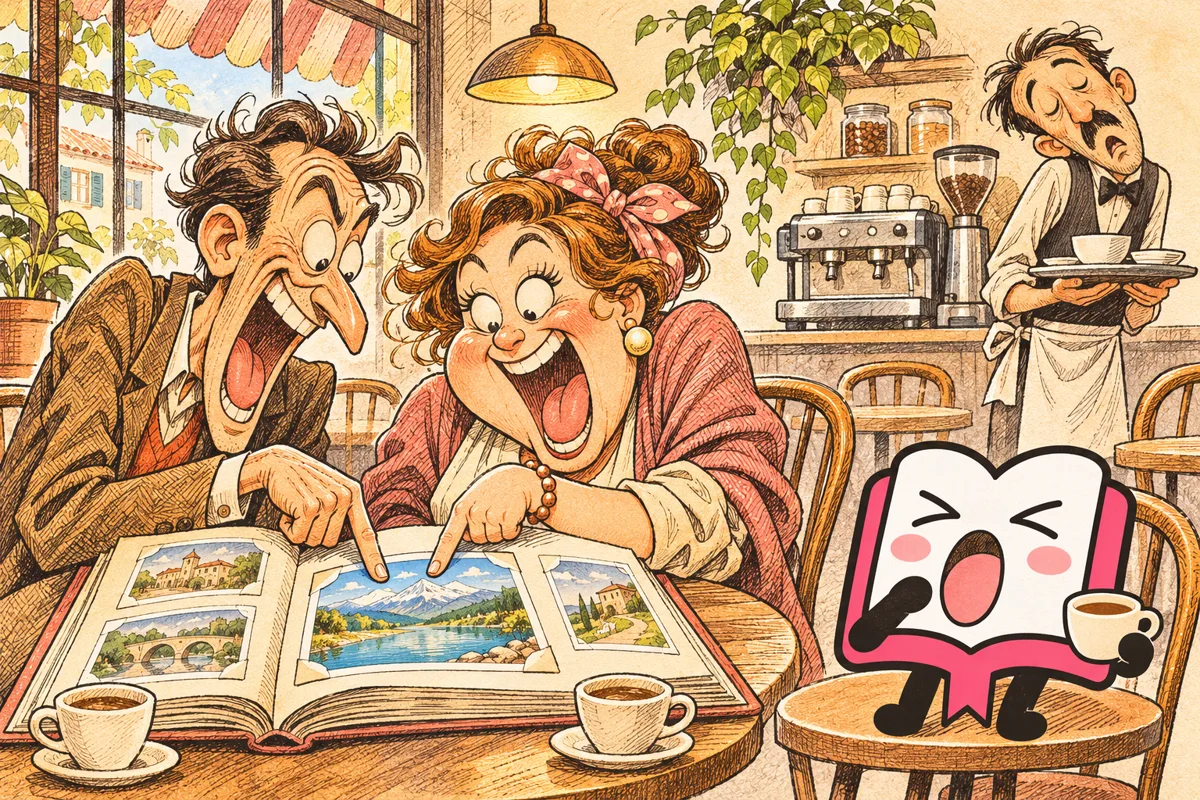
The fix is to decide where each piece of information should go.
"Six years" is information you really do want to get across. But instead of stating it as an explanation, put it inside words of reproach and it sounds natural. "It's been six years. Is that all you've got?" conveys both the number of years and Misaki's feelings at once.
"In the same class since elementary school" comes out of the dialogue and moves into action. If Ryo shows the same habit he had as a child, and Misaki notices it, the narration tells the reader they have known each other a long time.
"We walked home together every day" doesn't need to be said in full; let only part of it show. If Misaki says "I waited at the corner on the way home", readers fill in the rest themselves. Less explanation gives readers more room to think, and that room is what gives a scene its texture.
How to write dialogue in a novel with distinct voices: catchphrases, endings, and what goes unsaid
In the draft, both characters keep ending their lines with "right?" and "you know". Unless you write the names, there is no way to tell them apart. There are three clues for giving them different voices: catchphrases, the way their sentences end, and what each person leaves unsaid. Even with the same feeling, "I'm glad to see you", the words that come out differ from person to person.
One catchphrase per character is enough. Used every time, it gets tiresome, so bring it out only when the character's feelings shift. As for sentence endings, someone who ends lines flatly and firmly ("That's how it is.") and someone who trails off ("I guess…", "…but") seem like different people even when they say the same thing.
What works best is what goes unsaid. A quiet character falls silent or changes the subject at the moments that matter. In the draft, Ryo puts his whole feeling into words: "It's been on my mind this whole time." But the more something has really been on someone's mind, the harder it is to say it straight out. Going quiet, answering in a word, talking about something else: these let readers feel the weight of the emotion.
Looking back over the story requests sent to Original Novel (22 requests from November 6 to 7, 2026; the number is small, so take it as a rough sign of a trend), the field for characters' appearance tended to be filled in in great detail. But inside the text, what tells characters apart is not how they look; it is how they talk. When you ask an AI to write a story, adding one line per character with their catchphrase and way of ending sentences keeps the dialogue from blurring together. Original Novel's creation form also lets you choose the amount of dialogue and its tone.
Balancing dialogue and narration: put one action between the lines
There is no single right ratio of dialogue to narration. Some light reads are mostly dialogue; some heavy novels are almost all narration. Still, if you look at a page from a distance, its shape tells you roughly what the scene feels like.
When lines of the same length follow one another as on the left, it is like listening to a radio drama. You hear the voices, but you can't see where the two characters are or what their faces look like. As a rough guide, once dialogue has run for three or four lines, putting in one action through narration brings the scene into view. This "three or four lines" is this article's own guideline, not a rule. In a scene of quick back-and-forth, you may deliberately let the lines run without a break.
The narration you insert doesn't have to be a long explanation. The washing machine stops, someone looks out the window, someone pinches a key between their fingers. A one-sentence action becomes a pause in the conversation. Placing one action before a reply is enough to show that the character hesitated over the answer.
Read with the names hidden: can you guess who is speaking?
To check whether your characters sound different, pull out only the dialogue, delete the names and every "she said", and read it. If you can guess whose line each one is, their voices are distinct. Any line you can't place is the spot to fix.
Since you, the writer, always know who is speaking in your own text, this check is a handy job to give an AI. Don't let it rewrite the lines; just have it guess, so your own writing stays intact.
Below are only the lines of dialogue taken from a novel I wrote.
I have removed the speakers' names and tags such as "she said".
Please do not rewrite the lines.

Characters:
- [Name] (e.g. Misaki. Talks a lot. Hides her feelings behind words of blame)
- [Name] (e.g. Ryo. Says little. The more something matters, the less he says it)

Please tell me:
1. Who you think said each line
2. Which lines you hesitated over, and why
3. Where the two characters sound too alike (sentence endings, word choice)
4. Any lines that explain something the listener already knows

[Dialogue]
(Paste one line per row here)
A line the AI hesitates over is likely to make human readers hesitate too. How to fix it is your decision. If the reason was "the endings are the same", work on the endings; if it was "either of them could have said this", look for words only that character could say.
The scene after editing
With the three fixes and the final check in place, the first draft became this. The original Japanese version follows the Japanese novel conventions above; here the scene is shown in English.
The washing machine thudded to a stop, and Misaki looked up.
"…Ryo?"
The man at the dryer turned around. Before answering, he pinched the old key hanging from his neck between his fingers. The same habit he had in elementary school.
"Yeah."
"'Yeah'? It's been six years. Is that all you've got?"
"…Sorry."
"For what?"
Ryo kept his eyes on the dryer window and was quiet for a moment.
"For disappearing without a word."
Misaki tried to laugh, and couldn't quite manage it.
"You're late. I waited, you know. At the corner on the way home. For about three days."
The information conveyed is almost the same as in the draft: it has been six years, they have known each other since elementary school, Ryo moved away without telling anyone, and Misaki waited at the corner on the way home. What changed is that the characters no longer state it as explanation; it is split up into words of reproach, short replies, a habit and a silence. Misaki never says "I was angry" or "I'm glad", but the final "for about three days" gets both across.
A feel for different voices comes not only from writing but from reading. When you read a dialogue-heavy story, try guessing who is speaking without looking at the names, and you will start to see where the writer sets the characters apart.
Read a dialogue-heavy story
See more: Read a dialogue-heavy story ›Stories written by AI on this site. Try guessing who is speaking without looking at the names; it is good practice for writing distinct voices.
 The Only Voice I Can't HearFor teens · Showbiz & idolsCompletedMay We Begin With a Lie?For adults · RomanceThe Jingjok Behind the BlackboardFor kids · SchoolHeir to a Noodle CartFor adults · Comedy
Sources (date checked)
- Thoughts on Writing Official Documents (Council Recommendation)Council for Cultural Affairs (Japan) / Japanese / Checked Nov 18, 2026
- How to Use Punctuation Marks (Draft, 1946)Ministry of Education (Japan), Textbook Bureau; published by the Agency for Cultural Affairs / Japanese / Checked Nov 18, 2026
FAQ
How should I write a character's inner voice?
There is no fixed way. Some works blend it into the narration, others set it off with marks, and it varies from book to book. Choose one style that readers can tell apart from spoken lines and keep it consistent through the work. If you are unsure, blending inner thoughts into the narration keeps the page free of extra marks and easy to read.
Should phone calls or text messages look different from ordinary dialogue?
There is no rule either way. If, the first time it appears, you add a line of narration such as "on the other end of the line", readers understand the speaker is not in the room without any change of marks. If you do mark them differently, use the same mark throughout the work.
In web fiction, should I put blank lines before and after dialogue?
On a phone screen, a blank line between dialogue and narration can make the text easier to read. It is fine to choose based on where people will read it, but for a manuscript sent to a new-writer contest, follow the format in the submission guidelines (such as characters per line and lines per page).
How much dialect should I put in dialogue?
Keeping the dialect in sentence endings and a few words reads better than reproducing all of it exactly. When readers hit a run of words they cannot understand, they stop reading. Use just enough to convey who the character is, and fill in hard-to-follow words through the narration around them.
In Japanese, what happens when text follows "!" or "?" inside a line of dialogue?
In Japanese writing, when more text follows, you leave one full-width space after the mark. The commentary in Japan's Council for Cultural Affairs guide "Thinking on Writing Official Documents" (2022) also says to leave one character's space when a sentence continues after "?" or "!". No space is left right before a closing bracket.