How to Plot a Novel with AI: Turn One Idea into a Blueprint in 4 Rounds
If your AI-written story keeps drifting, the shortcut is to plot the novel with AI before asking for any prose. Don’t do it in one go: split it into four rounds — get options, split into chapters, hunt for holes, hand over a table. Using a short story set in an old photo studio, we follow one idea from a single sentence to a five-chapter plot table, with prompt examples.
Key takeaways
- Before asking for prose, build the plot with the AI: what happens in each chapter, and why it leads to the next
- Four rounds: get 3 options → split into chapters with “so” and “but” → have the AI find holes → make a table and request one chapter at a time
- You choose, mix and fix the options. The AI’s role is to expand on ideas and hunt for holes
- Paste the plot table at the top every time you ask for prose. If the prose drifts somewhere better, fix the table
When you write fiction with AI, the best way to keep the story from drifting or going thin is to plot the novel with AI before you ask for any prose. And don’t ask for the whole plot at once: split the work into four rounds — “get options,” “split into chapters,” “hunt for holes” and “hand over a table.” In this article we follow one short-story idea all the way through, from a one-sentence spark to a five-chapter plot table, step by step through the conversation with the AI. The prompt examples work as they are in ChatGPT, Claude or Gemini.
Why plot a novel with AI first, instead of asking for prose
Ask “write a bittersweet short story” and nothing else, and the AI quickly sends back something that reads well. But as you go on to chapter 2 and chapter 3, it often turns into a string of events, and you can no longer tell where the story is heading. The AI may write each chapter skillfully, yet unless you ask, it may not work backward from an ending five chapters away.
This is where the idea of a “plot” helps. Encyclopedias contrast a story, where events are arranged in time order, with a plot: a storyline built with the cause-and-effect links between events in mind (Britannica International Encyclopedia, Japanese edition, presenting E. M. Forster’s definition from Aspects of the Novel). In other words, a plot is when chapters are linked not by “and then” but by “so” and “but.”
When you have AI build a plot, the key is likewise to have it write, chapter by chapter, why the next thing happens. But if you ask for everything at once, the AI tends to return one safe storyline and stop. To separate what you choose from what the AI should expand on, we break the conversation into four rounds. The idea we follow in this article grows like this.
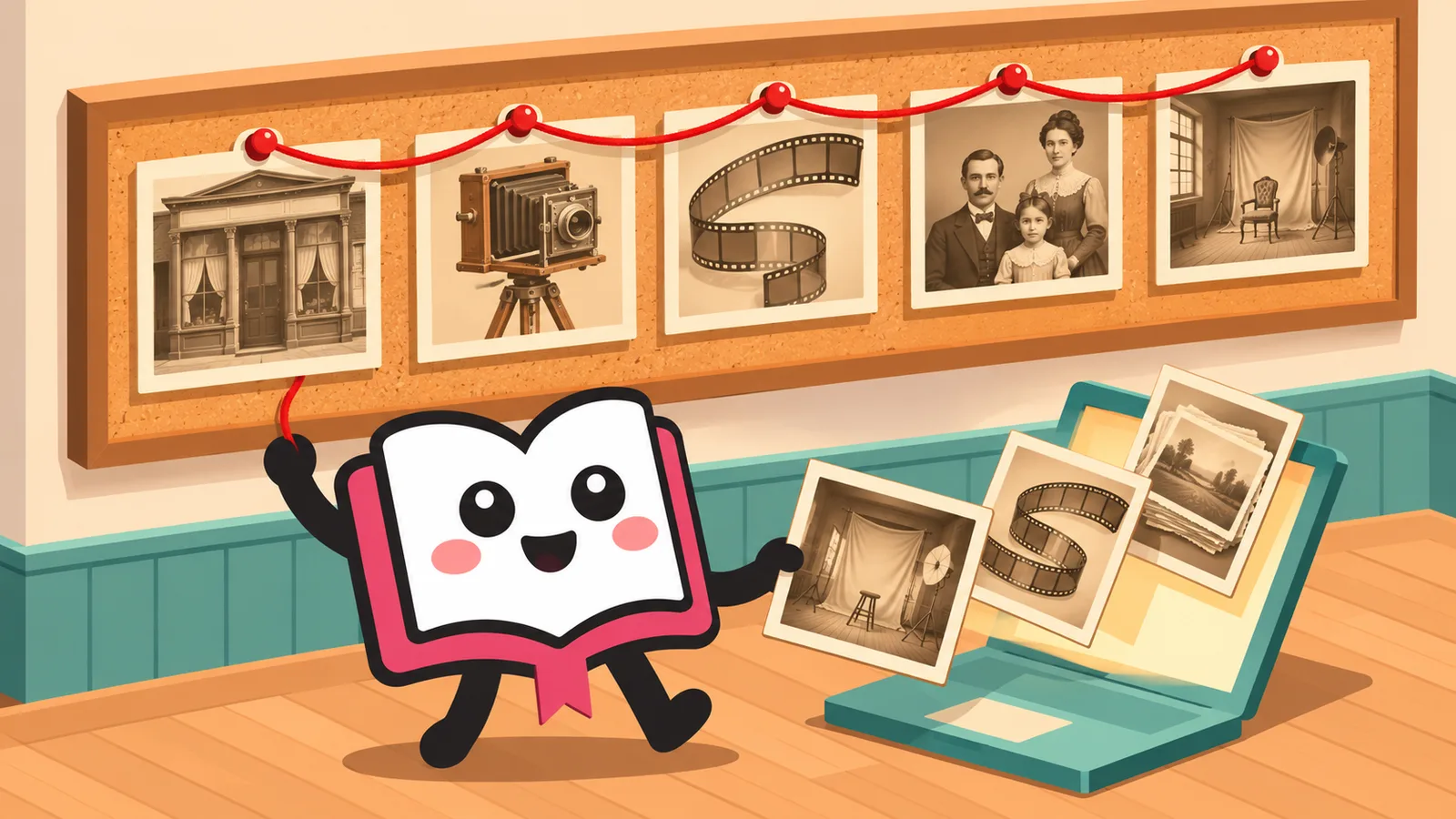
The example: an old photo studio and a roll of film nobody collects
Explanations alone are hard to picture, so we follow one idea to the end. At the start there is only a one-sentence spark and three requests.
The one-line idea: “Akari, 28, takes over a local photo studio that is set to close, and searches for the owner of a roll of film no one has come to collect in decades.” The three requests: make it a five-chapter short story, give it an ending that is bittersweet but lets you look forward, and have the protagonist reach the answer through her own actions.
At this stage, we haven’t decided what is on the film or who owns it. Having the AI expand on the undecided parts is round 1. Detailed character profiles can wait until the plot is done (how to decide on characters is covered in our character sheet template).
Round 1: get three plot options, and you choose
The first prompt doesn’t ask for a finished plot. It asks for three options that go in different directions. Ask for just one and the AI tends to pick a familiar storyline. Put three side by side and your own taste becomes clear: “not this one,” “I want to mix these two.”
Let’s build the plot of a story together. Don’t write any prose yet.

[One-line idea] A ___ protagonist does ___ in order to ___
[Length] A short story in ___ chapters
[Mood of the ending] e.g., bittersweet but hopeful
[Requests] e.g., the protagonist reaches the answer through their own actions

From this idea, give me three storyline options that go in different directions.
For each, describe “the biggest climax,” “the ending,” and “the lingering mood it leaves” in three lines or fewer.
Make sure the three storylines are not alike.
Use this prompt for the photo-studio idea and you might get three options like these. Lining them up against the same yardstick makes them easier to choose from.
| Option | Biggest climax | Ending | Lingering mood |
|---|---|---|---|
| A Father’s secret | Once developed, the film shows her father when young, with a woman she doesn’t know and a baby | She meets the woman and delivers the photos to the person who should really have them | Quietly tearful, warm at the end |
| B First-love reunion | The owner is her father’s first love, who left town, and Akari sets up a reunion | She sees the two reunite, then closes the shop | Sweet and gentle, with a touch of bitterness |
| C The blank film | It turns out nothing was ever on the film | The owner explains “why they didn’t take the pictures,” and Akari takes one last photo | Quiet, with a lingering echo |
The choice here is yours. In this example, we pick A for the strength of its climax and borrow only C’s ending, “Akari takes one last photo.” Knowing that you may mix options keeps you from being pulled along by the AI’s ideas. Once you choose, write in the next prompt exactly which one you picked and what you borrowed.
Round 2: split the chosen storyline into chapters with “so” and “but”
Next, have the AI split the chosen storyline into chapters. The trick here is to specify that the end of each chapter must lead to the next with “so” or “but.” Without this, the AI easily returns a storyline that just lists events in time order: “She finds it. And then she looks into it. And then she meets someone.”
I choose option ___. But for the ending, I’ll borrow “___” from option ___.
Split this storyline into ___ chapters, and for each chapter write these three things:

- What happens in this chapter (2 lines or fewer)
- What the protagonist chooses or decides in this chapter (1 line)
- The link to the next chapter (1 line, starting with “So…” or “But…”)

For the final chapter only, instead of the link, write “what has changed since the first chapter.”
Don’t write any prose yet.
In the photo-studio example, specifying the linking words changes the storyline roughly like this.
In the lower storyline, the woman’s name found in her father’s old ledger in chapter 1 becomes the reason to meet that woman in chapter 4. Relationships like this — something placed in an earlier chapter is used in a later one (setting up foreshadowing and paying it off) — also become visible at the chapter-splitting stage. In the upper storyline, the story still works whichever chapters you swap. That is usually why a story feels “thin.”
Round 3: have the AI hunt for holes in your plot
Once the plot is ready, have the same AI check it before moving on to prose. A freshly made plot always looks consistent to the person who made it. Ask the AI to switch roles from “writer” to “reader,” and it finds holes you would struggle to spot yourself.
Requests sent to this site show why this check matters. When we reread 22 story requests sent to Original Novel (November 6–7, 2026), 7 had requests that contradicted each other. In 3 of them, the person chose “complete in one chapter” yet asked for a twist ending or several foreshadowing payoffs. One person wanted to cover everything from the start of a romance to old age in five chapters. Some people even wrote the whole storyline up to the ending in the field for the other main character. We read this as a sign that people want to make the plot first. The numbers are still small, so treat this as a rough guide, but we think the reason a story doesn’t work is often less the AI’s skill and more the balance between requests (including their balance with the length).
Have the check look at these five points:
- Do the requests contradict each other? (Is a short story crammed with too many devices?)
- Is the time span too long for the number of chapters?
- Is every piece of foreshadowing paid off, and is everything paid off set up in an earlier chapter?
- Are important scenes resolved by coincidence? (Does the protagonist make her own choices?)
- Has the ending drifted from the mood decided at the start?
From now on, read the plot above as a strict editor.
Don’t give me a revised plot. List only the problems, up to five, biggest first.

What to look at:
1. Requests that contradict each other, and places overcrowded for the number of chapters
2. Whether it covers a time span too long for the number of chapters
3. Foreshadowing that is set up but never paid off, and things paid off without being set up earlier
4. Places resolved by coincidence or convenient events
5. Whether the ending has drifted from “___ (the mood decided at the start)”

For each, explain “which chapter, what, and why it is a problem” in 1–2 lines.
The point is to ask for “only the problems, not a revised plot.” If you let it produce a revised version too, the AI may rewrite parts other than the ones it flagged, and you can no longer track what changed. In the photo-studio example, if the AI points out that “after chapter 2 reveals the address is an empty lot, the clue that tells Akari where the woman is comes too much by chance,” you rework the clue so it comes through a personal connection, for example: “a neighbor had a group photo taken at her father’s studio.” Whether to fix it, and how, is again your call.
Round 4: put the plot in a table and ask for prose one chapter at a time
After the check, gather the plot into a single table. This table becomes the blueprint when you have the AI write the prose. As a conversation with the AI gets long, it can drop things decided early on, so the reliable way is to paste this table at the top every time you ask for prose.
[PLOT TABLE]
One-line idea: ___
Mood of the ending: ___
How the protagonist changes from the first chapter to the last: ___

Chapter 1: What happens / Protagonist’s choice / Link to the next (so / but) / Foreshadowing to set up
Chapter 2: What happens / Protagonist’s choice / Link to the next / Foreshadowing to set up or pay off
Chapter 3: (same)
Chapter 4: (same)
Chapter 5: What happens / Protagonist’s choice / Foreshadowing to pay off / What has changed since the first chapter
Chapter with the biggest climax: Chapter ___

[FIXED FACTS] Names, what characters call each other, era, places, and other facts that must not change

---
Following this plot table, write only chapter ___, in about ___ words.
Don’t add major events that are not in the table. If you think one should be added, mention it in one line outside the prose.
Ask for the prose one chapter at a time. If you have all five chapters written at once, the later chapters tend to stray from the table, and it is harder to see where they drifted. When a chapter is done, read it and check only whether the table’s “what happens” and “link” actually occur in that chapter, then move on to the next.
The stories on Original Novel are made with the same idea behind the scenes. Each story has a story bible holding its “blueprint, foreshadowing and fixed facts,” which is given to the AI every time a chapter is written. Up to 5 chapters can be created at a time, and before each chapter is published, AI checks it for contradictions with earlier chapters and for mistakes in names and numbers. Where to keep a story bible in each AI is explained in ChatGPT prompts for writing a novel.
If the prose drifts from the plot while you write
Even with a plot, scenes and lines that aren’t in the table can appear as the AI writes. When the prose drifts, before you immediately ask it to “rewrite it to match the table,” look at whether the drift is interesting. The decision splits two ways.
from the plot table
Fix that chapter and the later chapters in the plot table, then ask for the next chapter
Show the table’s “what happens” for that chapter only and have it rewritten
What matters is not to leave the plot table outdated after the prose has changed. If you ask for the next chapter while the table and the prose disagree, the AI won’t know which to follow, and the story becomes disjointed. It’s fine to keep fixing the plot table as you write.
When you want to try “what if something else happened after this chapter,” another option is to keep the original storyline and have a different one written, then read them side by side. On Original Novel, you can choose “what you want to happen in the next chapter” at the end of any chapter and create a continuation, and if you don’t like it, you can take the story in a different direction from the same chapter. The original story is never erased. See how a plot branches out in real stories.
Read stories that grow chapter by chapter
See more: Read stories that grow chapter by chapter ›Stories on this site where AI wrote chapter after chapter. You can take the story in a different direction from any chapter.
 The Only Voice I Can't HearFor teens · Showbiz & idolsCompletedMay We Begin With a Lie?For adults · RomanceThe Jingjok Behind the BlackboardFor kids · School
Sources (date checked)
- Plot (dictionary entry)Kotobank (Britannica International Encyclopedia, etc.) / Japanese / Checked Nov 18, 2026
FAQ
What is the difference between a plot and a synopsis?
A synopsis is a short summary of events in the order they happen. A plot is a storyline built so that events are linked by “why.” Encyclopedias distinguish a “story,” where events are arranged in time order, from a “plot,” which is built with cause and effect in mind. In everyday use, though, “plot” is sometimes used to mean the same as a synopsis. A simple way to think of it: you make a plot before writing, and you write a synopsis after.
How detailed should a plot be?
For a short story of about five chapters, each chapter needs only two lines for “what happens,” one line for “what the protagonist chooses,” and one line for “the link to the next chapter.” If you put dialogue and description into the plot, the AI tends to just follow it mechanically, and the prose gets stiff. Put your effort into making sure each chapter is linked to the next by a reason, rather than into detail.
Can AI plot a full-length novel too?
Yes. But if you ask it to break a story into dozens of chapters at once, the later ones get rougher. It is more reliable to work in two levels: first divide the whole story into four or five big parts, then plot the chapters part by part. At every level, paste the plot table of the previous part before you ask.
Can I plot with a free AI?
Many AI tools have a free tier, and plotting a short story often fits within it. Limits on the number of messages and length differ by service and can change, so check each service’s official information.
Should I fit my plot into a set structure such as kishōtenketsu?
You can plot without one. A structure is handy as a hint for each chapter’s role: for example, a four-chapter short story can give one chapter to each part of kishōtenketsu, the Japanese four-part structure (introduction, development, twist, conclusion). Before trying to fit a set structure, check first that the chapters are linked by “so” and “but.”