Novel opening lines: draw readers in with your first sentence and first page
Strong novel opening lines capture a moment when something is already happening in one short sentence. On the first page, show whose story it is, where they are, and what is strange, then leave one bigger question to carry readers forward. We compare six ways to begin the same scene—a letter arriving every morning in an apartment building's mailbox—then build the first page and revise it after finishing the story.
Key takeaways
- Keep the first sentence short and start at a moment when something is already happening.
- On page one, establish who, where, and what is strange, then leave one question bigger than the first sentence's.
- Choose one of the six approaches to match the feeling you want readers to take away.
- A placeholder first sentence is enough to get started; rewrite it after finishing the story.
- Of 62 Japanese-language first chapters on Original Novel, 39 began with an event or a description of the scene (November 17, 2026).
Novel opening lines: start when something is already happening
If you are stuck on your novel's opening lines, instead of starting with the protagonist waking up or introducing themselves, try one short sentence capturing a moment when something is already happening. This makes it easier to draw readers in. Then, within the first page, show whose story it is, where they are, and what is strange. Leave just one unresolved question to carry them to page two.
In the first sentence, readers are looking for a hint of what will happen next. For someone who does not yet know the protagonist, a name and backstory are information they have no reason to remember. But “There was another letter for someone I didn't know in the mailbox” makes them want to know whose letter it is and why it keeps arriving. The protagonist's name then slips naturally into that flow.
Here, “opening lines” means the first sentence to the first few lines, while “opening scene” means the first scene, roughly the first page. Opening lines make readers stop; the opening scene carries them to page two.
How the first chapters of 62 published stories begin
On November 17, 2026, we opened the first chapters of 62 stories available in Japanese on Original Novel (original-novel.com) and sorted their first sentences into four categories. These categories were defined for this article. When a sentence seemed to fit two, we classified it by what came first in the sentence.
The largest group, 39 of the 62 works, began with an event or a detail of the scene: sound, light, weather, a person's movement, or the view in front of them. The sentences tended to be short, too. Excluding punctuation and quotation marks, 36 works had a first sentence of 15 Japanese characters or fewer; extending the limit to 20 Japanese characters brought the total to 49. Some end in just three characters in the Japanese original, like the sound “Plop.”
The 13 works that began with a date or time did not stop at telling the time. In 12 of those 13, something happens within the first two paragraphs: a person freezes, something falls from the sky, or lights switch on by themselves in an empty corridor. The date or time serves as a cue that directs the reader's attention toward an event.
The stories on this site are AI-generated, so these findings should be kept separate from trends in novels written by people. Even so, such a consistent pattern of making something happen in the first few lines offers a useful yardstick when you revisit your own opening lines.
Compare six first sentences for the same scene
Writing the same scene in several ways and comparing them makes the differences clearer than memorizing categories of opening lines. We will use this scene, invented for this article.
Office worker Mizuki Sakaguchi has moved into an old danchi, a Japanese apartment complex, on the fourth level—three floors above ground. Every morning, an envelope arrives in the ground-floor mailbox for the previous resident, addressed to “Miura-sama,” using a respectful Japanese form of address. There is no sender's name.
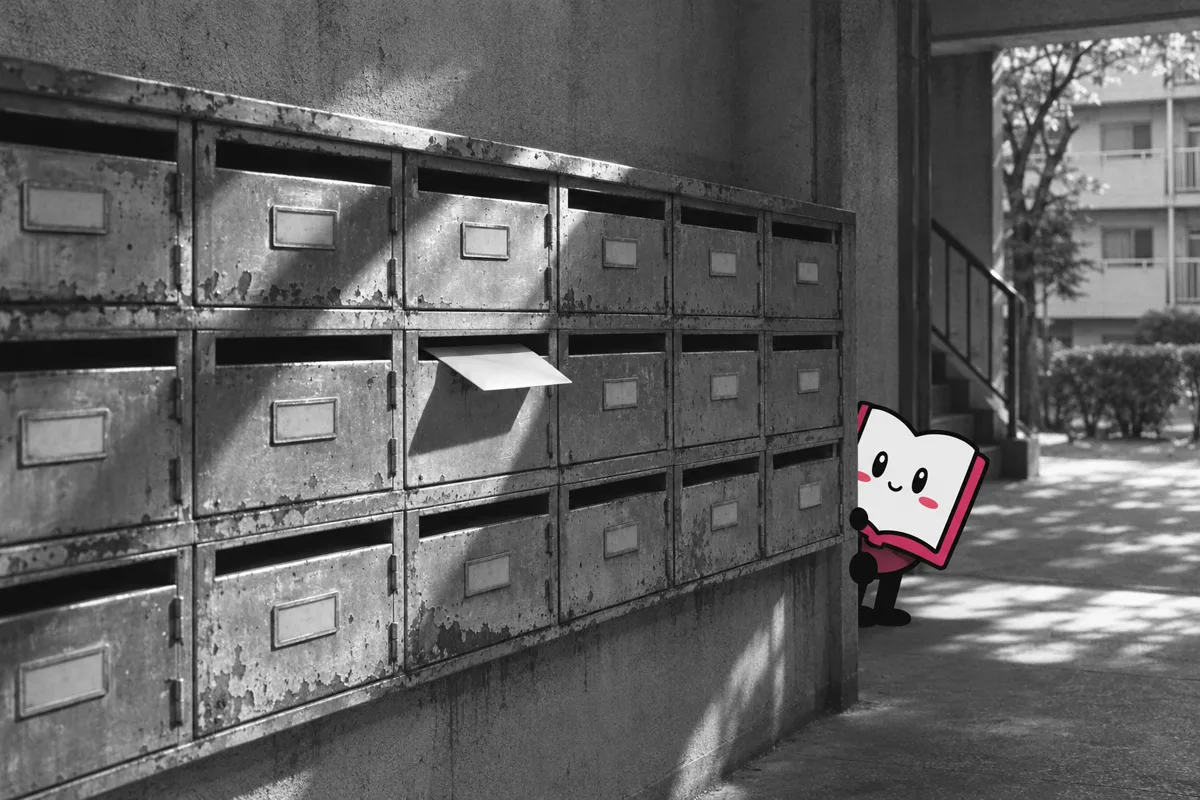
Let's write the first sentence of this scene six ways.
| Approach | Example | Best suited to | Watch out for |
|---|---|---|---|
| 1. Start with an event | Once again, an envelope rustled inside the mailbox. | Mystery, suspense, adventure, and other stories driven by events | Quickly establish when, where, and whom it happened to in the next sentence |
| 2. Start with dialogue | “That makes seven letters.” | Stories centered on relationships or with lots of dialogue | Make clear in the next sentence who spoke and to whom |
| 3. Start with a date, time, or place | April 9, ten past seven in the morning. | Stories in which timing matters, or stories told like a record | Follow the time immediately with an event (for example: “Once again, I stood in front of the apartment building's mailboxes.”) |
| 4. State what is strange | Ever since I moved into this apartment, a letter that isn't for me has arrived every morning. | Stories where mystery intrudes on daily life; short stories | Do not reveal the answer to the mystery in the first sentence |
| 5. Have the narrator introduce themselves or address the reader | Let me say this first: I'm not the sort of person who opens other people's letters. | Stories with a distinctive narrative voice; comedy | Return to the scene if the narration runs long |
| 6. Start with the setting | The corridor three floors up catches the first light of morning. | Quiet stories, or stories meant to leave a lingering feeling | Introduce a small disturbance in the scene within two or three sentences |
Even with the same scene, approaches 1 and 4 foreground the mystery of why the letters arrive, 2 foregrounds a relationship, and 6 foregrounds the quiet of daily life. None is the one right answer. Choose the approach closest to the feeling you want readers to take away. Choose 1 or 4 for a story propelled by mystery, 2 for one centered on two people's relationship, or 6 for a story with a quiet emotional impact.
Older works offer models for approaches 3 and 5. Ryunosuke Akutagawa's Rashomon sets the time with “It happened one day at dusk.” The very next sentence shows a servant waiting beneath Rashomon gate for the rain to stop. Natsume Soseki's I Am a Cat begins with its narrator introducing himself: “I am a cat. I have no name as yet.” Both works are out of copyright in Japan and can be read in Japanese on Aozora Bunko, a free Japanese library of public-domain texts.
Revise an opening with five common stumbling blocks
Here is a first page that deliberately puts five common opening-line problems into the apartment-complex story. The numbered passages mark the stumbling blocks.
①That morning, a noise like an explosion rang out in the sky above the apartment complex.
②Brrring! The alarm went off, and I opened my eyes in bed. Just another morning.
③The April sky was clear, and the cherry trees outside the window were in full bloom. The breeze was still a little cold.
④My name is Mizuki Sakaguchi. I'm twenty-six and work in an office. A week ago, I moved into this old apartment complex, three floors above ground. I'm fairly easygoing.
⑤I've already met Takahashi, my senior at work; Kimura, who joined the company when I did; Tanaka, the building manager; and Yamaguchi, my next-door neighbor.
- ① Only the opening is dramatic: The sound is never explained later and has no connection to the letters. The story does not deliver on the first sentence's promise.
- ② Waking up to an alarm: Time passes without anything happening, and the beginning can look just like countless others.
- ③ Describing the weather and season: Readers cannot see how the setting connects to the story.
- ④ A self-introduction: Names, age, and personality traits pile up before readers have a reason to remember them.
- ⑤ Five names on page one: Readers lose track of who the protagonist is.
Fixing all five gives us the version below. Its opening lines use approach 1 from the table.
Once again, an envelope rustled inside the mailbox.
April 9, ten past seven in the morning. Exactly one week since I'd moved into the apartment three floors up. I, Mizuki Sakaguchi, pinched the edge of the rusty mailbox door and pulled it open.
One white envelope. Addressed, again, to “Miura-sama.” The person who used to live in my apartment. The sender's space was blank.
According to the building manager, Miura had moved away without saying where. So every morning I took the letter to the “Address unknown” box in the manager's office. This made seven.
I held the envelope up to the morning sun. The writing on the paper inside showed through.
Rounded letters, slanting upward to the right, with that long crossbar on every t.
It was my mother's handwriting. She had died last winter.
We replaced the loud noise in ① with the small rustle of an envelope, connecting it to the mystery of the letters. We skipped the alarm-clock morning in ② and went straight to opening the mailbox. The weather in ③ became part of the action: “held the envelope up to the morning sun.” In ④, the name appears in the same sentence as the movement of opening the door. For ⑤, we limited named people to Mizuki and Miura; everyone else is identified by role, such as “the building manager.” A useful guideline is to name only the protagonist and one other person, keeping it clear whose story this is.
Problem ① often comes from trying to make the opening lines powerful. You can begin with a gunshot or a scream, but unless that event connects to the heart of the story, readers will feel left behind on page two. Opening lines also make a promise about what the story will be about.
Give three answers on page one, and leave one question
To carry someone caught by the first sentence to page two, provide three answers on page one: whose story is this, where are they, and what is strange? Without these, readers get lost. Yet if you answer everything, they have no reason to continue. So each time you give an answer, add a little of a new question. Here is how the revised first page passes answers and questions along.
The key is to make the question left at the end a step bigger than the first sentence's question. A story that began with “Why do these envelopes keep arriving?” has grown, by the end of the page, into “Why is her dead mother writing letters to someone she doesn't know?” If the question shrinks or is completely answered by the end of page one, readers are more likely to close the book there.
Rewrite the opening lines after finishing the story
Trying to perfect the first sentence before you write can leave you stuck on line one. A placeholder is enough to get started. Once you have written to the end, you can see more clearly what the story was about and choose an opening event to match. Settle on your opening lines in this order.
- Start with a placeholder sentence (“I opened the mailbox that morning” is fine).
- Write through to the final scene.
- Write one line stating what the finished story is about.
- Find the event that brings the question in that line into view earliest.
- Write two or three versions of the first sentence using the six approaches, and compare them.
- Read the first page aloud and check that it gives three answers and leaves one question.
The event you look for in step 4 may be buried partway through the draft. In the apartment-complex story, if the first draft has Mizuki notice her mother's handwriting on page three, you could move that moment to the end of page one.
To check whether your revised first page comes across, ask someone who does not yet know the story to read it. If no one is available, you can ask AI to play a first-time reader. Like Figure 3, the prompt below asks it to record what it understood and what it is curious about after each paragraph.
You are reading this novel for the first time. Read the first page I paste below, one paragraph at a time. After each paragraph, record one line in this format:

[Paragraph number] What I understood: ... / What I'm curious about: ...

If a paragraph loses your attention, add “My attention wandered here” at the end of that line. After the final paragraph, finish with one line stating “What I most want to know.” Do not give opinions or suggestions for rewriting. Write only the reading log.

[First page]
(Paste here)
Reading the log from top to bottom shows what came across in each paragraph. If, halfway through, the “What I understood” entries still do not establish who, where, and what is strange, sentences supplying those answers are missing. If the final “What I most want to know” differs from the story's central question, revisit the question you leave at the end of page one. For a paragraph marked “My attention wandered here,” check whether too much explanation comes too early. Once you can see a reader's response paragraph by paragraph, you can choose for yourself what to revise.
Read a collection of first-chapter opening lines
You develop a feel for opening lines by opening the first chapters of many stories and comparing just their first few lines. As you read, note which of the six approaches the first sentence uses and what question remains at the end of page one. This gives you more options for your own opening lines. The shelf below contains stories you can read on this site.
Compare the opening lines of first chapters
See more: Compare the opening lines of first chapters ›These stories were written by AI on this site. They are listed in order of readership.
 The Only Voice I Can't HearFor teens · Showbiz & idolsCompletedMay We Begin With a Lie?For adults · Romance
Opening lines are a place to return to after finishing the story. For now, start with a placeholder sentence and give yourself room to write.
Sources (date checked)
- Akutagawa Ryunosuke: RashomonAozora Bunko / Japanese / Checked Nov 18, 2026
- Natsume Soseki: Wagahai wa neko de aru (I Am a Cat)Aozora Bunko / Japanese / Checked Nov 18, 2026
- Q&A on extending the protection period of worksAgency for Cultural Affairs (Japan) / Japanese / Checked Nov 18, 2026
FAQ
Can I begin with a prologue?
Yes. A prologue shows a scene from another time or another character's perspective before the main story. Keep it short, and make something happen again at the start of Chapter 1 so the main story does not lose momentum. If the prologue only supplies background, first consider weaving that information gradually into Chapter 1.
Does writing in first or third person change how I should begin?
The same approaches are available; what changes is what you can easily show first. First person lends itself to the narrator's voice and thoughts, so it works well when the narrator introduces themselves or addresses the reader. Third person can show a scene from outside a character, letting you begin with an event or a view the protagonist has not yet noticed.
Can I put a flashback straight after the opening lines?
You can, but a long flashback on page one stops the event that has only just begun. Keep it to a few lines, or wait until one question has developed in the present scene. Readers can then follow the clue of why this memory surfaces now.