How to Make Up Stories With Kids: Let Your Child Be the Author in 4 Steps, With Tips by Age
The best way to make up stories with kids is simple: your child decides the plot, and you ask "And then?" and write it down. This guide covers four steps that work at any age, how the approach changes from age 3 through elementary school, story games that need no equipment, and what to keep in mind if you use AI.
Key takeaways
- Your child decides the plot; you ask questions and write it down
- Each session has 4 steps: choose a main character and a place, the adult says the first sentence, keep it going with "And then?", write it down and read it back
- As children get older, gradually hand over the writing and the opening line
- If you use AI, have it only make a clean copy and ask questions, and never enter your child's real name or school
- Don't stop scary or sad stories; decide how they end together
The secret to making up stories with kids: your child is the author, you are the listener and scribe
What helps most when you make up stories with kids is splitting the roles: your child decides the plot, and you only ask questions and write it down. If you steer the story with "Wouldn't it be fun if…", your child slowly becomes the listener, and before you know it, it's your story. If instead you ask "And then what happened?" and write down your child's words exactly as they are, you end up with a story, however short, that belongs to that child alone.
Think of it like cooking: your child chooses the menu, and you hand over the ingredients and watch the stove. Even if the story jumps somewhere that doesn't quite make sense, start by simply going along with it.
What your child decides
- Who the story is about (the main character)
- Where it happens
- What happens and how it turns out
- The story's title
What you do
- Get things going with the first sentence
- Ask "And then?"
- Write down your child's exact words
- Read the finished story back
What changes with age is how much your child takes on. With 3- and 4-year-olds, the adult does more of the telling, and the child starts with the job of choosing. Once your child can write, gradually hand over the writing too. Below, we start with a session flow that works at any age.
How one storytelling session goes (4 steps)
A session that wraps up in about 10 to 15 minutes is just the right length. Ending on "That was fun, let's do it again" leads to the next story better than dragging it out. Here are the four steps.
- 1Let your child choose a main character and a place
- 2You say just the first sentence
- 3Ask "And then?" and let your child continue
- 4Write down your child's exact words, add a title and read it back
1. Let your child choose a main character and a place
Ask just two questions: "Who is today's story about?" and "Where does it happen?" Any answer works: a crow you saw at the park today, the pudding in the fridge, Grandma's dog. If your child can't decide, offer two choices, like "An animal or a vehicle?"
2. You say just the first sentence
Even adults freeze in front of a blank page. Take on the first sentence yourself. A sentence that includes the main character and the place, like "One morning, a pudding woke up inside the fridge," makes it easier for your child to think of what comes next.
3. Ask "And then?" and let your child continue
From here on, it's your child's turn. Just ask "And then?" or "Who showed up just then?" and don't decide where the story goes. Questions that help when the story stalls are collected in the next section.
4. Write down your child's exact words, add a title and read it back
Write down what your child says without tidying up the wording. If it keeps going "and then… and then…", that's fine. When the story is done, have your child give it a title, and read it aloud from the beginning. Hearing their own words read as a "story" is often the moment kids love most.
Adjusting by age
The four steps are the same at every age, but how much your child can take on changes as they grow. The ages are only a guide, so try the approach for the next younger or older age group depending on your child.
| Approximate age | What your child does | What you do | Games that fit |
|---|---|---|---|
| 3–4 | Chooses the main character; answers "What happens next?" with a word or two | Do more of the telling; ask questions with two choices | Two-choice questions, picture stories |
| 5–6 | Takes turns with you, one sentence each | Keep your turns short and let your child pick the direction; write it down and ask questions when the story stalls | Story relay, three words |
| Grades 1–2 | Tells or writes a short story on their own (a few sentences to start) | Help with the opening line and the title | Three words, "what if" questions |
| Grade 3 and up | Writes a story with a beginning, a problem and an ending on their own | Become the reader and share reactions | Story relay (with friends), "what if" questions |
In Japan, the Ministry of Education's Course of Study for Kindergarten (issued in 2017) lists, as one of the contents of the "Language" area, becoming familiar with picture books and stories, listening with interest, and enjoying the fun of imagining. In the kindergarten years, it's enough for the adult to be the storyteller and give the child the job of choosing.
Once children start elementary school in Japan, making up stories becomes part of Japanese language lessons. In the national Course of Study for Elementary School (issued in 2017), the examples of writing activities for grades 1 and 2 include "making up simple stories," and for grades 3 and 4 "making up poems and stories," as ways to write about what children felt or imagined. Stories made at home double as practice for that kind of schoolwork, but if you keep storytelling at home just for fun, without grades, your child will talk more freely.
When siblings of different ages make a story together, put the older child in charge of writing. That gives them a role of their own and turns them into a listener for the younger child's words.
Questions that help when the story gets stuck
When a child says "I don't know" and stops, it may be that they can't see what kind of answer you want. Switching to a question that hints at the direction of the answer often gets them talking again.
- "Who showed up just then?": A new character naturally moves the story along
- "What did [main character] want?": Once the main character has a wish, the next move becomes clear
- "What if something went wrong? What would it be?": A story with no problem gets moving here
- "Do you think A happened, or B?": When open answers are hard, let your child pick from two
- "What did it sound like? What did it smell like?": The scene gets more detailed, and even a short story becomes easy to picture
- "How would you like it to end?": Deciding the ending first keeps the story from running too long
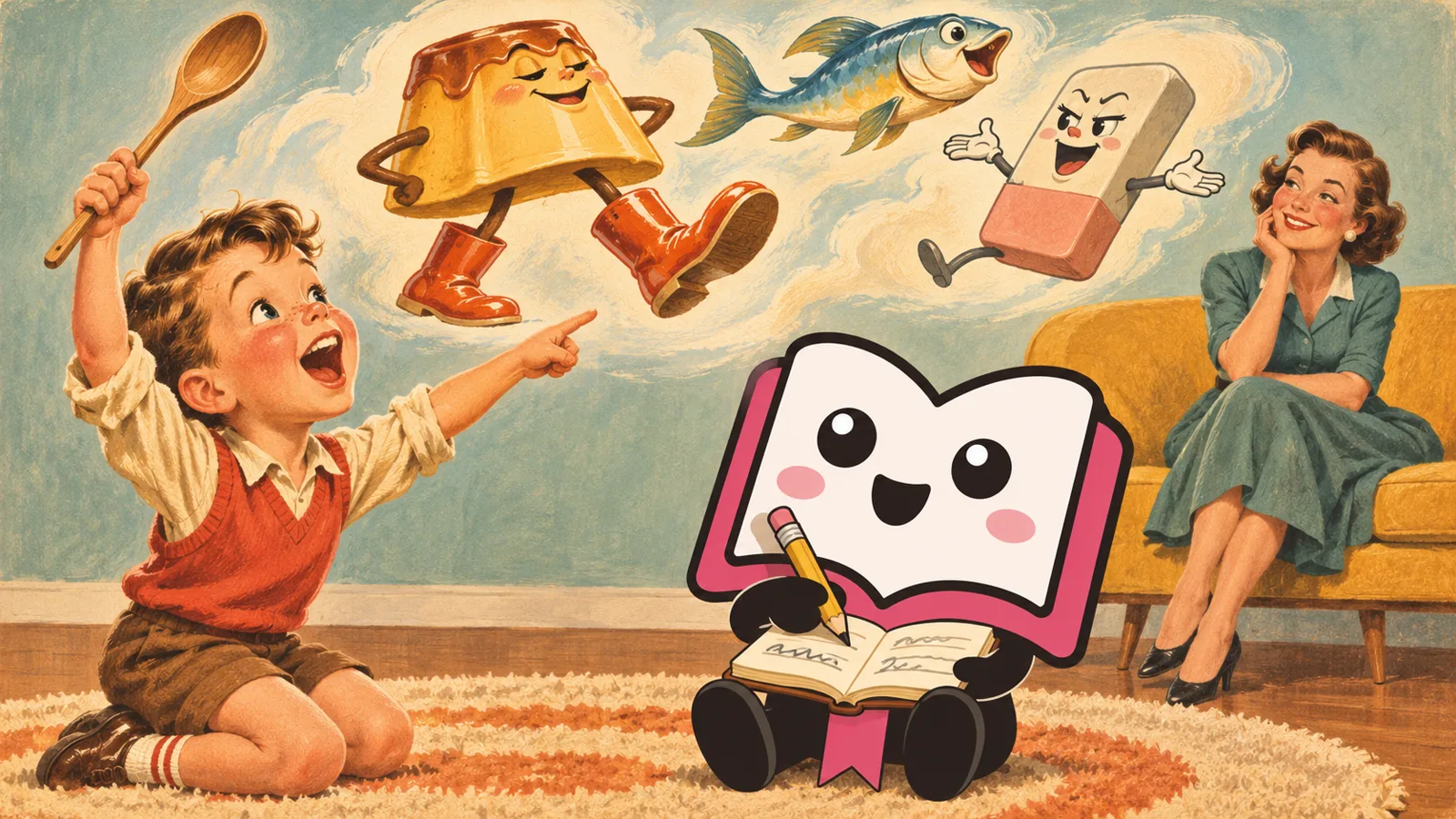
What to avoid, on the other hand, are corrections like "That doesn't make sense" or "That's not how it normally goes." Flying fish and talking erasers are perfectly fine inside a story. When the plot really doesn't connect, ask why, as in "How was it able to fly?", and your child will often connect the pieces on their own.
Story games you can play with just paper and pencil
Turning it into a game lets you keep going in the car or while you wait. Here are four that need almost no equipment.
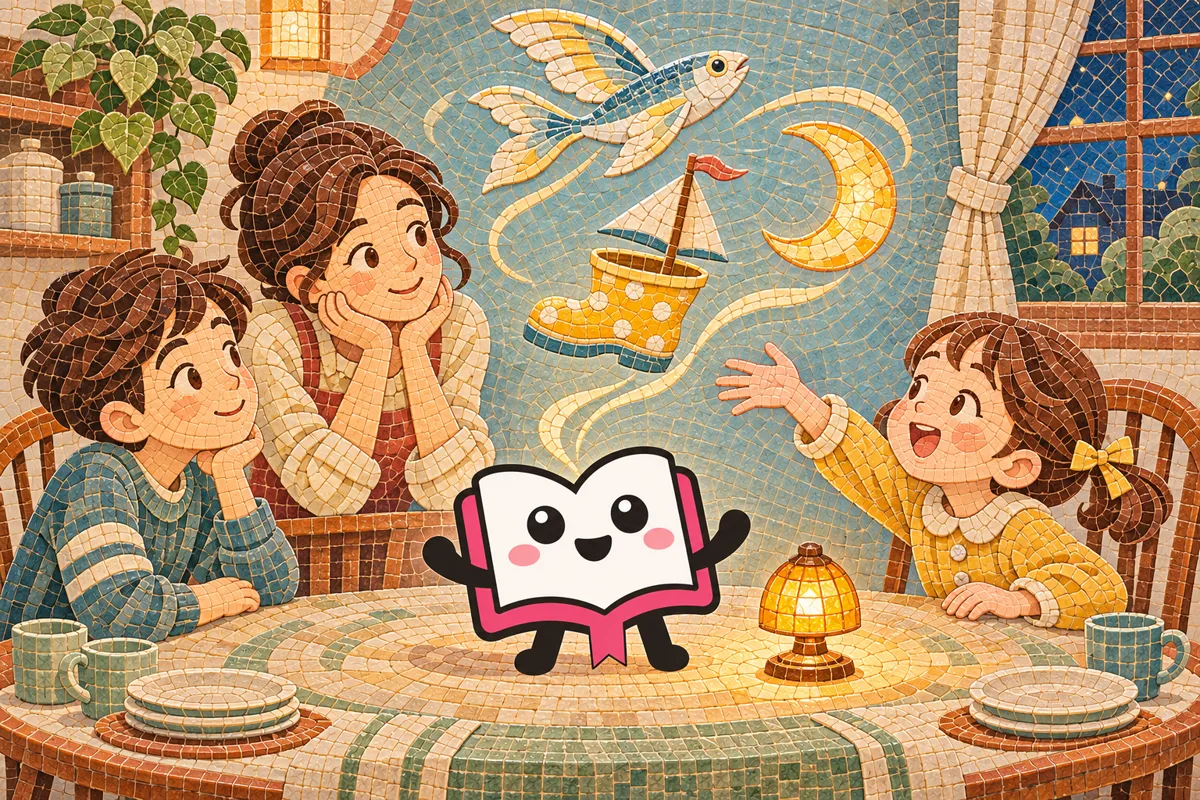
Story relay
Take turns, one sentence each, to keep a story going. The rule is that every sentence must follow on from the one before it. The fun is in the unexpected turns, so try adding a surprising sentence yourself on purpose. After three to five rounds, the last person closes the story with a "The end" sentence.
Three words
Write any words you think of on slips of paper, put them in a bag and draw three. If you get "rain boots," "moon" and "ghost," make up a story that includes all three. The more random the mix, the more fun it is to figure out how to connect them. Kids who can't write yet can draw pictures instead.
Picture stories
Look at a page from a picture book or a family vacation photo and ask, "What do you think this person does next?" With a picture right in front of them, even 3- and 4-year-olds find it easy to talk.
"What if" questions
Start with "What if…", as in "What if a cat were a schoolteacher?" or "What if the rain were juice?" Even if the answer is a single word, following up with "And who was happiest about it?" turns it into a story.
If you use AI, have it make a clean copy and ask questions
Chat-based AI tools like ChatGPT, Claude and Gemini can also help you make up stories with kids. But if you ask one to "write a story for kids," the AI writes the whole thing, and your child only gets to read it. When you're creating together, limit the AI's job to two things: a "clean copy" that makes your child's words easier to read, and a "question" that gives a hint for what comes next. The prompt below (the request you give the AI) is meant for an adult to paste in after writing down the child's words.
I want to finish a story my child told, together with my child. Please follow these rules.

[Child's age] About __ years old (I won't include their name)
[The story my child told]
(Paste your child's words here exactly as they said them)

[What I'd like you to do]
1. Turn it into easy-to-read sentences without changing my child's plot, characters or wording. Don't add new events or characters.
2. Use simple words that a __-year-old can read, and keep each sentence short.
3. At the end, write just one question that will help my child think of what happens next, speaking directly to my child (for example: "Who do they go to visit next?"). Do not write the rest of the story.
Read the AI's question aloud to your child, write down the answer and paste it in again, and the AI becomes your child's partner in a story relay. Your child always makes the decisions, and the AI stays a listener rather than a writer.
When you use AI, follow these three rules.
- An adult handles the AI. Many AI services have age requirements. For example, Anthropic's consumer terms for Claude require users to be 18 or older (or older, if the age of consent where you live is higher) (version effective October 8, 2025). Check the official terms of any other service before using it.
- Don't enter your child's real name, school, where you live or photos of their face. In Japan, the Personal Information Protection Commission has warned general users that personal information entered into generative AI may be used for machine learning and, combined with other information, may be output with accurate or inaccurate content (June 2, 2023). Make the main character your child's favorite thing or a made-up name.
- Read it yourself before showing it to your child. Even when asked "don't add anything," AI sometimes adds events or phrasing. Check that it hasn't changed your child's story before reading it aloud.
If your child wants to make up scary or sad stories
When you make up stories with kids, they sometimes want stories about being eaten by a ghost or about someone disappearing. When we looked back at story requests sent to Original Novel (of 22 requests from November 6–7, 2026, two were set for child readers), one of them was a story for kids that included a premise involving a profound loss. That's too few to call it a trend, but heavy events can show up even in stories for children.
Even then, you don't need to stop the story or take the topic away. Instead, we recommend deciding the ending together. Ask "How would it end so everyone feels safe?" and your child will give even a scary or sad story an ending of their own. On Original Novel, too, stories set for child readers follow a rule: even if a sad ending is chosen, some hope remains at the end, and death is portrayed quietly. For stories at home, drawing one line, "Whatever happens, the story ends with everyone feeling safe," helps both adults and children create calmly.
However, if your child keeps repeating the same scary or sad story, can't sleep after making one, or otherwise doesn't seem like themselves, try asking how they feel outside of story time.
Keep your stories and read them side by side
If you write the date and title on each story and keep them all in one notebook, rereading them later becomes a treat. Ask your child to draw a picture for each page, and it becomes a handmade picture book.
Reading other people's stories together now and then also gives you material for your next story. Ask "What would happen if this story's main character came into our story?" and your next story starts right there. On Original Novel, you can search for stories by reader age and genre.
Stories to read with your child
See more: Stories to read with your child ›Stories for kids written by AI on this site. After reading, ask "What if this character came into our story?" and your next story is already starting.
Sources (date checked)
- Course of Study for Kindergarten (March 2017)Ministry of Education, Culture, Sports, Science and Technology (MEXT), Japan / Japanese / Checked Nov 18, 2026
- Course of Study for Elementary Schools (announced 2017)Ministry of Education, Culture, Sports, Science and Technology (MEXT), Japan / Japanese / Checked Nov 18, 2026
- Consumer Terms of ServiceAnthropic / Checked Nov 18, 2026
- Alert on the use of generative AI services (June 2, 2023)Personal Information Protection Commission, Japan / Japanese / Checked Nov 18, 2026
FAQ
Can a child who can't write yet make up stories?
Yes. Let your child just talk while you do the writing. If your child draws pictures and you add their words next to each drawing, you end up with something like a picture book, even before they can write.
How much should I help with a school story-writing assignment?
A good rule of thumb is to leave the plot and the words to your child and stick to asking questions. Ask things like "What did the main character want?" or "How would you like it to end?" so your child can write the answers themselves. If you rewrite the sentences, it stops being your child's work.
My child keeps making up the same kind of story. Is that okay?
Using a favorite character or storyline again and again is very common. Don't force a change. Ask a question that changes just one thing, like "What if a new friend came into this story?", and the story grows while keeping the same main character.
What if I don't have time to write it all down?
You can record your child's story on a phone and type it up later when you have time. Even then, keep your child's own words instead of polishing them. Listening to the recording together and choosing a title lets you finish the writing step later.
Can we make up stories in another language?
Yes. At home, an easy way is a story relay where each person adds one sentence using only words they know. On Original Novel, you can choose up to 3 of 12 languages for a story's text, so you can create a story around the main character your child picked and read it side by side in English and a language your child is learning (as of November 2026).