Bedtime Stories for Kids: How to Choose Them and Make Up Your Own, Picking the Right Length, Scariness and Ending for Preschool and Elementary-Age Children
The basic rule for bedtime stories for kids: choose one short enough to finish before bedtime, keep the scary parts mild, and close on a scene that feels safe. This article covers how the choice changes for preschoolers and school-age kids, tips for reading aloud at bedtime, and how to make up a story that continues night after night with your child's favorite thing as the hero.
Key takeaways
- The basic rule for bedtime stories: short, only mildly scary, and ending on a scene that feels safe
- Work out the length backward from bedtime, and save scary or heavy stories for daytime
- Pick the story while it is still light out, and tell it with your voice, not a screen, once in bed
- If you make one up: your child's favorite thing as the hero, one event per night, and one seed for tomorrow at the end
Bedtime stories for kids: short, gentle, and ending somewhere safe
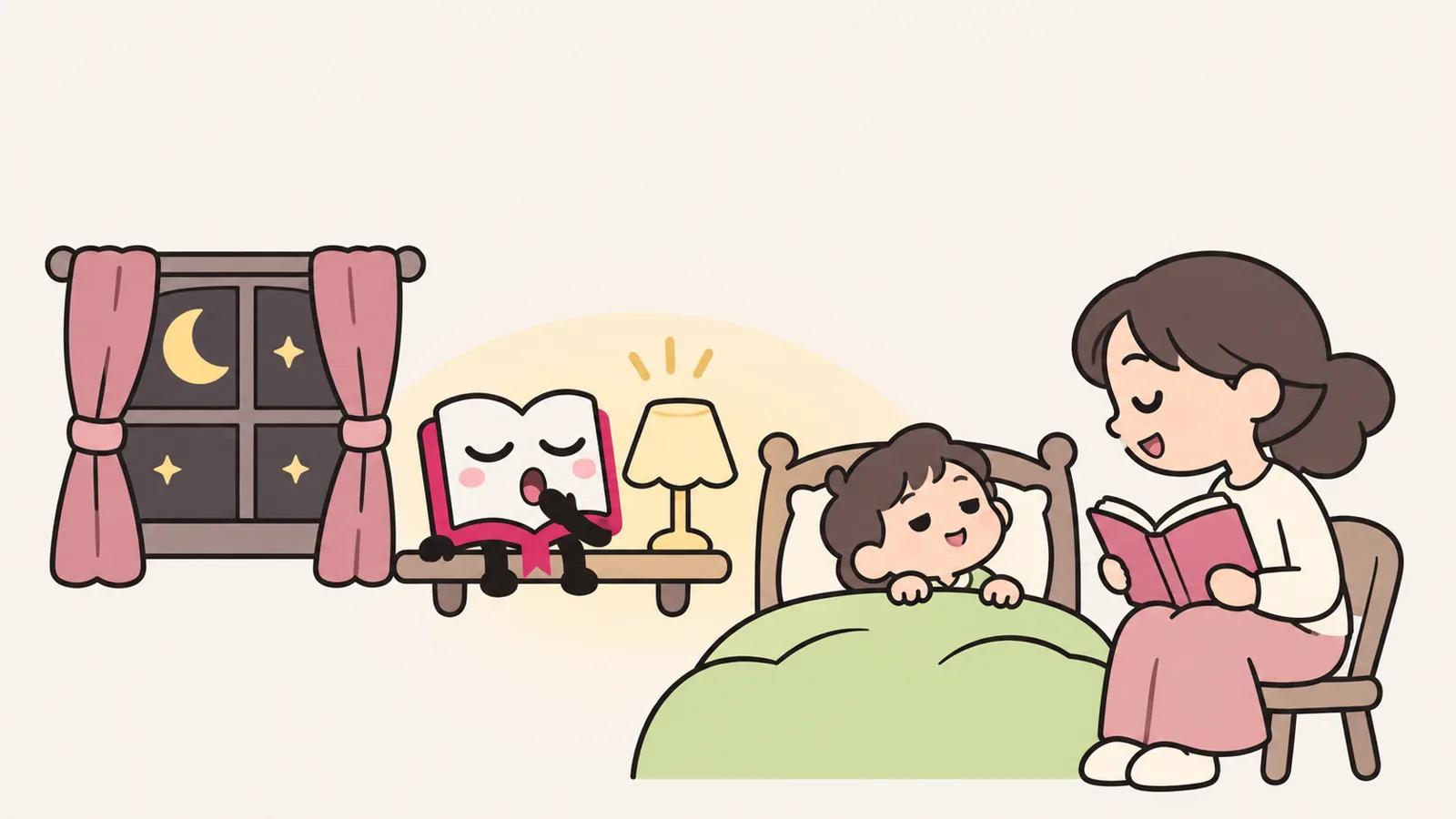
The basic rule when you choose bedtime stories for kids is to pick one that is short enough to finish before bedtime, only mildly scary, and closes on a scene that feels safe. The time before bed is less about getting excited over a story and more about calming down and handing your child over to sleep.
Japan's Ministry of Health, Labour and Welfare publishes a "Good Sleep Guide for Children" (the children's version of its Sleep Guide for Health Promotion 2023). Of its five principles, the third includes "relaxing before bed." This article treats the bedtime story as part of that relaxing time. The same guide also asks families to cut back on TV, games and smartphones before bed and in bed. Whether it is a paper book or a story an adult makes up, the format that suits bedtime is no screens in bed, just your voice.
Three yardsticks for choosing: length, scariness and ending
If you choose bedtime stories by length, scariness and ending, you will not get stuck. The same story can suit a preschooler but not a school-age child, or the other way around. The table below sums up this article's approach as a rough guide. Every child is different, so adjust as you watch how yours reacts.
| Yardstick | Preschoolers (daycare and preschool age) | Lower elementary grades | Upper elementary grades |
|---|---|---|---|
| Length | A short story that ends in one sitting. Repeating the same story is fine | A story that ends in one sitting, or a serial with short chapters | A serial with chapters. Stop at a good break |
| Scariness | No scary characters, or ones who quickly become friends | A little suspense at most. Save stories starring ghosts or the dark for daytime | Can enjoy a moderate mystery or adventure. Save ghost stories that linger for daytime |
| Ending | Close with "back home, and goodnight" | Close once the problem is solved | Even if they want to know what happens next, close tonight's scene on a calm note |
| Stories that work | Animals and vehicles, stories with repetition | Small adventures, stories about friends | Adventure serials, stories with a touch of magic |
Length: work backward from bedtime
Before you think about how long the story should be, decide what time you want your child asleep. The children's version of the guide lists recommended sleep times by age.
| Age | Recommended sleep |
|---|---|
| 1–2 years | 11–14 hours |
| 3–5 years | 10–13 hours |
| Elementary school | 9–12 hours |
| Junior high and high school | 8–10 hours |
For example, an elementary schooler who wakes at 7 a.m. needs to be asleep by 10 p.m., even at the shortest recommendation of 9 hours. The story should be short enough to end a little before that. On nights that have run late, simply recalling yesterday's story in two or three lines is plenty.
Scariness: dial it down a notch at night
Plenty of kids love scary stories, but at bedtime, tell a version that is one notch milder. An article on HealthyChildren.org, the parenting website of the American Academy of Pediatrics (AAP), recommends avoiding scary digital content in the 2 hours before bedtime. That advice is about screen content, but the split of "scary stories in the daytime, calm stories before bed" works just as well for books and made-up stories.
Endings: leave some hope in heavy stories
Sad stories, or stories about losing someone important, are not off-limits. At bedtime, though, choose ones that handle sadness quietly and leave some comfort or hope at the end. Even children's stories sometimes need to show a hard goodbye. One option is to read stories like that together in the bright daytime and swap in one that ends safely at bedtime.
The same thinking works for stories adults read before bed: choose a short story that ends within one episode, and decide beforehand that it is "just one tonight," so you don't stay up wondering what happens next. Which stories work, which to avoid, and where to read some for free are covered in Bedtime Stories for Adults: Choosing Short, Calm Reads.
How to tell a bedtime story: tips for reading aloud
In a September 2024 news release, the AAP introduced its policy statement on reading with children (Literacy Promotion: An Essential Component of Primary Care Pediatric Practice) and called on pediatricians to advise parents to read with their children from birth through at least kindergarten (the grade before first grade in the US). The recommendation is about reading together in general, not only at bedtime. The release says reading together helps lay the groundwork for emotional, cognitive, language and literacy development, and also notes that e-books do not produce the same parent-child interaction as print books. Keeping the following six points in mind when you read aloud at bedtime makes a calm time more likely.
- Pick the story while it is still light out: Hunting for a book or a phone in bed wakes kids up. Settle on "tonight's book" by the end of dinner.
- Keep the room dim: The children's guide recommends keeping living spaces dim at night and sleeping in a dark bedroom. Use only a small reading light.
- Let your voice get slower and softer: Start in your normal voice and read more slowly as you near the end, so your child can feel the story winding down.
- Keep answers to questions short: Questions like "Why did the turtle cry?" are an important part of reading together. But don't let them spin off; wrap up with "Let's think about it again tomorrow."
- Choose an ending signal: Closing with the same words every night, such as "The end. Goodnight," marks the point where it is time to sleep.
- Short is fine on tired nights: You don't need to read for a long time every night. One short story, read with care, is enough.
How to make up a bedtime story, alone or with your child
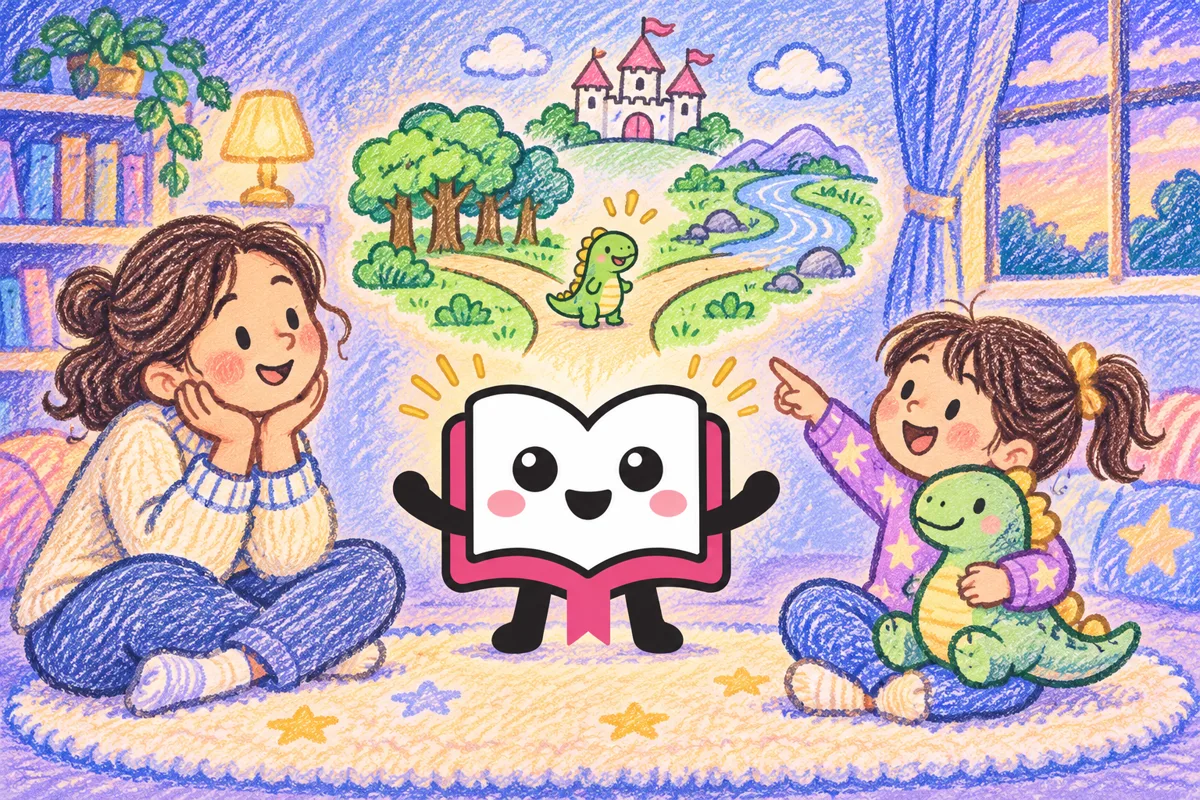
You can tell a bedtime story even without a book at hand. There are three tricks: make the hero your child's favorite thing, let only one thing happen each night, and leave one seed for tomorrow. The story doesn't have to be good. Kids will often lean in just because their favorite thing is the hero.
- 1Make the hero your child's favorite thing
- 2Pick one small problem for tonight
- 3Let your child make just one choice along the way
- 4Solve the problem tonight
- 5Close with a "goodnight" scene where the hero falls asleep
- 6Leave one seed for tomorrow and jot down 3 lines
1–2. Decide on the hero and "tonight's problem"
Make the hero whatever your child loves most right now: a dinosaur, a stuffed animal, a train, a loaf of bread. The problem can be tiny. "The wind blew away its hat" or "It's hungry but can't find the bakery" is plenty. Bedtime has no need for big drama.
3–5. Let your child choose, and solve it tonight
Partway through, ask just once: "The forest path or the river path, which way should we go?" When the story moves forward on your child's answer, kids often start listening to it as their own story. Keeping it to one choice stops the story from running too long. Solve the problem tonight, and at the end the hero gets into bed too and you close with "Goodnight." Ending on the hero falling asleep tends to help the child listening close their eyes in the same mood.
6. Leave a seed for tomorrow and keep going a little each night
At the end, leave just one line, such as "Tomorrow, a letter might arrive from across the river." Then, once your child is asleep, write three lines in a notebook or your phone's notes: "hero," "what happened tonight," and "seed for tomorrow." With those three lines, you can pick the serial back up no matter how many days pass. On days the story is a hit, thinking together about "Who should they meet next?" can become a daytime treat too.
How to make up a bedtime story
- Make the hero a favorite thingDinosaur, teddy, train No real names
- One small problem tonightNo big drama needed Just one per night
- Let your child make one choiceForest or river path? Their answer leads on
- Solve the problem tonightNothing left hanging so they sleep easy
- Close with a goodnight sceneThe hero goes to bed too Keep the room dim
- Leave one seed for tomorrowJot down 3 lines and pick it up anytime
Making bedtime stories with AI: what to watch for
On days when coming up with a story every night is too much, you can ask a chat-style AI such as ChatGPT, Claude or Gemini for a draft. Usage limits and pricing differ by service and can change, so check each service's official information. When you ask, the trick is to decide the scariness and the ending first and include them.
Please write a short bedtime story for me to read aloud to a child.

Listener: about ___ years old (don't use a name)
Hero: ___ (something the child loves, e.g. a hungry little dinosaur)
Setting: ___ (e.g. a bakery at the edge of the forest)
Tonight's small problem: ___ (e.g. the wind blew away the hero's hat)
Scariness: no scary scenes, serious injuries or deaths
Ending: the problem is solved and the hero falls asleep feeling safe
Length: about ___ words (short enough to read aloud)
Language: simple words and short sentences
At the end: one line planting a seed for tomorrow, like "Tomorrow, maybe ___"
When you use AI, these three rules keep things safe.
- Don't enter your child's real name or photos: The same goes for their school or where you live. If the hero is a favorite thing, such as "a teddy bear" or "a little dinosaur," no name is needed. How your input is handled can vary by service and settings, so check the official information.
- Read it yourself before reading it aloud: AI sometimes adds plot turns you didn't ask for. Check first that no scary or sad scenes have slipped in.
- Check the length out loud: Even if you ask for a word count, how long it takes to read aloud varies from person to person. Read it out loud once to make sure it fits before bedtime.
Start by reading: stories for kids
If you're not sure how to make up a story, reading stories for kids together is a good shortcut. Original Novel (original-novel.com) is a story site launched in November 2026 where you can create stories with AI and read them. With any story that isn't finished, you can create a continuation from whichever chapter you like, so your family can choose what happens next, one chapter each night.
Read stories for kids
See more: Read stories for kids ›Stories for kids written by AI on this site, most-read first.
Summary
Choose bedtime stories that are short, only mildly scary, and close on a scene that feels safe. Work out the length backward from bedtime, and save scary or heavy stories for daytime. Pick the story while it is still light out, and in bed, tell it with your voice instead of a screen. If you make one up, make the hero your child's favorite thing, let one thing happen each night, and leave one seed for tomorrow at the end. Start tonight with one short story.
Sources (date checked)
- Good Sleep Guide for Children – Sleep Guide for Health Promotion 2023Ministry of Health, Labour and Welfare (Japan) / Japanese / Checked Nov 18, 2026
- Sleep and Health: Why Rest Matters for Your Child—and Your Whole FamilyHealthyChildren.org (AAP) / Checked Nov 18, 2026
- American Academy of Pediatrics Promotes Shared Reading Starting in Infancy as a Positive Parenting Practice with Lifelong BenefitsAmerican Academy of Pediatrics / Checked Nov 18, 2026
- Good Sleep Guide for Adults – Sleep Guide for Health Promotion 2023Ministry of Health, Labour and Welfare (Japan) / Japanese / Checked Nov 18, 2026
FAQ
At what age should we start reading together at bedtime?
Reading books together can start from birth. In a September 2024 news release, the American Academy of Pediatrics (AAP) called on pediatricians to advise parents to read with their children from birth through at least kindergarten (the grade before first grade in the US). The recommendation is about reading books together in general, not only at bedtime.
How long should a bedtime story be?
Short enough to finish before the time you want your child asleep. The children's version of a sleep guide from Japan's Ministry of Health, Labour and Welfare gives recommended sleep of 10–13 hours for ages 3–5 and 9–12 hours for elementary school children. An elementary schooler who wakes at 7 a.m. needs to be asleep by 10 p.m. even at the shortest 9 hours, so the story should end a little before that.
What should I do if my child begs for a scary story at bedtime?
Tell a version that is one notch less scary, or save the scary story for daytime. An article on the American Academy of Pediatrics' parenting website recommends avoiding scary digital content in the 2 hours before bedtime. That advice is about screen content, but the same split, with calm stories before bed, works for books and made-up stories too.
Is it okay to read an AI-written story to my child at bedtime?
Yes, as long as an adult reads it through first to check that no scary or sad scenes have slipped in. When you ask for one, decide the level of scariness and the ending in advance; that makes it more likely you get a story that suits bedtime. Do not enter your child's real name, photos or school name into the AI. Making the hero your child's favorite thing is the safe choice.