When to start reading to your baby: how to begin from birth, and how to read and choose books month by month
You can start reading to your baby from the day they are born. In the first year, it is less about reading a story to the end and more about looking at pictures together on your lap and talking. This article splits the time from birth to 18 months into four stages and covers how to read to match what your baby can see and do with their hands, how to choose books, and how to keep going on days when your baby doesn't respond.
Key takeaways
- You can start reading to your baby from the day they are born. In the first year, it is time spent looking at pictures and talking together, not reading to the end
- The WHO guidelines (2019) do not recommend screen time for babies under 1 and recommend reading and storytelling with a caregiver when the baby is sedentary
- At 0–3 months, talk from 20–30 cm away; at 3–6 months, answer your baby's sounds; at 6–12 months, give them a sturdy book; after 12 months, ask "Where's the…?" and wait
- Choose books by four things rather than the age label: sturdiness, clear pictures, the sound of the words, and length
- Don't push on days your baby resists. Fitting one short book into the daily routine makes it easier to keep going
When to start reading to baby: from day one. In the first year, "look together" matters more than "read"
Open a picture book for a two-month-old, and their eyes may be on your face rather than the page. It is easy to think "maybe it's too early," but that is perfectly fine. You can start reading to your baby from the day they are born. It helps to think of reading in the first year not as getting through a story to the end, but as time on your lap spent looking at pictures together and talking. That takes the pressure off.
The World Health Organization (WHO) guidelines published in 2019 on physical activity, sedentary behaviour and sleep for children under 5 do not recommend screen time for babies under 1 year, and recommend that when a baby is sedentary, a caregiver reads to them or tells them stories. The same is recommended for children aged 1 to 2. Public programmes that gift books to babies follow the same idea: in England, Wales and Northern Ireland, BookTrust's Bookstart programme gives families a Bookstart Baby pack during the baby's first year.
Still, a newborn and a one-year-old see different things, can do different things with their hands, and relate to books in completely different ways. This article divides the time from birth to 18 months into four stages and walks through what babies are like at each stage, how to read to them and which books suit them. The stages are based on the milestones for vision and "early literacy" on HealthyChildren.org, the parent website of the American Academy of Pediatrics (AAP).
0–3 months: looking at your face rather than the pictures, and listening to your voice
According to the AAP site, newborns see best at about 20–30 cm (8–12 inches) from their eyes, and things farther away are still blurry. In the first few weeks, they begin to see light, shapes and people's faces. At this stage, open the book about 20–30 cm from your baby's face so it sits where they can see it easily. If you hold your baby and lift the book a little, your face and the book end up at about the same distance.
At this age, your voice and your expressions matter more to your baby than the pictures. Reading a book with short text slowly, as if you were talking to them, is enough. You don't have to stick to the words on the page: point to a picture and say "It's round" or "It's red." If it's a sleepy time of day, singing a lullaby is the same kind of "time together."
3–6 months: smiling at voices and reaching out
Around 3 months, babies hold their heads higher than before, swipe at things in front of them and try to bring them to their mouths. They make sounds, copy sounds and smile at their parents' voices. The AAP site says that at this age babies begin to follow with their eyes what is being read, or at least their parent's expressions. By around 4 months, they can also tell differences in colour and shade better than before.
The main change in how you read is the pause. When your baby says "ahh," stop reading, answer "Yes, it's a bear," and carry on. This is the stage when reading turns from a one-way activity, adult to baby, into a back-and-forth of sounds. When your baby starts reaching, bring the book a little closer and let them touch it. That leads into the next stage, when they grab books themselves.
6–12 months: grabbing, chewing and trying to turn pages
Between 6 and 12 months, babies gain head control, can sit up with a straight back, and grab pages. Then they put the book in their mouth. Adults tend to want to take it away, but the AAP site explains that chewing on books to explore them is a sign of interest in books. It also says that at this age babies like pictures with bold colours, pictures of simple objects and photos of faces.
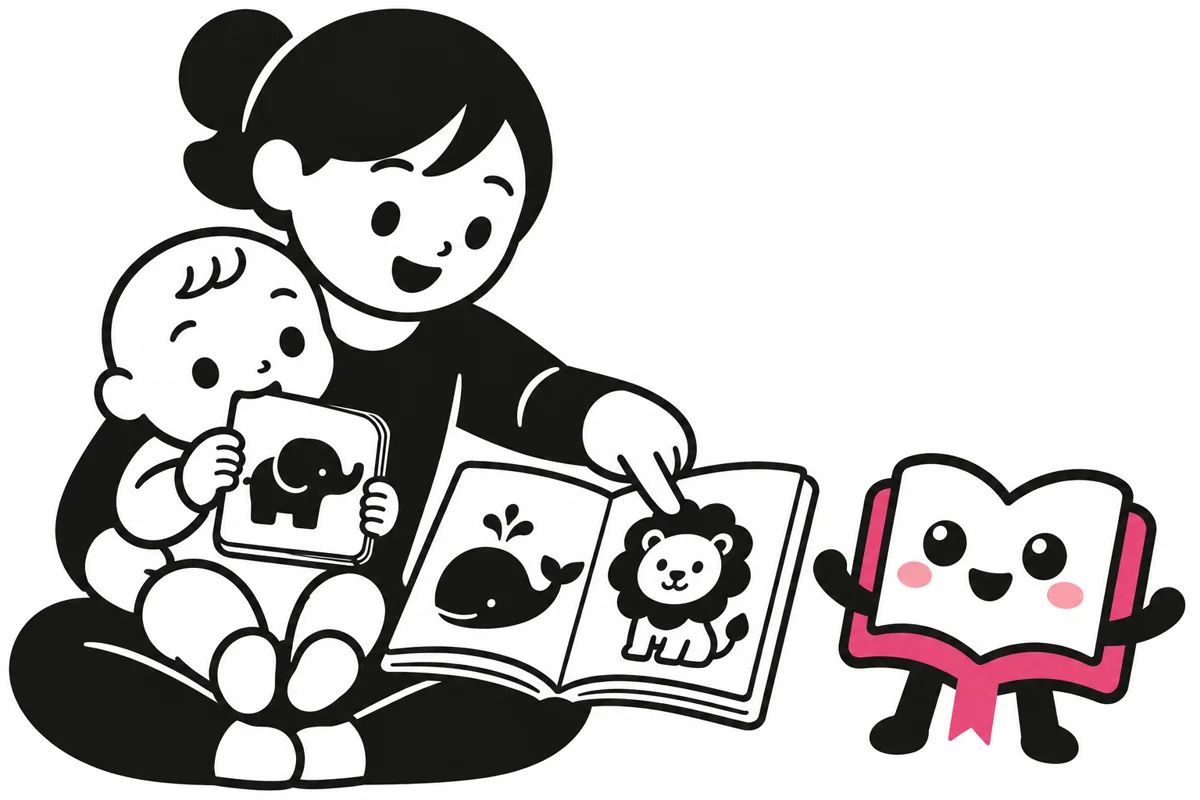
That is why the AAP site recommends board books and bath books that stand up to the chewing and drool of teething. Give your baby one book that is fine to chew, and open a different one to read aloud to your baby. That way there's no tug-of-war. For the book you read, picture books with one large object per page work well.
12–18 months: bringing you books and pointing when you ask "Where's…?"
Between 12 and 18 months, children sit without support, hold a book with both hands and turn several board-book pages at once. This is also when they carry a favourite book over, hand it to you and ask you to read it. According to the AAP site, when you ask "Where's the…?", they can point to a picture with one finger, and they begin to notice when a book is upside down.
At this age, asking questions as you read becomes fun. Ask "Where's the shoe?" and then wait a moment. When your child points, put it into words: "Yes, the shoe. A bouncy, hoppy shoe." If they can't answer yet, pointing it out yourself is enough. The AAP site goes on to say that after 18 months children begin to answer "What's this?" by naming what is in the picture and to say the end of lines in favourite books. For reading aloud after that, when children enjoy the story itself, see "Reading stories aloud to children," organized by age.
Choosing books for babies: check these four things
Some baby books are labelled "from birth" or "from age 1," but age labels are only a guide. At the same age, some babies look quietly and others reach right away. When you pick up a book at a bookstore or library, checking the following four things tells you more about whether it suits your child than the age label does.
- Sturdiness: For the grabbing and chewing stage, board books, cloth books and bath books. Keep books with paper pages for the adult to hold and read.
- Clear pictures: Uncluttered backgrounds and only a few things drawn on each page. The AAP site also lists photos of faces as something babies around 6–12 months like.
- The sound of the words: Books with repeated words and sound words like "pop" or "roll, roll, roll" are fun to say aloud even before your baby understands the meaning.
- Length: Short enough to finish in 1–2 minutes, so you can keep up with your baby's "again!" as many times as they ask.
Days when your baby shuts the book, chews it or doesn't react
Not every day goes well. Some days your baby arches away; other days they just bang on the book. What to do depends on how your baby is acting.
Stop for today. Try again tomorrow
Give them a sturdy book and read a different one
They're listening, so keep going
Repeat it as often as they like
There is research from the United States on whether keeping at it matters. In a study of 2,581 low-income mothers (Raikes et al., 2006, in the journal Child Development), among English-speaking families, reading at 14 months was linked to the child's vocabulary and comprehension at the same age and to vocabulary and cognitive development at 24 months. Among English-speaking families, daily reading at all three points (14, 24 and 36 months) was reported to predict language and cognitive development at 36 months. However, the authors also showed that parents' reading and children's vocabulary influence each other in a relationship that builds like a snowball. Reading aloud alone cannot be called the cause.
Even so, one practical takeaway holds: a short book fitted into the daily routine is easier to keep up than one long session. Tie a book to something that happens every day, such as after the bath or after a diaper change, and it becomes harder to forget.
Getting books: book-gifting programmes, libraries and screen books
Your first book may not have to be bought. Bookstart began in the UK in 1992, when BookTrust ran a pilot with 300 babies. Today, in England, Wales and Northern Ireland, families are gifted a Bookstart Baby pack during the baby's first year, in many areas through the health visiting team. If you don't receive one, you can ask at your local library. Outside the UK, whether a similar programme exists and when books are handed out varies, so check with your local library or child health service.
Libraries are also a great way to build up a collection of baby books. Borrow books and buy only the ones that get "again!" over and over, and your bookshelf will grow to match your baby's tastes. Check your local library's listings to see whether it runs events for babies.
As for picture-book apps on phones and tablets, the WHO guidelines mentioned earlier do not recommend screen time for babies under 1. For 1-year-olds, they do not recommend sedentary screen time either, and for 2-year-olds they say no more than one hour, and less is better. While your child is a baby, paper and cloth books, delivered in your own voice, are the better fit.
After age 1, once they can listen to a story
When children move from pointing at pictures to enjoying following a short story differs from child to child. Original Novel (original-novel.com) is a fiction site where you can create stories with AI and read them. In a count on November 14, 2026, 5 of the 55 published works were stories aimed at children. They are not a replacement for baby picture books, but suit the stage when a parent and a young child read stories together. Across the whole site, more than 80% of the 55 published works can also be read in languages other than Japanese (counted on the same day).
Stories to read together once your child is a toddler
See more: Stories to read together once your child is a toddler ›Stories for children written by AI on this site, including family stories and tales of wonder.
Sources (date checked)
- To grow up healthy, children need to sit less and play moreWorld Health Organization / Checked Nov 18, 2026
- A history of BookstartBookTrust / Checked Nov 18, 2026
- BookstartBookTrust / Checked Nov 18, 2026
- Bookstart schemeWest Northamptonshire Council / Checked Nov 18, 2026
- Infant Vision Development: What Can Babies See?American Academy of Pediatrics (HealthyChildren.org) / Checked Nov 18, 2026
- Developmental Milestones of Early LiteracyAmerican Academy of Pediatrics (HealthyChildren.org) / Checked Nov 18, 2026
- Mother-child bookreading in low-income families: correlates and outcomes during the first three years of lifeChild Development (PubMed) / Checked Nov 18, 2026
FAQ
How many baby books do I need?
A few are enough to start. Babies often want to look at the same book again and again, so reading one favorite over and over is more fun than building a big collection. Borrow from the library and buy the ones that get the most "again!" requests, and nothing goes to waste.
We use two languages at home. Which one should we read to our baby in?
Read in the language you can speak with the most feeling. If each parent has a different language, each can read in their own. Reading the same picture book in a different language on different days is another option.