How to Write a Story for Beginners: 7 Steps to Finish Your First Story, Plus Tips for the 4-Part Kishōtenketsu Structure
When you make a story, decide 5 things first, in this order: the main character, their wish, the problem, the climax and the ending. Then even your very first story is much easier to finish. This guide on how to write a story for beginners splits the work into 7 steps and walks through one example story. You'll learn how to sort your story into the 4 parts of kishōtenketsu (a Japanese way of building a story), how long your first story should be, how to explain it to kids, and how to fix common stumbling points.
Key takeaways
- A story takes shape once you decide 5 things: the main character, their wish, the problem, the climax and the ending
- Decide them in this order: main character → wish → problem → climax → ending. Decide the ending before you start writing
- Sort them into the 4 kishōtenketsu boxes. For your first story, aim for about 1,000–2,000 words with just one twist
- When you reread, check that the wish is specific and that the main character makes their own choice at the climax
How to write a story: you only need to decide 5 things
When you make a story for the first time, you only need to decide 5 things: the main character, their wish, the problem, the climax and the ending. Once you have these 5, you have one complete story, no matter how long it is or how good your writing is.
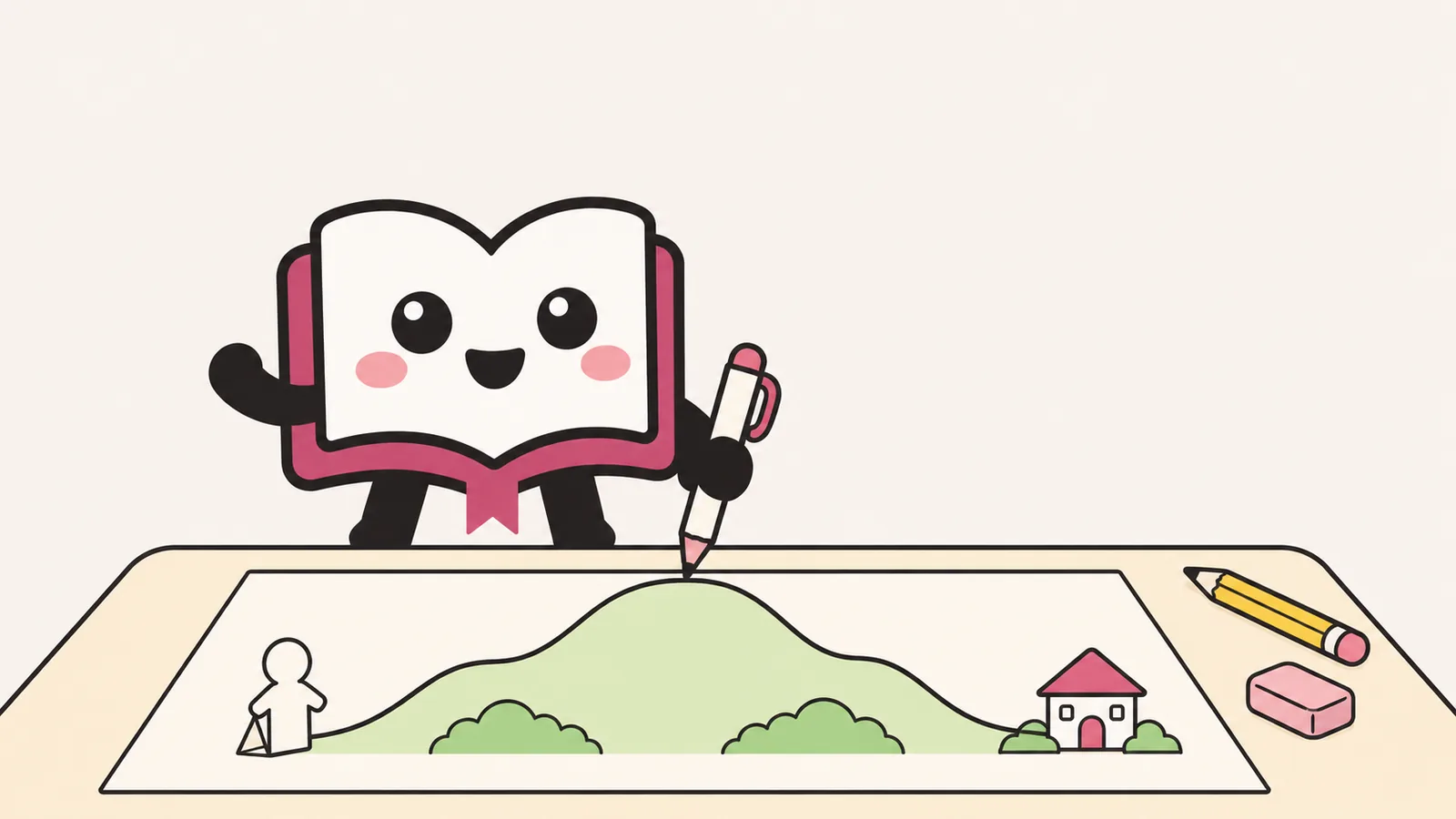
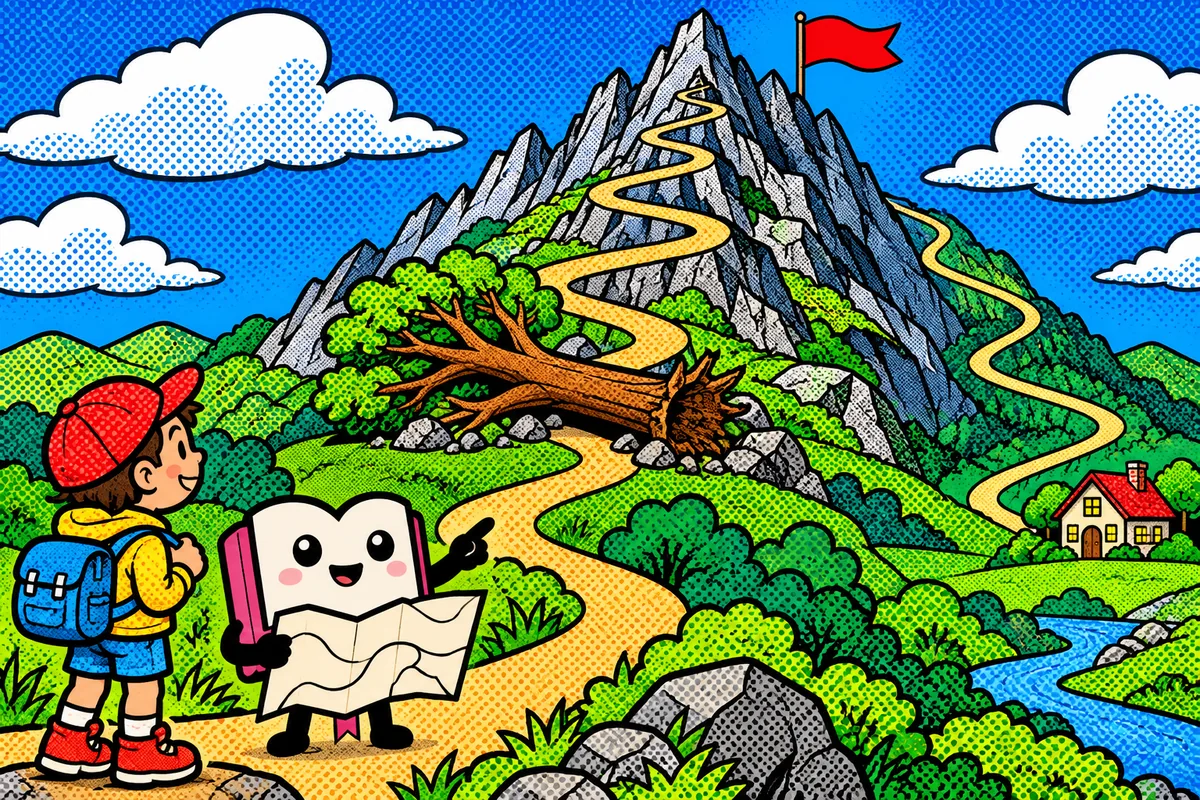
Think of it like climbing a mountain. The main character is the climber. The wish is the place they want to reach on the other side of the mountain. The problem is the fallen tree or steep slope blocking the path. The climax is the steepest part, at the top. The ending is the place they reach after coming down the other side.
| Part | What to ask yourself | Example (the story used in this article) |
|---|---|---|
| Main character | Whose story is it? | Yui, a first-year junior high school student. She loves the piano, but her hands shake when people are watching |
| Wish | What do they want to do by the end? | To play the piano part for the school choir contest all the way through without mistakes |
| Problem | What gets in the way? | In practice, she always makes a mistake at the same spot |
| Climax | When things are at their worst, what does the main character do? | On the day, she makes the mistake again. She has to choose: stop, or keep playing |
| Ending | How does it end? How are they different from the start? | It wasn't perfect, but she became someone who doesn't stop, even after a mistake |
These 5 are easier to decide in order, from top to bottom. You can't decide the wish without a main character, and you can't decide the problem without a wish.
How to write a story step by step: 7 steps to finish your first one
The steps come in 3 stages: “decide,” “write” and “review.” Steps 1–5 fit on a single sheet of notes. If you make these notes first, you're less likely to get stuck partway through.
- 1Pick one main character
- 2Decide the main character's wish
- 3Decide the problem that blocks the wish
- 4Decide the climax
- 5Decide the ending first
- 6Sort it into the 4 kishōtenketsu boxes and write
- 7Read it again and fix one spot at a time
1. Pick one main character
Decide a name, an age and one trait. For the trait, pick a weakness that's linked to the wish instead of a personality word like “kind.” That gets the story moving. Yui's “her hands shake when people are watching” leads straight into the problem.
2. Decide the main character's wish
The wish is something the main character wants to get or to achieve by the end of the story. A fuzzy wish like “I want to be happy” is hard for readers to cheer for. Make it show by when and what, like “I want to play the piano part without mistakes at the performance on Friday.”
3. Decide the problem that blocks the wish
The problem is the reason the wish can't come true right away. Some problems come from outside (a rival, running out of time) and some come from inside (feeling scared). Having both gives the story depth. Don't solve the problem in one go. Let the character fail once or twice, and the climax will be more exciting.
4. Decide the climax
The climax is the scene where the problem is at its biggest. What matters most here is that the main character chooses something on their own. If the problem is solved only by luck or by someone else's help, readers will feel something is missing when they finish.
5. Decide the ending first
Decide the ending before you start writing. When you know where you're going, you can write the scenes along the way so they lead there. If you can't decide, pick one of 3: the wish “comes true,” “doesn't come true” or “comes true in a different way.”
on the day without mistakes
She plays without a single mistake and finishes to applause
She stops partway through and decides: next year for sure
She makes a mistake but doesn't stop, and the singers' voices carry her to the end
Any of them is fine, but if the main character has changed a little since the beginning, the story will feel satisfying to read.
6. Sort it into the 4 kishōtenketsu boxes and write
Sort your notes from steps 1–5 into 4 boxes, ki, shō, ten and ketsu, and then write (the next section shows how to sort them). For your first draft, the most important thing is to write all the way to the end.
7. Read it again and fix one spot at a time
Wait a little while, then read it out loud and fix one spot at a time. What to check is listed in the table under Common stumbling points and how to fix them.
How to use kishōtenketsu: sort your story into 4 boxes
Kishōtenketsu is a Japanese term for a 4-part structure: ki, shō, ten and ketsu. It first described how classical Chinese poems were built, especially four-line poems (called jueju), and it is also used to describe how things in general are put together (according to Japanese dictionaries such as Digital Daijisen and Seisenban Nihon Kokugo Daijiten, checked on November 11, 2026). In a story, you put the 5 parts into these 4 boxes.
| Box | Its job | Parts that go in | Rough length | Yui's story |
|---|---|---|---|---|
| Ki (start) | Show whose story it is and what it's about | Main character, wish | About 20% | She's chosen to play the piano for the choir and wants to play without mistakes |
| Shō (build) | Move the story forward with the problem | Problem (1st and 2nd failure) | About 40% | She keeps making mistakes at the same spot in practice, and the big day gets closer |
| Ten (turn) | The biggest change happens | Climax | About 30% | She makes a mistake on the day. She decides to keep playing without stopping |
| Ketsu (end) | Show how it turned out and how the character changed | Ending | About 10% | The singers' voices join in, and she plays to the end. Only when it's over does she notice her hands are shaking |
These length percentages are this article's suggested guide. A common mistake for beginners is making the ki part too long. When the explaining goes on and on, readers are left waiting. Show the wish within the first 20% of the story.
One more tip: make ten the scene where the problems that piled up in shō get as big as they can. Yui kept making mistakes at that spot in shō, and on the day she makes a mistake there again. That way, ten doesn't come out of nowhere. Ketsu can be short.
Kishōtenketsu isn't a rule you must follow. It's a guide to help you plan how your story fits together.
How long should your first story be? About 1,000–2,000 words
For the first story you finish, we recommend about 1,000–2,000 words (in Japan, story length is often counted in sheets of 400-character manuscript paper, and this is about 5–10 sheets). If it's too short, there's no room for the character to fail at the problem. If it's too long, you're more likely to get stuck before you finish.
| Length (Japanese manuscript sheets) | Number of scenes | Main characters | What you can fit in |
|---|---|---|---|
| About 500 words (2–3 sheets) | 1–2 scenes | 1–2 | One little twist at the end |
| About 1,000 words (5 sheets) | About 3 scenes | 2 | One failure and one climax |
| About 2,000 words (10 sheets) | 4–5 scenes | 2–3 | Two failures and one climax |
The numbers in the table are this article's guide. In Japan, manuscript paper (genkō yōshi, paper with a grid of squares, one character per square) is usually counted at 400 characters per sheet (20 characters × 20 lines). If you're entering a contest, check the word count or page count in the contest rules.
For a longer piece of up to 5,000 words, including how to set a word limit and spread the words across scenes, see How to Write a Short Story Under 5,000 Words.
How to explain it to elementary and middle school kids
Words like “main character” and “climax” may be new to elementary school kids. When you explain it to children, turn the 5 parts into questions.
| Grown-up word | How to ask an elementary school kid |
|---|---|
| Main character | Who is the story about? |
| Wish | What does that character want to do? |
| Problem | What gets in the way? |
| Climax | What's the most exciting part? |
| Ending | How does it end? What's different from the beginning? |
Middle school students will understand the grown-up words as they are. Going one step deeper with questions like “What's that character's weakness?” or “If they fail once or twice, how does it happen?” makes the story richer. For elementary school kids, say kishōtenketsu as “the beginning, what happens, the big trouble, the end.” Draw 4 boxes in a notebook and jot 1–2 lines of notes in each box before writing. Then even kids who find writing hard can make it to the end more easily.
When an adult helps, the trick is to only ask questions and not give the answers. When someone asks “And then what happens?”, children move the story forward in their own words.
Common stumbling points and how to fix them
When you read your story again, go through this table from top to bottom.
| Stumbling point | What happens | How to fix it |
|---|---|---|
| The wish is fuzzy | Readers don't know what to cheer for | Rewrite the wish so it shows “by when and what” |
| The main character's wish gets mixed up with the writer's wish | It's unclear what the main character is aiming for | Write down what the main character aims for inside the story separately from the ending the writer wants to show |
| The problem is solved right away | The climax isn't exciting | Let the character fail once or twice before the climax |
| The problem is solved by luck or by someone else | The story feels unsatisfying at the end | At the climax, add a scene where the main character chooses something on their own |
| No ending is decided, so you get stuck partway | You lose track of where the story is going | Before writing, choose “comes true,” “doesn't come true” or “comes true in a different way” |
| The story is short but packed with plot twists (where the story suddenly flips at the end) or several mysteries | None of them goes very deep | Stick to one twist. If you want more, make the story longer |
The second one, getting the wishes “mixed up,” is a stumbling point that's easy to miss. For a love story, write them separately, as in the figure below.
The main character's wish (inside the story)
- What the main character aims for on their own
- Example: I want to hear their answer before graduation
- The problem and the climax come from this
The writer's wish (outside the story)
- How you want things to look when readers finish
- Example: I want the two of them to end up together
- This goes into the ending in step 5
ChatGPT prompts for story writing: ask AI to help you plan
With AI such as ChatGPT, Claude or Gemini, you'll get more practice making stories yourself if you use it as a partner to talk through how your story fits together, rather than having it write the story for you. Here are 2 example prompts (a prompt is the request you type to the AI) that you can use as they are, once you fill in the ___ part. AI services have age rules, so if a child will use one, read the note at the end of this section first.
You are a story-writing teacher. Please help me make my first short story (about 1,000 words) by asking me questions. Do not write the story itself.

Ask me the following 5 questions one at a time, in order. After I answer each one, point out just one part that is still vague, then move on to the next question.
1. Who is the main character? (name, age and one weakness)
2. What is the main character's wish? (What do they want to do by the end of the story?)
3. What is the problem? (What gets in the way of the wish?)
4. What is the climax? (When things are at their worst, what does the main character choose to do on their own?)
5. What is the ending? (Does the wish come true / not come true / come true in a different way?)

When all 5 are ready, put them in a table sorted into 4 boxes: ki (start), shō (build), ten (turn) and ketsu (end).
The theme of the story I want to write: ___
The story below is a draft I wrote. Don't give me any rewritten sentences. Just answer these 4 questions.
1. Which paragraphs does each part, ki (start), shō (build), ten (turn) and ketsu (end), run from and to?
2. Can readers tell what the main character's wish is within the first 20% of the story?
3. At the climax, was the problem solved by the main character's own choice, or by luck?
4. What is the one spot that most needs fixing? (Where is it, and why?)

[Draft]
___ (paste it here)
In both prompts, the key is to say right at the start that the AI should not write the story. Even when you only ask for advice, AI sometimes sends back a draft of the story too, and if you use it as it is, it's no longer your own story. You're the one who decides.
When children use AI, be careful about age rules. The rules are different for each service. For example, Anthropic's Claude says in its terms of use for general users that you must be 18 or older (checked on November 11, 2026). You cannot use a service if you are younger than its required age, even together with a parent. Before using any service, a parent should check its latest terms, choose a service that is OK to use, and use it together with the child.
Read a short story first and find how it's built
Before you write, another good way to practice is to read one short story and look for its main character, wish, problem, climax and ending. Original Novel (original-novel.com) is a story site launched in November 2026 where you can create and read stories with AI (as of November 2026, you can read without signing up).
Read stories for kids and look for how they're built
See more: Read stories for kids and look for how they're built ›Stories for kids written by AI on this site. As you read, try to find where the main character's wish and the climax are.
Summary
The basic way to write a short story for beginners is to decide 5 things first, in this order: the main character, their wish, the problem, the climax and the ending. Then sort them into the 4 kishōtenketsu boxes and write one story of about 1,000–2,000 words to start. Aim to finish it, rather than to write it perfectly.
Sources (date checked)
- Kishōtenketsu: meaning and usageKotobank (Shogakukan Digital Daijisen and other reference works) / Japanese / Checked Nov 18, 2026
- Genkō yōshi (manuscript paper): meaning and usageKotobank (Shogakukan Digital Daijisen and other reference works) / Japanese / Checked Nov 18, 2026
- Consumer Terms of ServiceAnthropic / Checked Nov 18, 2026
FAQ
What should I decide first when I make a story?
Start with the main character and their wish (what they want to do by the end of the story). Once the wish is set, it's easier to decide, in order, the problem that gets in the way, the climax where things are at their worst, and the ending. If you decide the ending before you start writing, you're less likely to get stuck partway.
Do I have to follow kishōtenketsu?
No. It isn't a rule you must follow; it's a guide for planning how your story fits together. Kishōtenketsu is a Japanese term that originally described how classical Chinese poems (four-line poems called jueju) were built, and it's also used to describe how things in general are put together. In your first short story, the story comes together more easily if you show the main character and the wish in ki, the problem in shō, the climax in ten and the ending in ketsu.
How long should my first story be?
This article recommends about 1,000–2,000 words (in Japan, that's about 5–10 sheets of 400-character manuscript paper). That's just the right length to let the character fail once or twice at the problem and include one climax. If you're entering a contest, check the word count or page count in the contest rules.
How can I teach elementary school kids how to make a story?
It's easier to get across if you turn it into 5 questions: “Who is the story about?”, “What do they want to do?”, “What gets in the way?”, “What's the most exciting part?” and “How does it end?” Say kishōtenketsu as “the beginning, what happens, the big trouble, the end.” The trick is for adults to only ask questions and not give the answers.
What should I do if I can't think of an ending?
Choose one of 3: the main character's wish “comes true,” “doesn't come true” or “comes true in a different way.” Whichever you choose, if the main character has changed a little since the beginning, the story will feel satisfying to read. Decide the ending first, then rebuild the climax so it leads there, and the writing will go more smoothly.