Romance Story Ideas: How to Grow an Idea Generator Prompt into a Love Story with 5 Parts
If a romance story idea generator gave you a prompt but you can't start writing, sort the prompt into the "parts" of a love story and fill in the empty ones yourself. That turns it into one solid romance story idea. This article covers the 5 parts that shape a romance idea, an example that grows a "last bus" prompt into an idea for 5 chapters, and a prompt that has AI check just 2 spots in the parts you filled in.
Key takeaways
- A generator prompt is raw material. To make it a love story, fill in the empty "romance parts" yourself
- The 5 parts: how the two differ, why they're drawn to each other, what keeps them apart (an outer wall and an inner wall), events that move the distance, and the direction of the ending
- "Why they're drawn to each other" and "what keeps them apart" are empty in almost every prompt, so decide them yourself instead of leaving them to chance
- Put events that push them apart between the ones that bring them closer, decide only the direction of the ending, and use the prompt once more at the very end
You drew a romance prompt but can't start? The story is missing some "parts"
If a romance story idea generator gave you a prompt but you can't start writing, sort the prompt into the "parts" of a love story and fill in the empty ones yourself. That turns it into one solid romance story idea. What an idea generator gives you is raw material: a combination of words, or a one-line scene. To make it move as a love story, you also need parts like "why are these two drawn to each other?" and "why can't they get close right away?"
Say you drew three words: "rain," "library" and "spare key." There's a mood, yet your hands stop. That's because you haven't decided yet who the story is about, or why a spare key becomes a problem between the two of them. The prompt's job is to supply the material up to this point. The writer adds the remaining parts.
How to come up with ideas in general (4 methods and prompt tables by genre) is covered in "How to find story ideas when you want to write but have none." This article focuses on romance and looks closely at how to grow a prompt into a love story.
The 5 parts that shape romance story ideas
A love story is a story about the distance between two people changing. These are the 5 parts that decide that distance.
① How the two differ
What's different about the two of them? Their status, their way of life, the time they have (someone about to leave town, and someone who will always stay), and so on. Two people with no difference won't get a story moving even if they meet. Because they differ, each sees the other as something new, and misunderstandings arise.
② Why they're drawn to each other
What is it about the love interest that draws the protagonist in? Don't stop at words that fit anyone, like "kind" or "cool." Go as far as something only this person has. When this part is left as generic words, the story easily ends up like every other romance.
③ What keeps them apart
Readers keep turning pages while the two still can't get close. Think of what keeps them apart as two kinds of walls: an outer wall built by circumstances (a job transfer, a family that disapproves, status) and an inner wall inside the person (a wound from a past love, a secret they can't tell, pride). With only an outer wall, the story ends the moment the wall comes down. With only an inner wall, the two can meet any time, so the tension is hard to build. Put in one outer and one inner wall, and the story lasts longer.
④ Events that move the distance
These are events that bring the two closer and events that push them apart. A story where they only get closer becomes predictable partway through. Put an event that pushes them apart in between, and readers start waiting for the next moment they get closer.
⑤ The direction of the ending
Do they end up together, do they part, or does it end open, without settling either way? Don't plan the detailed plot yet; decide only the direction first. Once the direction is set, you have a standard for choosing the events in between.
Sort the generator's prompt into the 5 parts
Depending on how an idea generator presents its prompt, different parts are already filled in from the start. Here is how prompts from three common formats sort out.
| Prompt format (example) | Parts already filled | Empty parts | Best part to add first |
|---|---|---|---|
| Three words "rain," "library," "spare key" | None (only a place and props) | All of ① to ⑤ | ① How the two differ (who has the spare key?) |
| A one-line scene "Two people who always sit in the same seats on the last bus" | The two people and where they meet (a seed for ④) | ① ② ③ ⑤ | ③ What keeps them apart |
| A pair of characters "A quiet florist" × "a detective who buys flowers every week" | ① How the two differ | ② ③ ④ ⑤ | ② Why they're drawn (who does the detective buy flowers for?) |
Whatever the format, the parts most often left empty are ② why they're drawn to each other and ③ what keeps them apart. These two decide how this love differs from every other love, so the story gets a stronger core if the writer decides them instead of leaving them to chance. In other words, you can leave the two people, the scene and the props to the idea generator; everything after that is the writer's job.
Example: growing a "last bus" prompt into a romance story idea
Let's grow the second prompt in Table 1, "Two people who always sit in the same seats on the last bus," into a romance story idea. There are 6 steps.
- Draw a prompt and mark the parts it already fills
- Decide how the two differ
- Decide what keeps them apart: one outer wall and one inner wall
- Decide why they're drawn to each other, using something only that person has
- Put events that push them apart between the events that bring them closer
- Decide the direction of the ending and which part of the prompt to use once more at the end
Step 1: All this prompt fills in is that there are two people and a place where they meet every night. Who they are, and why they don't speak to each other, are still empty.
Step 2: The protagonist is a 30-year-old office worker who is being transferred to Tokyo in spring. The other person is older, grew up in this town, and studies for a professional qualification at night school. The difference between them: "someone leaving town, and someone staying."
Step 3: The outer wall is a deadline: three months until the transfer. The inner wall is a rule the protagonist made after losing a past love to long distance: "Don't get close to someone I'll have to leave someday." Deciding the walls first lets you measure, in the next step, whether the reason is strong enough to make the protagonist want to get over them.
Step 4: Every night on the bus, the other person writes the same words in pencil over and over. In that unhurried repetition, the protagonist sees what they have let go of in days spent always rushing. Instead of stopping at "a serious person," go as far as what it means to the protagonist, and it becomes a reason only these two share.
Step 5: List the events that bring them closer, put events that push them apart in between, and spread them over 5 chapters (Figure 3 in the next section). The biggest step closer is the night a heavy snowfall stops the bus and they talk until morning in the waiting room at the last stop.
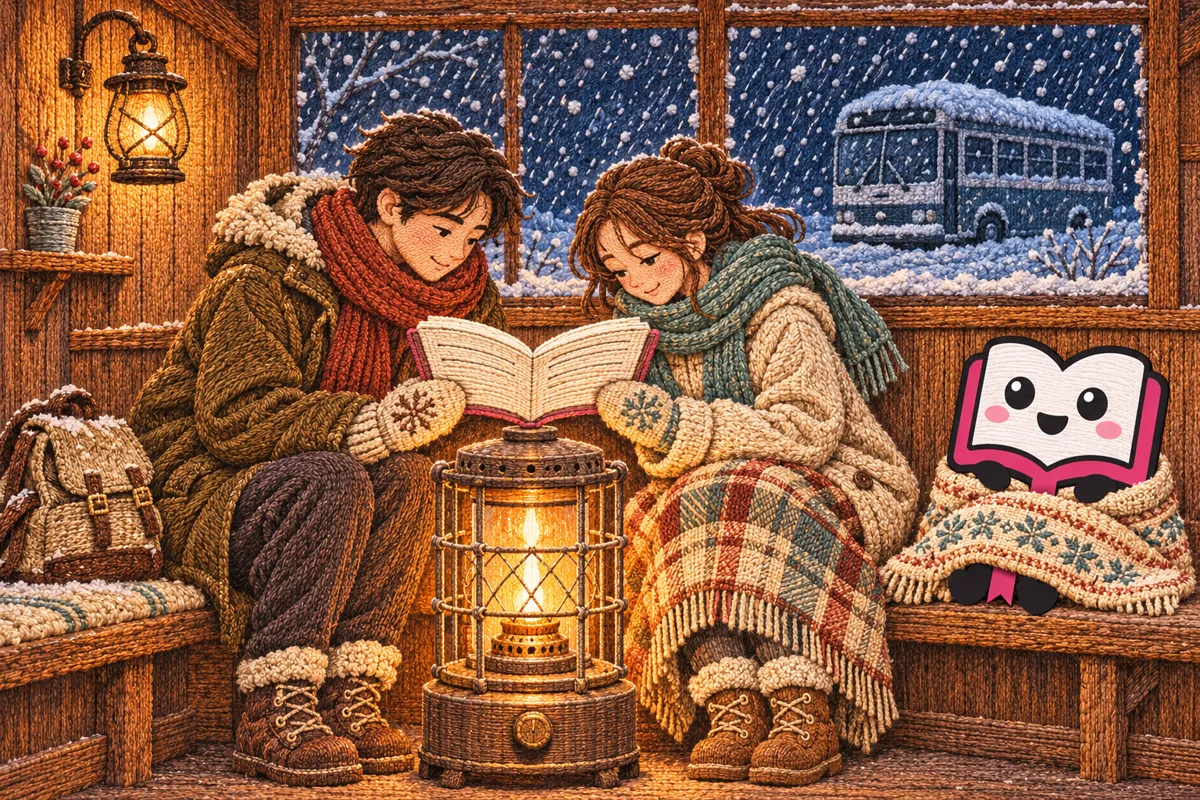
Step 6: The ending is "left open." On the morning of the transfer, the protagonist takes not the last bus but the first bus, and finds one of the other person's notebooks left on their usual seat. The prompt's "same seat" is used once more at the very end.
Put into one sentence, it becomes: "An office worker leaving town in spring is drawn to the older student who sits beside them on the last bus every night, and is torn between a deadline and a rule they made for themselves." A one-line prompt has become an idea that can carry a 5-chapter love story.
Put events that push them apart between the ones that bring them closer
Drawn as the change in how close the two are, the events from Step 5 look like this.
The key is that chapter 4, right after they get closest in chapter 3, holds an event that pushes them apart. Precisely because they opened up on the snowy night, the protagonist can't bring up the transfer. An event that pushes them apart doesn't have to be something big like a fight. In love stories, things left unsaid, a missed connection, or a side of the other person you didn't know tend to open distance more naturally. If chapter 5 ends without closing the gap completely, the "left open" ending keeps some room to breathe.
Another thing to watch is the length of time the story covers. Among the requests sent to Original Novel on November 6–7, 2026, one asked to tell, in 5 chapters, everything from the start of a love to growing old and dying. Covering decades in 5 chapters rushes every step closer and every step apart. Either cut the period short, like "the three months until the transfer," or, if you want a long span, decide clearly which chapters will make big jumps in time. Then you can write the changes in distance with care.
Choose the love interest by "why they're drawn," not by "type"
The love interest is an easy part to decide if you pick from types. On Original Novel's creation form, we counted the love-interest field in new-story requests over the same two days: "a dependable older person" and "someone cheerful who brightens the mood" came up 3 times each, "a gentle gentleman or lady" twice, and "a mysterious person," "starts as a rival" and "an eccentric genius" once each. The numbers are small, so treat them as a rough guide, but the chosen types do lean in certain directions.
Even with the same type, a different reason for being drawn makes a different story. Take the same "dependable older person": depending on what draws the protagonist in, it can split like this, for example.
- On a day the protagonist failed, they don't ask why; they only say what to do next
- They're dependable, yet they turn their own failures, and only those, into funny stories
- They can do anything, but there's one thing they can only ask the protagonist to do
The first is a love of feeling safe, the second a love that lets you relax, and the third a love where the two become equals. Choose the type as a way in, and let ② why they're drawn to each other decide the story's personality. Then your story is less likely to resemble those of other people who drew the same prompt from the idea generator.
Decide only the direction of the ending, and use the prompt once more at the end
In Japanese rakugo (traditional comic storytelling), sandaibanashi ("three-topic story") is a form in which the storyteller takes three topics from the audience and turns them into one story on the spot. It is said to have been started in 1804 by Sanshotei Karaku I. Heibonsha's World Encyclopedia (in Japanese) says that one of the three topics is supposed to be used in the punchline. Using the prompt's "same seat" once more in Step 6 borrows this idea. When the prompt shows up at both the beginning and the end, a prompt drawn by chance starts to look like an ending that was planned from the start.
On the other hand, deciding the ending too firmly is a problem. In the requests sent to Original Novel, 5 requests used the field "what the protagonist wants most" not for the protagonist's goal but for a wish about the whole story (such as "I want the two to end up together"). When the ending's plot is fixed in detail first, the events along the way become explanations leading to it, and there's no room left for scenes that push the two apart. Deciding the direction is enough. What to place along the way differs by direction, as follows.
| Direction of the ending | Feeling left with the reader | What to place along the way |
|---|---|---|
| Together | Relief, fulfillment | Something the protagonist gives up to get over the wall |
| Apart | Bittersweet, yet able to look ahead | Something that remains between the two even after they part (words, a habit, an object) |
| Left open | A lingering feeling, wanting to imagine what comes next | A clue that lets readers imagine what comes next (the notebook in the "last bus" example) |
Have AI check just 2 spots in the parts you filled in
Once you've filled in the parts yourself, one way to use an AI such as ChatGPT, Claude or Gemini is to show it your idea and have it check only the 2 spots that tend to be weak: whether ② why they're drawn to each other is still in words that fit anyone, and whether ③ what keeps them apart has one outer wall and one inner wall. You do the fixing. If you let the AI rewrite, the parts you decided yourself tend to slide back into words you've read somewhere before. Things to watch out for when you have AI produce whole ideas are covered in "How to find story ideas when you want to write but have none."
I came up with a romance story idea myself. Please read the 5 parts below and check only 2 things.

[Prompt] ___ (what I got from the idea generator)
① How the two differ: ___
② Why they're drawn to each other: ___
③ What keeps them apart: outer wall = ___ / inner wall = ___
④ Events that move the distance: ___
⑤ Direction of the ending: one of together / apart / left open

What to check:
1. Is ② still in words that fit anyone, like "kind" or "cool"? If so, point out which words
2. Does ③ have one outer wall and one inner wall? If something is missing, just tell me which one

Rules:
- Don't give me rewritten versions or new story elements. I'll do the fixing
- No praise or comments on the other parts. Just the 2 points, briefly
Skim other love stories for the "inner wall"
If the check shows your ③ inner wall is weak, try skimming other love stories just for what the protagonist is carrying inside. Outer walls show up even in a synopsis, but inner walls appear only in dialogue and gestures, so this is good practice for spotting them. Below are love stories written by AI on Original Novel.
Read some love stories
See more: Read some love stories ›Love stories written by AI on this site, starting with the most read.
 The Only Voice I Can't HearFor teens · Showbiz & idolsCompletedMay We Begin With a Lie?For adults · Romance
 CompletedI Want to Count Your Gray HairsFor adults · RomanceCalls at First LightFor adults · RomanceThe Villa's Blind SpotFor adults · Romance
Sources (date checked)
- Sandaibanashi (three-topic story): meaning and usageKotobank (Shogakukan Digital Daijisen and other reference works) / Japanese / Checked Nov 18, 2026
FAQ
In an age-gap romance, can the age gap be the only thing that keeps them apart?
You can write it that way, but an age gap tends to work as an outer wall, like other people's opinions or a difference in status, and the story often stalls once the two stop caring about it. Add one inner wall that grows out of the age gap, such as the younger one's pride about not being treated like a kid, or the older one's hesitation about growing old first, and the story lasts longer.
Do I need to decide all 5 parts even for a short romance story?
Deciding all 5 makes writing easier, but you don't have to put all of them on the page. For a short story that ends in one chapter, narrowing it to one reason they can't get close, and about one event that brings them closer and one that pushes them apart, keeps it from feeling rushed.
Should I start a romance story idea from the protagonist or from the love interest?
We recommend starting with the protagonist. Once the protagonist is set, you can work backward to the love interest from "how they differ from the protagonist" and "what draws the protagonist to them." If you pick the love interest's type first, the protagonist's reason for choosing that person tends to feel tacked on.
Are romance story idea generators free to use?
Prices, limits on how many times you can use them, and the rules for using the prompts in your own work differ from site to site, so check each site's official information before you use it. You can also make your own romance idea generator by writing candidates for each of the 5 parts on slips of paper and drawing them like a lottery.
Can these 5 parts be used for genres other than romance?
They work as-is for any story where the distance between two people changes, such as friendship, rivals, or parent and child. In mysteries and horror, too, deciding the 5 parts before you add a romance subplot keeps it from clashing with the main plot.