How to Build a Story Idea Notebook That Turns Each Note into an Idea You Can Use
A story idea notebook is not a place to pile up ideas. It is a place to keep them in a form you can pull out the day you want to write. This guide shows how to organize story ideas: split the notebook into four places, give each idea its own card, grow it through three stages, and keep it all moving with one weekly review, following a single idea from start to finish.
Key takeaways
- An idea notebook is not for piling up ideas but for keeping them ready to pull out the day you want to write
- Split it into four places: the inbox, idea cards, the ready shelf and the resting box
- Give each idea one card with a number, the reason it grabbed you, and its linked cards
- Track growth in three stages: Memo, Seed and Ready. A Seed is one sentence that sets the protagonist and their problem
- Once a week, spend 10 minutes: empty the inbox first, then grow your cards
Three reasons a story idea notebook goes unused
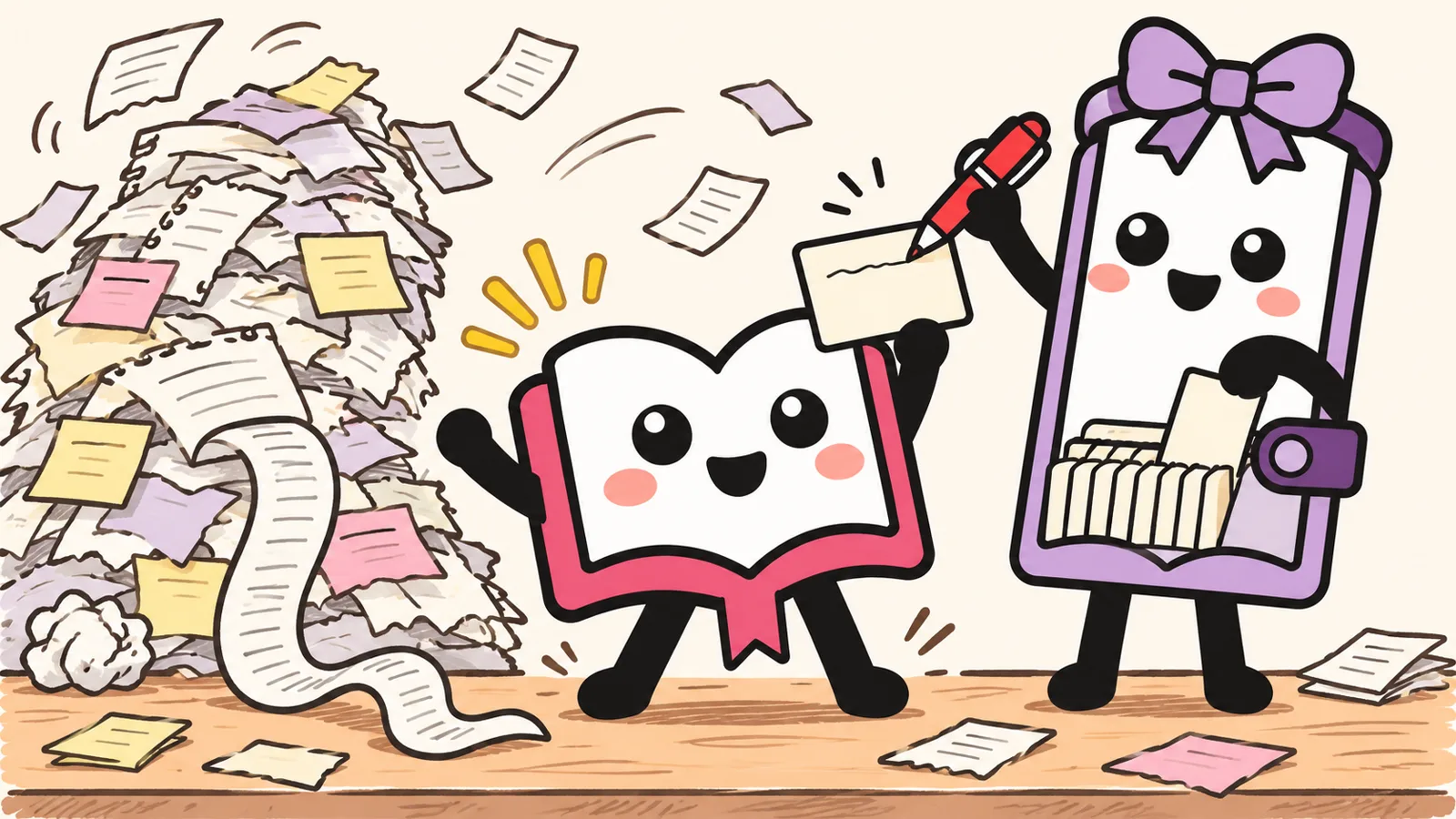
A story idea notebook is not a place to pile up ideas. It is a place to keep them in a form you can pull out the day you want to write. If you keep an idea notebook but it never helps when you sit down to write, the cause is usually that you never decided how you would get things back out.
The three most common stumbling blocks are:
- You can't find anything: ideas are scattered across phone notes, a planner and the backs of receipts, and you can't remember where you wrote what
- You reread a note and it means nothing: all it says is "blue umbrella," and you can't recall what seemed interesting about it
- It never gets past being a memo: the event is written down, but there is no protagonist and no ending, so there is nothing to stand on when you start writing
Think of a mailbox: it is like stacking letters without ever opening them. You can't tell which ones matter, and the ones you meant to answer sink to the bottom. This guide shows how to organize story ideas into a notebook you can actually use, with three habits: "separate where things go," "write each idea so you can tell what it is," and "look through it now and then and bring the useful ones forward." How to come up with ideas in the first place is covered in how to find story ideas when you have none, so here we focus on what comes after: keeping, growing and pulling out the ideas you already have.
Split your notebook into four places
Divide one notebook (or one app) into four places, each with a different job. Ideas move gradually from left to right.
The most important thing is to keep ① the inbox separate from ② the cards. When an idea strikes, speed matters most, so a quick scribble in the inbox is fine. In exchange, treat the inbox as a temporary holding spot and write things up on cards later. "One way in, one place for clean copies" solves almost all of the scattered-notes problem.
④ The resting box is where cards that aren't going anywhere right now wait until they meet another idea. You keep them instead of deleting them, and when a good pairing turns up, they go back to the cards.
You can set up the same four places on paper or on your phone.
| Place | In a paper notebook | In a phone notes app |
|---|---|---|
| ① Inbox | Write from the last page backward | Make one note called "Inbox" and keep adding to it |
| ② Idea cards | From the front, half a two-page spread per idea | One note per idea, with a number at the start of the title |
| ③ Ready shelf | Mark the card number and list it on a contents page | A "Ready" folder or tag |
| ④ Resting box | Put a different mark next to the number (don't move the page) | A "Resting" folder or tag |
Since you can't reorder the pages of a paper notebook, you show a card's move with a "mark." On a phone, you can move notes with folders or tags. The exact features of each note-taking tool can change, so check the official help for the one you use.
Give each idea its own card
When you write up a note from the inbox, give each idea its own card and fill in the same fields every time. With matching fields, you can compare dozens of cards and see at a glance how far each one has grown. If you already use the three-line memo from how to find story ideas when you have none (what you saw, what if, who's in trouble), copy it straight over; the main things to add are "why it grabbed me," "number" and "linked cards." If "who's in trouble" is already filled in, start the card at the Seed stage.
Let's follow one example. Say the inbox has the scribble "moving box, previous person's letter." Six months from now, you won't know what that means. As a card, it looks like this:
Number: No.023
Working title: The Letter at the Bottom of the Box
Found (date, place): November 14, while unpacking after a move
What I saw: An envelope addressed to the box's previous user was stuck at the bottom of a borrowed cardboard box
Twist (what if): What if the letter said "To whoever receives this box"?
Who's in trouble: (not yet)
Why it grabbed me: I love the feeling of being linked to a stranger's life by pure chance
Possible genres: heartwarming / a little uncanny
Growth stage: Memo
Linked cards: No.008 (the story about the old apartment complex)
The field people forget most is "why it grabbed me." The excitement you felt the day the idea came is gone a few months later. A card that records only the event leaves you cold when you reread it. If you add a few words on why you wrote it down, that becomes the core of the story when you write it.
A famous example of collecting and linking cards is the card box of the sociologist Niklas Luhmann, who wrote some 90,000 note cards between 1951 and 1996 (Bielefeld University in Germany holds the collection and is working on organizing it and publishing it as a database).
The first thing to do in your own notebook is to number your cards. With numbers, you can link cards to each other: "No.023 might connect with No.008." One idea rarely makes a whole story on its own; more often two or three combine into one, so numbers let you trace those connections inside your notebook.
Grow ideas through three stages
In the card's "growth stage" field, write one of three stages. The stage depends on what is already written on the card. With a clear rule, you'll know what to add next each time you review.
| Stage | What the card has | Next step | Example: the letter idea |
|---|---|---|---|
| Memo | What you saw, the twist, why it grabbed you | Add "who is in trouble, and over what" | A letter for whoever receives the box, at the bottom of a cardboard box |
| Seed | One sentence that sets the protagonist and their problem | Decide the ending's direction and rough length | A college student who has just started living alone can't refuse the letter's request and is stuck |
| Ready | The ending's direction and rough length | Move it to ③ the ready shelf | She never meets the letter's writer but carries out the request to the end. Three chapters |
The trick to turning a Memo into a Seed is to hand the event to a person. "There was a letter" alone doesn't move a story. Ask who that letter causes trouble for, or who it makes happy, and your protagonist comes into view. To move from Seed to Ready, decide the ending's direction (a happy ending or a bittersweet one) and the rough length, whether a short story or a series. You don't need detailed character settings yet. Once the card is on the ready shelf, it's enough to expand it with story notes like a character profile template.
You don't have to grow every card to Ready. Even with lots of cards at the Memo stage, it's enough if one card you want to write grows out of them.
Rest ideas that won't move instead of deleting them
Cards that don't grow no matter how often you review them go to ④ the resting box. A resting idea can suddenly come alive when it meets a newer one, so keep it instead of deleting it.
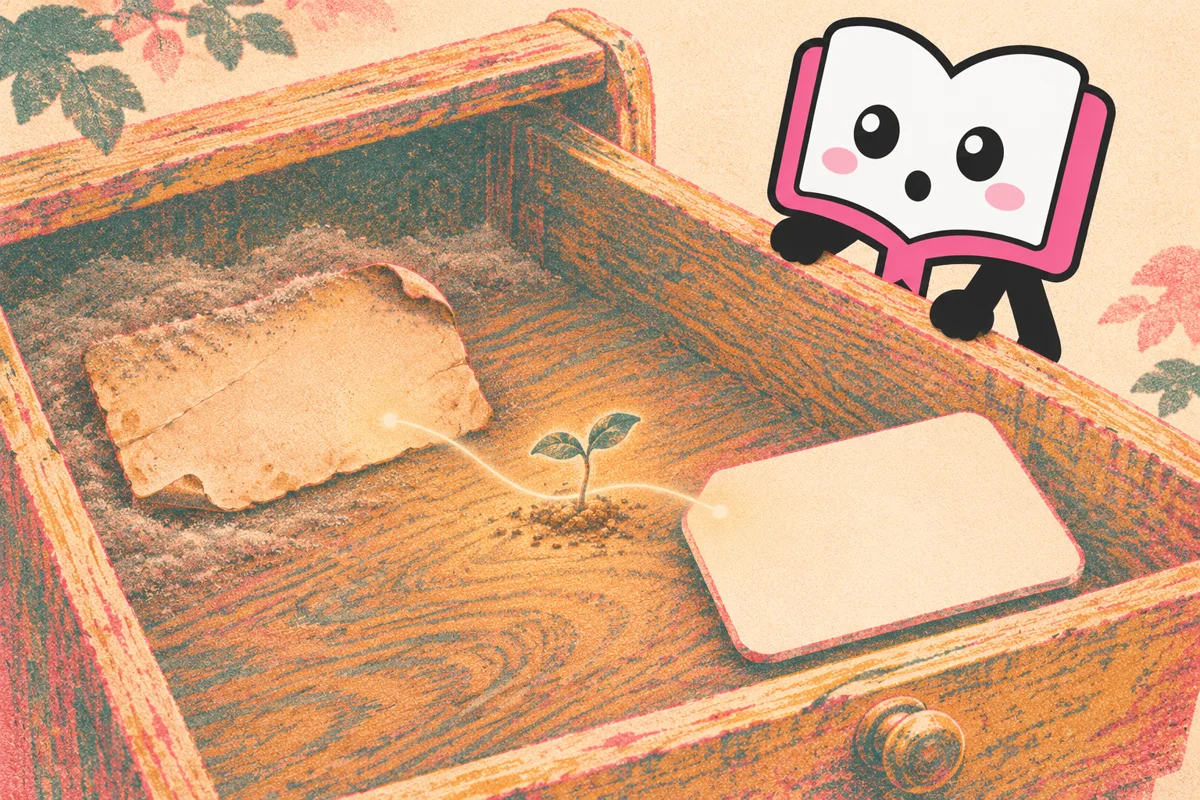
For example, say the letter idea from earlier (No.023) has been stuck at the Seed stage. One day, the note "the unused mailbox at Grandma's house" lands in the inbox. Put the two side by side and a new Memo appears, "a house where a letter that should never arrive comes on the same day every year," and you have one more card. Meetings like this only happen if you keep a resting box.
When you move a card to the resting box, add just a few words: "date rested" and "why it stalled" (such as "can't settle on a protagonist"). If you know why, you'll notice when an idea arrives that fills the gap.
Keep the notebook moving with a 10-minute weekly review
Even with four places and cards in place, if you never look back, ideas just pile up in the inbox. Once a week, take 10 minutes: empty the inbox first, then grow your cards.
You empty the inbox first because if you start growing cards while scattered notes are still lying around, you'll just end up with more ideas you can't find. In step 2, delete only notes that make you feel nothing when you reread them. When in doubt, keep it and make it a card.
In step 5, pick just one card from the resting box and look at it next to this week's new cards. Doing one card a week means resting ideas won't be forgotten either. In weeks when 10 minutes isn't enough, stopping after step 3 is fine. If you managed to empty the inbox, that week's review has done its job.
Pull it out on writing day: turn the card into story notes and a prompt
When you take a card off the ready shelf, make it the first piece of your story notes. The card's fields are already the raw material you need to start writing.
When you pull a card out, be careful to write the protagonist's wish and your own wish as the writer separately. Looking back over story requests submitted to Original Novel (22 requests from November 6–7, 2026; a small sample, so treat it as a rough guide), 5 of them filled the "what the protagonist wants most" field not with the protagonist's goal but with a hope for the story as a whole, such as "I want the two of them to get married at the end." The same mix-up happens when you copy an idea into a story request.
For the letter idea, the protagonist's wish is "to finish what the letter asks and get back to normal life," while the writer's wish is "a story that leaves readers feeling a little warmer." When the two get mixed up, both AI and people lose sight of what the protagonist is acting for. For other examples of conflicting instructions and how to fix them, see "Common mistakes and fixes" in how to write a novel with AI.
When you ask AI to expand an idea, paste the card as is and have it suggest directions before writing any story text. That keeps the core of the idea from drifting.
Below is an idea card for my novel. Please don't write any story text yet.

(Paste your idea card here)

Give me 3 directions for turning this idea into a short story, 3 lines each.
- Shape them so the feeling in "Why it grabbed me" stays with the reader at the end
- Treat the protagonist's wish and the feeling I want readers to have as separate things
- If there are linked cards, the most important one is card No.[number]
- For each direction, if any information is missing, end with just one question
The story notes that start from a card stay in use after you begin writing. Behind the scenes, Original Novel also keeps story notes for each work, gathering its "blueprint, foreshadowing and established facts," and hands them to the AI every time it writes a chapter. If you keep growing your story notes as you write, you won't lose sight of the original "why it grabbed me," even in a long story.
Reading other people's stories makes it easier to see how a card can be used. Try a few stories that begin with a small event.
Read stories that begin with a small event
See more: Read stories that begin with a small event ›Stories written by AI on this site. These start from everyday moments or small mysteries, sorted by how much they are being read.
Sources (date checked)
- Niklas-Luhmann-ArchivBielefeld University / Deutsch / Checked Nov 18, 2026
- What is a copyrighted work?Copyright Research and Information Center, CRIC (Japan) / Japanese / Checked Nov 18, 2026
FAQ
What if I can't keep up an idea notebook?
Write less, and keep only the quick jotting in the inbox going. Save writing up and growing ideas for the weekly review, and your only daily task becomes "jot a few words when something comes to mind." In weeks when the review won't fit into 10 minutes, emptying the inbox is enough.
Are the ideas in my notebook protected by copyright?
In Japan, according to the Copyright Research and Information Center (CRIC), a Japanese public-interest organization, images and ideas that exist only in your head are not copyrighted works; they can become works only once they are concretely expressed as a piece of writing. It is safest to assume that an idea at the notebook stage is, as a general rule, not protected by copyright. The parts you have actually written out as concrete text can be copyrighted works.
How do I gather ideas scattered across old notebooks and my phone?
Don't try to write everything up at once. First collect it all in the inbox. Then, at each weekly review, turn into cards only the notes that still move you when you reread them. Notes that make you feel nothing don't need to be kept.
Can I put cut scenes and unfinished drafts in my idea notebook?
Yes. Rather than pasting in the whole draft, write a line in the inbox saying which story and which scene it is, plus why you want to keep it. That makes it easier to turn into a card later. A line of dialogue or a description you loved can be a memo all on its own. Since it may come alive in a different story, the resting box is a good place for it.