How to Write a Novel with AI: Plan, Draft, and Revise a Whole Book in 7 Steps
The way to write a novel with AI is to plan the book yourself, then let the AI draft one chapter at a time. You decide the premise, the ending, the outline, and a story bible of facts that must stay true; the AI turns each chapter plan into prose. This guide covers the seven steps, a reusable chapter prompt, how to revise, what AI still does badly, and the disclosure rules for publishing.
Key takeaways
- Plan before chapter one: a one-line premise, the ending, and an outline by acts and chapters
- Keep a story bible of facts that must stay true, and give the relevant parts to the AI with every chapter
- Draft one chapter at a time, then revise in three passes: continuity, scenes, and sentences
- Using AI isn't cheating in itself, but check disclosure rules: Amazon KDP asks you to disclose AI-generated content
Can AI write a whole novel?
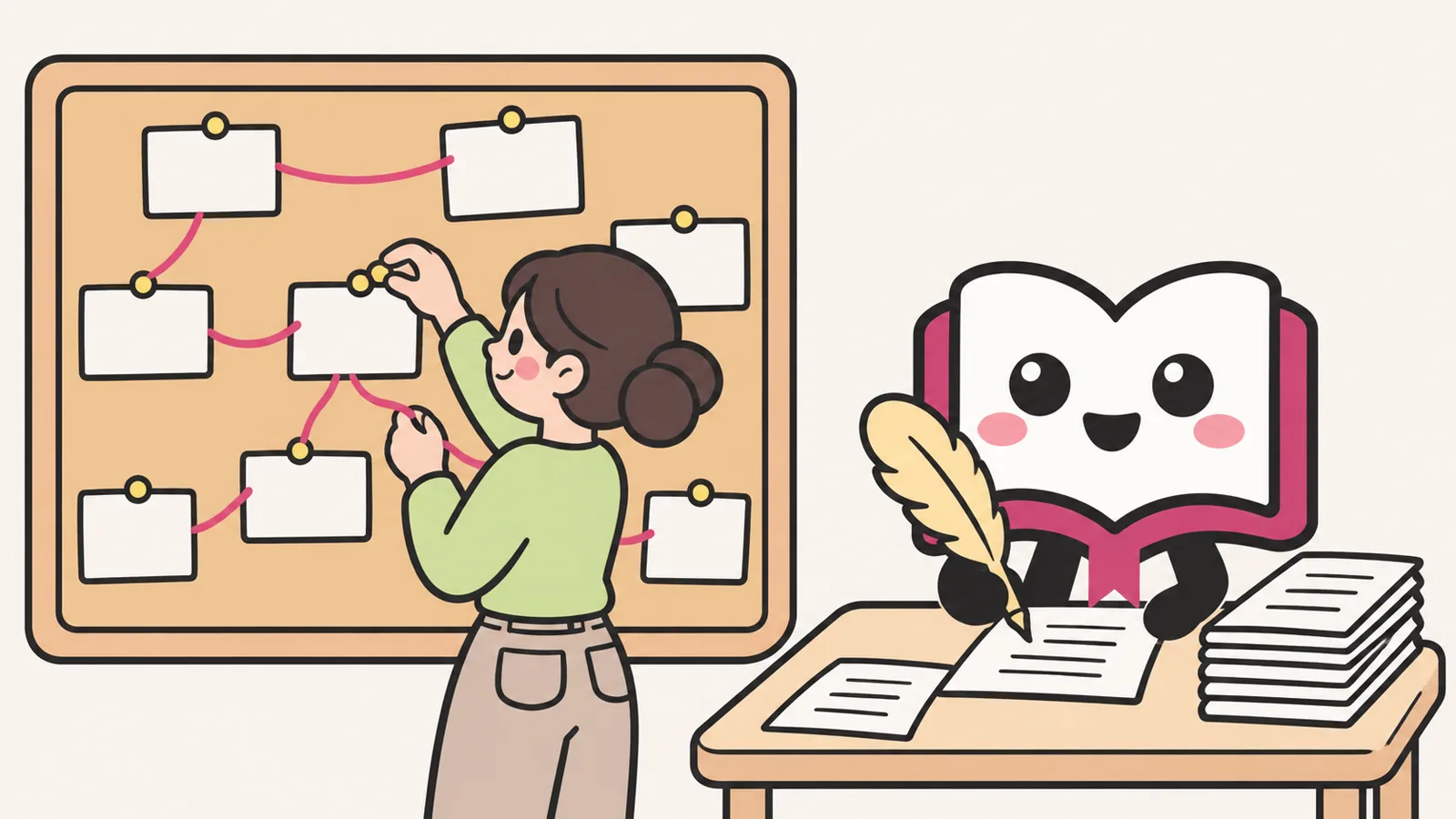
An AI can draft every chapter of a novel, but it can't keep the whole book in its head. Ask for "a fantasy novel" and you'll get a few promising chapters, then drift: a sister who turns into a cousin, a clue that never pays off, an ending that shows up fifty pages early. What works is a clear division of labor, where you plan the book and keep the record, and the AI drafts one chapter at a time.
Think of yourself as a film director and the AI as a fast, tireless crew. The crew can build any set you ask for, but only the director knows how the movie ends.
You decide
- The premise, in one line
- The ending
- The outline by acts and chapters
- The story bible (what must stay true)
- What to cut and what to keep
AI drafts and checks
- Turns each chapter plan into scenes
- Offers dialogue and wording options
- Writes alternative versions of a chapter
- Lists contradictions when you ask
How to write a novel with AI in 7 steps
The steps fall into three stages: plan, draft, and revise. Steps 1–4 happen once, before chapter one.
- 1Write a one-line premise
- 2Decide the ending before chapter one
- 3Outline by acts, then by chapters
- 4Build a story bible
- 5Draft one chapter at a time
- 6Update the bible after every chapter
- 7Revise in three passes
1. Write a one-line premise
Say who the story is about, what they want, and what stands in the way: "A retired detective moves to a quiet island and realizes her new neighbor is the man she failed to put away." If you can't say it in one sentence, the AI won't find it in three hundred pages.
2. Decide the ending before chapter one
Write the final scene in two or three lines, plus how readers should feel when they close the book. An AI that doesn't know the ending often wraps up the main conflict too early.
3. Outline by acts, then by chapters
Start with three acts: the setup, the rising trouble, and the climax with its aftermath. Then give each chapter one to three lines: what happens, what changes, and how it ends. A 50,000-word draft is about 20 chapters of 2,500 words, so that's about 20 short entries.
4. Build a story bible
The document that keeps a long book consistent. See the next section.
5. Draft one chapter at a time
Give the AI the relevant parts of the bible, the chapter's outline entry, and the last few paragraphs of the previous chapter, then ask for one chapter. One at a time is easier to check. The prompt is below; for more on handing off the last scene, see our guide to continuing a story with AI.
6. Update the bible after every chapter
Each chapter adds facts: a scar, a lie someone told, a promise made in passing. Ask the AI to list the new facts it introduced, decide which to keep, and add them to the bible.
7. Revise in three passes
Continuity first, then scenes, then sentences. The revision section explains why.
How to write a novel with AI
- Write a one-line premiseWho, what they want, what stands in the way
- Decide the ending before chapter oneOtherwise AI wraps up the conflict too early
- Outline by acts, then by chapters1–3 lines per chapter: what happens and changes
- Build a story bibleNames, rules, clues, and facts that must stay true
- Draft one chapter at a timeGive the AI the bible, the outline, the last scene
- Update the bible after every chapterAsk the AI to list the new facts it added
- Revise in three passesContinuity, then scenes, then sentences
How to keep 50,000 words consistent: the story bible
A story bible is a short document of everything that must stay true in your book. AI assistants can lose track of details from early in a long conversation, and a new chat may not carry over what you settled before.
| Section | What to write | Example |
|---|---|---|
| Premise and ending | One line each | "She proves he did it, and loses the island's trust doing so" |
| Characters | Name, age, what others call them, looks, what they want, their secret and who knows it | "Ruth Kane, 61, 'the Inspector' to locals. Secretly kept the old case file" |
| World rules | Places, how things work, what is impossible | "The ferry runs twice a day and not at all in storms" |
| Timeline | When key events happen | "Ch. 1–6: one week in October" |
| Planted clues | The clue, where it was planted, where it pays off | "The missing oar, Ch. 3, pays off in Ch. 17" |
| Settled facts | Anything a chapter has already established | "Ch. 7: Ruth sprained her left wrist" |
| Style | Point of view, tense, tone, words to avoid | "Third person, past tense, dry humor" |
Keep it to a couple of pages, and paste only the sections each chapter needs.
AI novel writing prompts: a reusable chapter prompt
Use it for every chapter, changing only the chapter-specific parts.
You are drafting Chapter [N] of a novel. I am the author. Follow my plan.

[PREMISE] one line
[ENDING] how the book ends (do not reach it in this chapter)
[STORY BIBLE] the characters, world rules, and settled facts that matter in this chapter
[OPEN CLUES] clues planted so far that must not be resolved yet
[THIS CHAPTER] 1–3 lines from the outline: what happens, what changes
[LENGTH] about 2,500 words
[CHAPTER ENDING] cliffhanger / quiet moment / a decision
[STYLE] point of view, tense, tone
[PREVIOUS SCENE] the last 3–5 paragraphs of Chapter [N-1], word for word

Write only this chapter. After it, list any new facts you introduced (names, injuries, dates, promises) so I can add them to the story bible.
Two helper prompts cover the rest of the process:
- Outline help: "Here is my premise and ending. Suggest three ways to split the story into 20 chapters. Don't write any prose."
- Continuity check: "Here is my story bible and Chapter 12. List every place the chapter contradicts the bible. Don't rewrite anything."
Saying what not to do keeps a planning question from turning into a chapter.
How to revise a novel drafted with AI
Revise in three passes, in this order, so you don't polish sentences in a chapter you later cut.
- Continuity. Run the continuity check on each chapter. Then read the planted clues list: does every clue pay off?
- Scenes. For each chapter, ask "what changed?" If nothing did, merge it into a neighbor or cut it. AI drafts often repeat a beat (another argument, another walk on the beach) in new words.
- Sentences. Rewrite dialogue until each character sounds different, turn stated feelings ("she was sad") into actions, and cut phrases that repeat across chapters. Reading aloud catches most of them.
On Original Novel, each chapter is checked by AI before publishing for contradictions with earlier chapters and wrong names or numbers, and flagged issues go to the site team. A check like that catches slips; whether a scene is boring is still your call.
What AI still does badly in long fiction
- Memory over distance. Without a bible in every request, details from early chapters fade.
- Rushing. AI tends to skip time and settle tension too soon. Your outline and chapter endings are the brakes.
- Sameness. Familiar phrasing, similar names, and twists readers see coming. Fix these in the sentence pass.
- Made-up facts. Real places, history, medicine, and law can come out confidently wrong. Check them.
- Conflicting instructions. Of 22 story requests from 11 people in Original Novel's first days (November 2026), 7 asked for things that pulled against each other, such as a big twist in a one-chapter story; it's a small sample, so read it as a pattern rather than a statistic. If two wishes compete, tell the AI which one wins.
Is writing a novel with AI cheating?
Using AI as a writing tool isn't cheating in itself. The problems come from hiding it where the rules ask you to disclose it, or from presenting text you didn't write as entirely your own. Contests, classes, publishers, and agents can set their own rules, so read them before you submit. Here's what Amazon KDP and the U.S. Copyright Office ask for.
| Where | What to disclose | Notes |
|---|---|---|
| Amazon KDP (self-publishing) | AI-generated content (text, images, or translations) when you publish a new book, or edit and republish an existing one. Content an AI tool created counts as AI-generated even if you edited it substantially afterward | AI-assisted content doesn't need to be disclosed: work you wrote yourself and used AI to edit, refine, or error-check, or where AI only helped you brainstorm ideas |
| U.S. Copyright Office (registration guidance, March 2023) | Applicants have a duty to disclose AI-generated content in the work and briefly explain the human author's contributions | AI-generated content that is more than de minimis (more than a trivial amount) should be explicitly excluded from the application |
On ownership, the U.S. Copyright Office's Part 2 report (January 29, 2025) concluded that AI output can be protected only where a human author has determined sufficient expressive elements, such as perceptible human-written material or creative arrangement or modification, but not the mere provision of prompts. Put simply, prompts alone aren't enough; what counts is the human authorship you can show in the finished work. Rules differ by country.
See what a long AI-drafted story looks like
A few chapters of a long AI-drafted story show where AI shines and where a person needs to steer. Original Novel (original-novel.com) launched in November 2026 as a place to read and create AI-written stories, and ongoing ones can be continued in the direction you choose.
Long stories written with AI
See more: Long stories written with AI ›AI-written stories on Original Novel, drafted chapter by chapter. Ongoing ones can be continued; finished ones are read-only.
 The Only Voice I Can't HearFor teens · Showbiz & idolsCompletedMay We Begin With a Lie?For adults · Romance
Summary
To write a novel with AI, plan the book yourself first: a one-line premise, the ending, an outline by acts and chapters, and a story bible. Then have the AI draft one chapter at a time with the bible in every request, update the bible after each chapter, and revise in three passes: continuity, scenes, and sentences. If you publish, check the platform's AI disclosure rules before you upload.
Sources (date checked)
- Content GuidelinesAmazon Kindle Direct Publishing (KDP) / Checked Nov 18, 2026
- Copyright Registration Guidance: Works Containing Material Generated by Artificial IntelligenceFederal Register (U.S. Copyright Office) / Checked Nov 18, 2026
- Copyright and Artificial IntelligenceU.S. Copyright Office / Checked Nov 18, 2026
- Copyright Office Releases Part 2 of Artificial Intelligence Report (NewsNet Issue 1060)U.S. Copyright Office / Checked Nov 18, 2026
FAQ
Can AI write a whole novel for you?
AI can draft every chapter, but it can't keep a whole book consistent on its own. The novels that hold together are planned by a person (premise, ending, chapter outline, and a story bible of fixed facts) and drafted by the AI one chapter at a time. Revision is still your job.
Is writing a novel with AI cheating?
Using AI as a writing tool isn't cheating in itself. Problems come from hiding it where rules require disclosure, or presenting AI-written text as entirely your own. Contests, classes, publishers, and agents can set their own rules, so read them before you submit.
Do I have to disclose AI use when publishing on Amazon KDP?
Amazon KDP requires you to disclose AI-generated content (text, images, or translations) when you publish a new book or edit and republish an existing one. AI-assisted content, meaning work you created yourself and used AI to edit, refine, error-check, or brainstorm, does not need to be disclosed. Check KDP's Content Guidelines for the current wording.
Can I copyright a novel written with AI?
In the United States, the Copyright Office concluded in January 2025 that AI output can be protected only where a human author determined sufficient expressive elements, such as human-written material perceptible in the output or creative arrangement or modification, but not through prompts alone. Using AI to assist does not by itself bar protection. Rules differ by country.
How do I keep AI consistent across a long novel?
Keep a story bible: characters, world rules, timeline, planted clues, and facts each chapter has settled. Give the AI the relevant parts with every chapter request, ask it to list any new facts it introduced, and add the ones you keep to the bible.