How to Write and Enjoy a Branching Story: 3 Shapes, Keeping Branches Under Control, and Story Flags That Prevent Contradictions
The key to finishing a branching story is to decide how many endings it will have and where the split paths will merge back together before you write the text. This article uses diagrams and tables to show how to enjoy stories with branching paths, the 3 shapes of branching, how to keep branches from multiplying, how to write choices readers want to make, and how to use story flags to prevent contradictions on each path.
Key takeaways
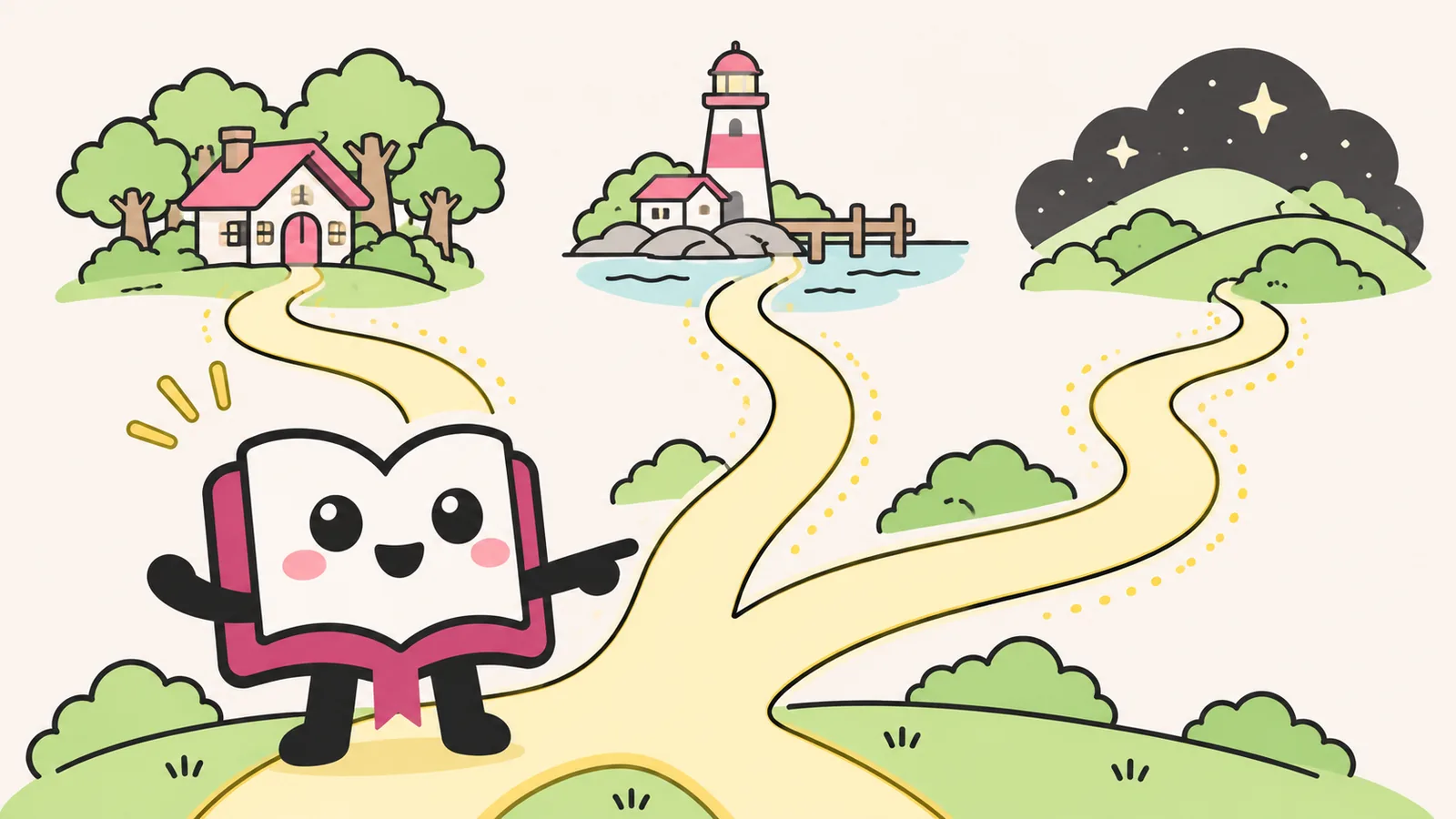
- You can finish a branching story if you decide the number of endings and the merge points before you write
- There are 3 branching shapes: tree, merging, and branching only at the ending. For a first attempt, use the merging shape
- Make every option cost something, and offer no more than 2 or 3 options per choice
- Prevent contradictions with a story flag table for each path, and give AI only the path the reader took
What Is a Branching Story? How It Differs from Gamebooks and Stories with Multiple Endings
A branching story is a story with moments where you choose “what now?”, and the rest of the story changes depending on the path you pick. Here's the key to writing one, up front: decide how many endings there will be and where the split paths will merge back together before anything else. If you start writing without deciding this, the paths double again and again until you can't finish.
| Name | What it is | Number of choices |
|---|---|---|
| Branching story | The broad name for stories that split depending on the reader's choices. Covers books, online stories and games | Depends on the work |
| Gamebook (choose your own adventure book) | A book where each scene ends with choices and “turn to section ___,” so you pick what happens next by flipping pages | Many |
| Story with multiple endings | A story with more than one ending. In some, the middle is almost the same and only the ending changes, based on late choices or what has built up along the way | Fewer |
The best-known branching stories in book form are the “Choose Your Own Adventure” series, which began in the United States in 1979. According to the history on the official website, by 1999 the publisher Bantam had released 184 titles, more than 250 million copies had been sold, and the books had been translated into 38 languages. The idea of “the reader is the main character and picks what happens next” has been enjoyed around the world for more than 40 years.
How to Enjoy Stories with Branching Paths
A story with branching paths isn't something you read once and put down. The fun is in reading it again and again and comparing the paths. Here are 4 ways to read one.
- The first time, choose by gut feeling: Don't hunt for the “right” answer. Just choose what you would do. Your first ending becomes “your story.”
- The second time, take the path you'd be least likely to choose: Choose as if you were a main character with the opposite personality to yours, and the same scenes look completely different.
- Write down the paths you choose: If you note something like “A at 3, B at 7,” you can see later where your paths split, and it's easier to look for endings you haven't seen yet.
- Compare endings with other people: Read the same book as your family or friends and talk about which ending you each reached. The way people choose shows their personality.
The ending people want to read varies a lot from person to person. Looking back at the story requests sent to Original Novel (22 requests on November 6–7, 2026), 8 asked for “a big twist” and 6 for “a story that makes me cry my eyes out,” while 4 asked for a bad ending or an ending left up to the reader. It's a small number, so treat it only as a rough guide, but it suggests that even with the same story, different readers want to see different endings. A branching story, with several endings, can meet those differences directly.
The 3 Shapes of Branching: Tree, Merging, and Branching Only at the Ending
Branching falls roughly into 3 shapes. In Sam Kabo Ashwell's 2015 classification of the structures of choice-based stories, the tree shape is called “Time Cave” and the merging shape is called “Branch and Bottleneck.” The shape that splits only at the ending is closest to “Gauntlet,” where the main plot is almost a single line and, if there are several endings, the final choice decides which one you get. If this is your first time, the middle one, the “merging shape,” is the easiest to finish.
Tree
- The path splits every time you choose and never comes back together
- A very large number of endings
- The amount you have to write doubles again and again
- Suits short stories and works with few choices
Merging
- Split paths come back together into one at a big event
- What the reader chose is saved as a “flag” (a marker that remembers the choice) and pays off later
- Easier to keep the amount of writing down
- Suits novellas and novels
Branching only at the ending
- Almost a single path that splits only near the end
- Side trips quickly return to the main plot
- Close to an ordinary novel, so it's easy to write
- Suits stories with multiple endings
The merging shape is easy to picture if you think of a train line. A local train and an express see different scenery along the way, but at the big stations they pull up at the same platform again. In a story, you decide in advance on an event every reader passes through (a merge point), such as “whichever path you take, a stormy night comes at the end of chapter 3.” Then, if you make “did the hero save the dog along the way?” a flag and change whether the dog comes to the rescue on the stormy night, the choice still means something even after the paths merge.
How to Keep Branches from Multiplying
If you keep adding branches in the tree shape, the amount you have to write shoots up. Here's what happens when you keep offering two-way choices:
| Number of choices | Options per choice | Endings | Scenes to write |
|---|---|---|---|
| 1 | 2 | 2 | 3 |
| 3 | 2 | 8 | 15 |
| 3 | 3 | 27 | 40 |
| 5 | 2 | 32 | 63 |
| 10 | 2 | 1,024 | 2,047 |
With 10 two-way choices, you have more than 2,000 scenes. Here are 5 ways to keep it to an amount you can finish.
- Decide the number of endings first: For a first short story, 2 to 4 is plenty. Work backward from the endings to lay out the paths.
- Merge after 2 or 3 splits: Put one event that every reader passes through in each chapter.
- Mix in paths that end quickly: A short path like “open the door, and the story ends there” creates tension in choosing without adding much writing.
- Show differences with flags: Instead of adding more paths, make items the hero carries or relationships with other characters into flags, and change the dialogue a little in later scenes.
- Keep it to 2 or 3 options per choice: With 4 or more, readers hesitate and the writer has more to write.
How to Write a Branching Story in 6 Steps
The process has 3 stages: “decide,” “map,” and “write.” If you finish the design work in steps 1 to 4 first, you won't get lost halfway through.
- 1Decide the number and content of the endings first
- 2Decide the branching shape and how many choices
- 3Draw a branching map and number the scenes
- 4Make a story bible and a story flag table
- 5Write the text scene by scene
- 6Read every path from start to finish and fix it
1. Decide the number and content of the endings first
Write each ending in one sentence, such as “reach the truth,” “fail to protect someone important,” or “forget everything and go back to everyday life.” Mixing good and bad endings gives the choices weight.
2. Decide the branching shape and how many choices
Pick one of the 3 shapes and decide how many choices the reader will make. As a guide, for a short story, aim for 2 to 3 choices and 2 to 4 endings.
3. Draw a branching map and number the scenes
Draw each scene as a circle on paper and connect them with arrows. Number the scenes like “1,” “2A,” “2B,” “3 (merge).” If you want a tool, the open-source tool “Twine” (open source means its code is public and anyone can use it for free) is an easy option. According to its official website, you can make simple stories without writing any code, and you can export the finished story as an HTML file that readers can play without installing any extra software. For people who want to build stories into a game, there is also “ink,” inkle's scripting language for stories (also open source).
4. Make a story bible and a story flag table
In addition to a story bible for your characters and setting, make a table of facts that change depending on the path. This is explained in detail in Story flags that prevent contradictions.
5. Write the text scene by scene
Write one scene at a time, in number order. At the end of each scene, add the choices and the number of the scene each one leads to. If you ask AI for a draft, always tell it “which path the reader took to get here,” as in the prompt template below.
6. Read every path from start to finish and fix it
Follow each path on the branching map one at a time, from the beginning to the ending. If there are many paths, mark each one as “read” in a table as you go.
You are a novelist. Please write one scene of a branching story.

Scene number: 4A
Path so far: 1 → 2A → 3 (merge point) → 4A. In 2A, the hero picked up a key. In 3, a boy she didn't know called out to her, and she decided to follow him
Fixed settings: Main character: Mina (16, catchphrase “Well, let's go and see”) / Setting: a foggy port town
Flags on this path: She has the key. She hasn't met the lighthouse keeper yet. She knows there's something in the warehouse. She trusts the boy
What happens in this scene: Behind the warehouse the boy led her to, the lighthouse light suddenly goes out
Length: about 400 words
Ending: End with the 2 choices below. In each one, the main character gains something and loses something
- Choice 1: Tell the boy about the key (→ 5A)
- Choice 2: Keep the key hidden and run to the lighthouse (→ 5B)
Don't: Reveal anything that happens later
How to Write Choices: Choices Readers Want to Make vs. Boring Ones
A choice readers want to make is one where every option has a reason behind it, and every option costs something. With choices where you can't see any difference, like “the right path” and “the left path,” or where one option is obviously correct, readers choose without thinking.
“Let's run away together”
You protect your friend, but lie to your family
You protect your family, but leave your friend alone
It's safe, but you lose your friend's trust
| Boring choice | What happens | How to fix it |
|---|---|---|
| You can't see the difference (the right path / the left path) | Readers choose as if drawing lots | Show something or someone at the end of each path (“the path with a light in the distance / the path with footprints”) |
| One option is obviously correct | Everyone takes the same path, and the other paths go unread | Make every option cost something |
| The result of the choice is unfair | “Suddenly it's over because of a trap you knew nothing about” kills the mood | Leave one hint of the danger in an earlier scene |
| The paths merge right away and nothing changes | Readers feel the choice doesn't matter | Leave differences in the dialogue or items after the merge |
If you place choices where the main character's personality could go either way (courage or caution, friendship or family), the act of choosing itself becomes time to think “what would I do?”
Story Flags That Prevent Contradictions: A Table of What to Track on Each Path
The most common problem in a branching story is a scene that doesn't match the path the reader took: using a key on a path where the hero never picked it up, or calling someone by name before meeting them. To prevent this, keep a single table of the facts that change depending on the path (story flags), separate from your story bible.
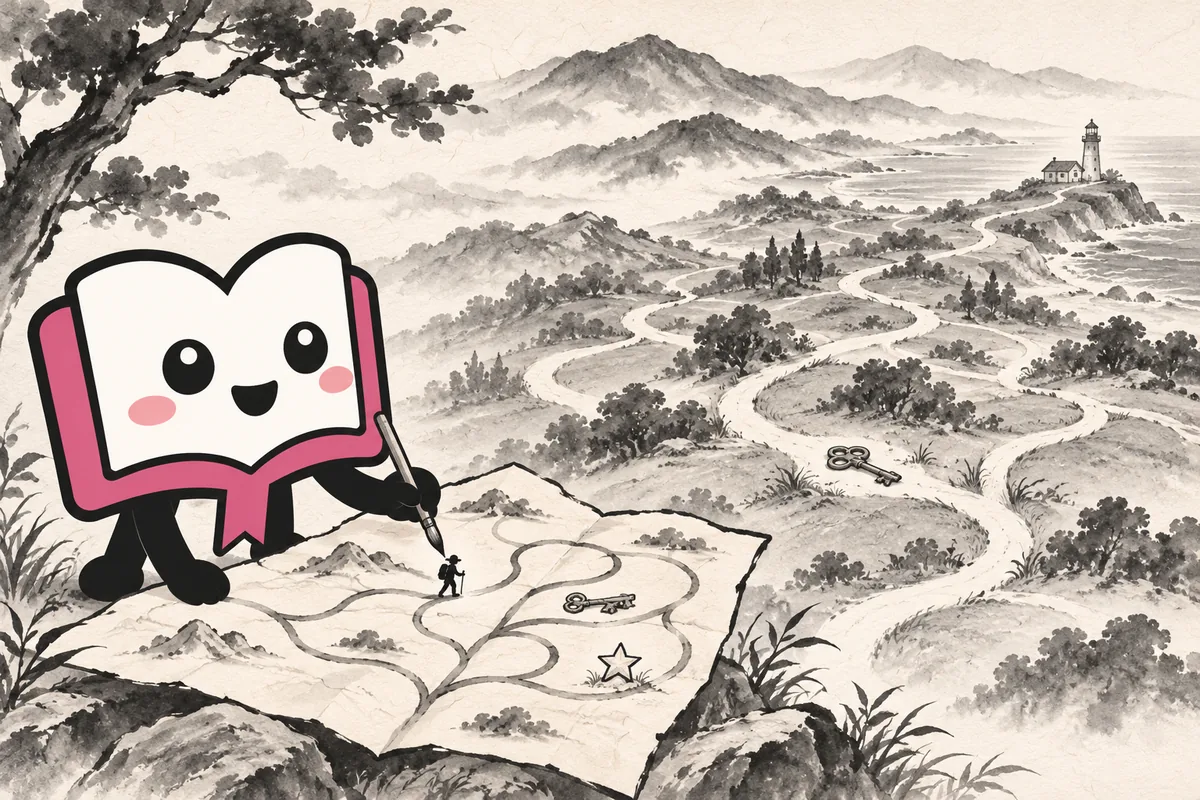
| Flag | Path through 2A | Path through 2B |
|---|---|---|
| Items | Has the key | Has nothing |
| People met | Hasn't met the lighthouse keeper | Talked with the lighthouse keeper |
| Secrets known | There's something in the warehouse | The boy is lying |
| Relationships | Trusts the boy | Suspects the boy |
There are 3 tips for tracking flags. First, limit the table to about 4 rows: items, people met, secrets known, and relationships. With too many rows, you'll forget to update them. Second, before writing a merge-point scene, look at every column in the table and sort the text into “sentences that work whichever path the reader came from” and “sentences that change by path.” Third, when you ask AI to write a scene, paste only the column for the path the reader took. If you paste every column, the AI may mix in facts from other paths.
Behind the scenes, every story on Original Novel also has its own story bible that gathers its “blueprint, foreshadowing, and established facts,” and it is handed to the AI every time a chapter is written. Before each chapter is published, AI checks it for contradictions with earlier chapters and for mistakes in names and numbers. These same two habits, “hand it over every time” and “check against it after writing,” work for branching stories too.
Start by Reading a Story That Branches
The fastest way to get a feel for writing one is to read a branching story yourself and make the choices. With an ongoing story on Original Novel, you just pick what comes next at the end of a chapter, and you have one path you chose yourself.
Read a story where you choose what happens next
See more: Read a story where you choose what happens next ›Stories written by AI on this site. You can create the next chapter or a different turn of events from any chapter of an ongoing story. Finished stories are for reading only.

 Completed
Summary
The key to writing a branching story is to decide the number of endings and the merge points before you write. There are 3 shapes: tree, merging, and branching only at the ending. For a first short story, start with the merging shape, 2 to 3 choices and 2 to 4 endings, and you'll be able to finish it. Make every option cost something, and prevent contradictions with a story flag table for each path.
Sources (date checked)
- Our History - Choose Your Own AdventureChoose Your Own Adventure / Checked Nov 18, 2026
- Standard Patterns in Choice-Based GamesThese Heterogenous Tasks (Sam Kabo Ashwell) / Checked Nov 18, 2026
- Twine / An open-source tool for telling interactive, nonlinear storiesTwine (Twinery.org) / Checked Nov 18, 2026
- Introduction (Twine Reference)Twine (Twinery.org) / Checked Nov 18, 2026
- ink - inkle's narrative scripting languageinkle / Checked Nov 18, 2026
FAQ
What's the difference between a branching story and a gamebook?
“Branching story” is the broad name for stories that split depending on the reader's choices. A gamebook is one kind: a book where each scene ends with choices and “turn to section ___,” so you pick what happens next by flipping pages (the Choose Your Own Adventure books are the best-known example). When the focus is on having several endings, it's also called a story with multiple endings.
Where can I read stories with branching paths?
You can read them in printed gamebooks, visual novel games with choices, and branching stories published online. On Original Novel, at the end of a chapter of an ongoing story, you can pick “what you want to happen in the next chapter” to create what comes next, and you can create different turns of events from the same chapter (as of November 2026).
How do I keep branches from multiplying?
Decide the number of endings first, and every 2 or 3 splits, merge the paths at an event every reader passes through. So that the choices still matter after the paths merge, make items or relationships with other characters into flags and change the dialogue in later scenes. If you offer 10 two-way choices in a row without merging, you'll have more than 2,000 scenes to write.
Are there free tools for making a branching story?
You can draw a branching map with paper and a spreadsheet. If you want a dedicated tool, the open-source Twine lets you make simple stories without writing any code and export them as HTML files. If you want to build a story into a game, there's also ink, inkle's scripting language for stories (also open source).
How do I prevent contradictions in a branching story?
Separately from your story bible, keep a single story flag table of facts that change depending on the path (flags), such as items, people met, secrets known and relationships. Before writing a merge-point scene, check the table and sort the text into sentences that work whichever path the reader came from and sentences that change by path. When you're done, read every path from the beginning to the ending to check it.