Chapter 15
Thirty Days
At the end of where One had walked, there was a door.
A square seam in the metal wall. A little lower than a man's height. No handle, no hinges.
One pressed the wall beside the door, three times, in set places. Each press, his fingers sank to a different depth.
The door fell inward. It fell, and became a floor.
“Nine years, that took. Seven of them just to find where to press.”
“And the other two.”
“The order to press them in.”
Inside was a narrow passage. Just wide enough to get a pair of shoulders through.
And it went up.
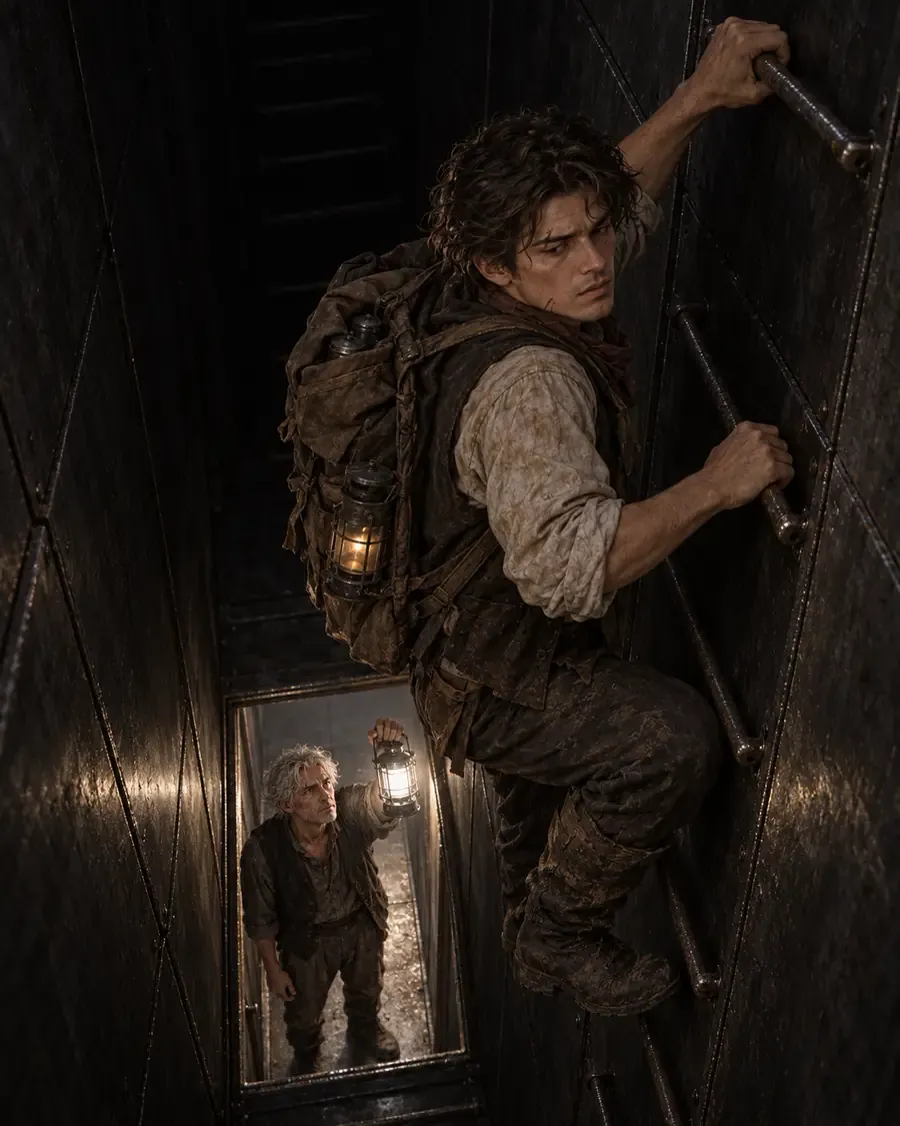
One put the lamp inside. White light on the wall. Bars were set crosswise into it at even spacing. Something to put a foot on and climb.
The light gave out about ten meters up. Past that, nothing.
*
“How far does it go.”
“To the top.”
“The top, meaning the ground.”
“Should be. It's got three thousand eight hundred meters in it.”
“Did you climb it.”
“I got up a hundred and twenty meters. Then I came back down.”
“Why did you come down.”
One drew the lamp back and sat on the lip of the door.
“Because I did the arithmetic. Say a hundred and thirty meters in a day. That's thirty days.”
“Thirty days.”
“There's no water on the way. No food. No place to rest. You sleep with your arm hooked through a bar, and that's all there is.”
“Carry thirty days of water on your back.”
“Thirty days is sixty liters. Can you climb a wall with sixty kilos on you.”
Marlow said nothing.
“I couldn't. So I came down.”
*
One changed the subject there. It looked like a change. It wasn't.
“You. When did the pain go.”
“Counting from the day I came back over the wall, the second night.”
“Cold.”
“Morning of the fifth day.”
“Thirst.”
“Around the tenth. Taste went too.”
“Sleep.”
“From about the fourteenth day I stopped getting sleepy. Today I got sleepy for the first time in twenty-odd days.”
One nodded. He nodded several times.
“I don't know my own order.”
“What do you mean, you don't know.”
“Because on the morning of the eleventh day, it all came at once.”
Something in the way he said it caught at Marlow.
“Hold on. You got past the eleventh day.”
“I got past it.”
“Then you turned too. Once.”
“I turned. Two and a half years of it.”
“Two and a half years.”
“Turned on the eleventh day and stayed that way two and a half years. Hauled loads in the town, said sir to everyone I spoke to, the roster came, and I got in the cage without a word.”
“You remember that.”
“I remember all of it. What goes isn't the memory. It's only the feeling that you're you.”
One looked at the back of his hand. The hand with all the cuts in it.
“I watched, the whole time. Watched myself answering politely, from behind. Two and a half years of it.”
Marlow went to say something, and nothing came.
“…When did you come back.”
“Three months after I came down.”
“Does it come back on its own.”
“I slept and woke by the water for three months. One morning I got angry.”
“Angry.”
“Watched the cage go up empty, and I got angry. First time in two and a half years. That's how I knew I was back.”
Then Marlow saw one more thing.
“They pick the divers after the turn.”
“After. Put a man in the cage before he turns and he says no.”
“All fourteen of them.”
“All fourteen. Me too.”
“There are two in the town. Men I know.”
“Divers.”
“No. Just scavengers. Two men who worked twenty years with the same partner, and one night they were like that.”
For the first time, One's hands stopped.
“One night.”
“One night. They were taken off in the dark, and by that evening they were already saying sir.”
“That isn't our story.”
“Looked the same to me.”
“I expect it did. But it doesn't come in a night. Mine took eleven days. All fourteen, the same.”
One tapped the floor twice with a finger.
“That comes later. We settle the order first. Starting with why you're the slow one. Any idea.”
Marlow had exactly one idea.
“Past the wall, seawater came down over me.”
“Came down over you. Not drank it.”
“A ship blew up and the sea stood up. Grain came flying and landed on my blood.”
One was quiet for a while.
“That's it.”
“What is.”
“That's the starting point.”
“Starting point.”
“It's a question of where you count the eleven days from. The ones up top count from the day a man comes back from past the wall. That's only half right.”
“Then what do you count from.”
“From the day you first touch seawater.”
It took Marlow a moment to get hold of what that meant.
“You said first.”
“I said first. Until it's touched it once, the body doesn't know seawater. It doesn't want what it doesn't know. So nothing happens.”
“Touch it and it wants it.”
“It wants it. Once it knows, it never forgets. From then on, the body needs seawater in it.”
“And if you don't put any in.”
“It lives off what you touched the first time. That's the store.”
“When the store runs out.”
“It starts using your own water. A little at a time. Below a certain amount, the feeling that you're you goes.”
One held up one finger.
“So how long you last depends on how much you took in. Wrist-deep, and it’s eleven days. That’s all there is to it.”
Marlow counted up his own ten years.
Scavenging at the market, stripping clothes off bones outside the wall, sleeping in a barn when it rained. He never went near the sea. There was no reason to.
Ten years, and nothing happened.
“I'm near thirty. If eleven days does it, I'd have turned long ago.”
“Because you hadn't touched it. Nothing happens till you touch it. Not in ten years, not in twenty.”
“It came down on me past the wall. That was the first time.”
“That's where it started moving. Eleven days from there.”
“I didn't turn in eleven days.”
“Amount. You were drenched. The whole sea stood up and the top of it came down on you, I’d guess. Most people only ever go in to the wrist.”
“Even a splash?”
“That won’t start it. Not wet sand under your boots, not spray scattered like rain.”
“Then where’s the line?”
“When your skin’s been under long enough for your body to learn the water. Wrist-deep, count to ten. About there.”
“So the more you get, the longer it holds.”
“I told you it's a store. More is longer. That's all.”
“How many days does one of those cylinders give?”
“One is one day. What came down on you, there'd have been twenty days in it.”
“Yours was eleven days. When did you touch it.”
“Don't remember. When they made me, I expect. I came to in the town, and eleven days from there.”
“No memory of touching it, and eleven days.”
“Means they put me in to the wrist. The ones who made me did it on purpose, I reckon.”
Marlow laid out the days he had been counting.
Pain on the second day. Cold on the fifth. Thirst on the tenth. Sleep on the fourteenth.
It had not all gone at once. What had come down on him had been draining, a little at a time.
“The nine in the Black Book. Were they born the same as us.”
“No. Those were ordinary people, I'd say.”
“Then why did they turn.”
“Because anyone turns.”
Marlow raised his head.
“Anyone.”
“Anyone. Go into the sea and a person turns on the eleventh day. It isn’t only us.”
“Then the ban.”
“It's the truth. Three hundred years of saying a true thing. Nobody remembers the reason, is all.”
Marlow remembered the words he had heard all his life.
You must not touch seawater. He had never once met anyone who could explain why.
They only could not explain it. They had not been wrong.
“Then what makes us different. If anyone turns, why send us down.”
“Blood.”
One pointed at the water's edge.
“You put your hand in a while ago. The water turned to grain. That doesn't happen with ordinary human blood. Stick a cut finger in and the water stays water.”
“Did you test that.”
“Not me. They did it up top, I expect. It's not a thing you know without doing it.”
“Then what are we.”
“Tools for turning the sea into grain. Made for that and nothing else. The turning is extra. Anybody human gets it. Just extra.”
“What about orcs and goblins.”
“Those don't turn.”
“How can you be sure.”
“Back when I was in the town I heard it from one of the wall watch. Two orcs fell off a watchtower, the story went. Both of them took a wave, and neither of them was any different. They're still on duty.”
Marlow checked the story in his head.
The ones standing on top of the Sea Wall are mostly orcs. For decades they eat and sleep a hundred meters from the sea.
He had never once heard of one of them turning.
“Then have orcs do the drawing. It doesn't do anything to them.”
“They do. The barrels up top are carried by orcs.”
“Have them dive too.”
“That won't work. With their blood, the water stays water.”
And then, for the first time, One said something like irony.
“The ones the sea can't touch can't turn the sea into grain. The ones who can turn the sea into grain turn themselves if they touch it. Neatly made, isn't it.”
Marlow thought about Drag.
That man could break the glass and be fine. He could hold it bare-handed. He could drink it and nothing would happen.
Marlow could not judge how useful that was.
Marlow put a hand on his own shoulder. The place where eight stitches' worth of wound had disappeared.
“So it doesn't go any further while I'm down here.”
“It doesn't. The sea's right there. The body has no call to use its own water.”
“Not a single day's worth.”
“Eight years and more since I came back. Not a day's worth.”
“Then me getting sleepy before.”
“Because you're by the water. Stay three months and it all comes back to you too.”
“Three months.”
“Three months. If you stay here.”
*
One went back to the earlier thread.
“Those two in the town. You said they turned in a night.”
“I did.”
“That wasn't seawater.”
“Looked the same to me. The way they talked, the way they bowed.”
“I expect it did. But the reasoning doesn't hold.”
One jerked his chin toward the water's edge.
“Seawater is a store. Take in a lot, it lasts long. A little, it runs short. Either way, there’s no amount small enough to run out in a single night. Wrist-deep buys you eleven days.”
“Wouldn't making them drink it be faster.”
“Other way round. Drink it and the store grows. It holds longer.”
Marlow ran the words through his head twice.
It added up. It added up all too well.
“Then what was done to them.”
“Don't know.”
“You don't know.”
“What I know is this body and this hole. Nine years' worth. Anything past that, I can only say I don't know.”
And then, for the first time, One shifted the way he was talking.
“Though there's one thing I can say. Somebody did it.”
“Obviously.”
“With us it takes eleven days. The ones up top did it in one night. Somebody has a way to squeeze eleven days into one night.”
Marlow remembered the night at Vesta's shop.
Otto had taken a little glass bottle the size of a finger out of the inside of his coat. He pulled the stopper and let one drop fall on his thumb. The blood turned to grain.
That was seawater. He carried it around to test blood with.
That night, those men had said they came to make sure Marlow was the right one.
There was no reason at all to think that men carrying a tool for making sure did nothing with it but make sure.
“Do you think they can be brought back. Those two.”
“Don't know. If it's the same thing, three months without letting the seawater run out and they come back. If it's something else, nothing you do brings them back.”
“The same thing—meaning what?”
“Water strong enough to turn a man in one night—that’s deep water, I’d say. Like the water down here.”
“Deep water’s got living things in it. Too small to see. The kind that can only live in the dark, where the sun’s never once reached. Put them in daylight and they die in a day. In a day.”
“How do you know?”
“Nine years down here. I came back to myself at the bottom of this hole, where no sun gets in. And the empty tubes they send down come wrapped in black cloth, every time. Means send them back wrapped, I reckon.”
“The sea past the wall is shallow. Sun-soaked. There’s little living things in it too, but a different kind—used to the light. Weaker. That’s why it takes eleven days. What turned a man in one night, you won’t turn back with anything but the same dark water.”
“Is it worth trying.”
“I'd try it. If there's nothing else to try.”
“How much is three months' worth.”
“A drop a day, every day. One cylinder. For one man.”
Marlow heard the number and counted on his fingers.
On the shelves of Vesta's shop stood dozens of bolts of linen. Sewn into one of them was one glass cylinder.
One.
“There are two of them.”
“Then it's one.”
One did not put it any more gently than that. For nine years the man had had nobody to put anything gently to.
“I'll tell you now, the choosing isn't yours.”
“Then whose.”
“There's a man who worked twenty years beside him, isn't there. His.”
*
Marlow looked up the passage.
Dark. Nothing to see.
“Thirty days of climbing. The eleventh day comes somewhere in the middle.”
“Eleven days is the least of it. Your body will use up its water. The man who comes out at the top on the thirtieth day will have your face, and every one of your memories, and he'll call everyone he meets sir.”
“That isn't me.”
“I think so too. But the ones up top can't tell the difference.”
Willa's face came up.
Not so much came up as stepped forward, from where it had been all along.
“There's one person who can tell.”
“Is there.”
“If she sees it, she'll probably break.”
“I expect she would.”
*
One stood and walked back into the dark.
When he came back, he was dragging a wooden box.
He opened the lid.
There were glass cylinders inside. Laid in rows, with straw packed into the gaps.
Marlow counted.
There were thirty.
“…What is this.”
“Seawater. Kept in glass. Through glass it doesn't turn to grain. That's why the Empire moves it in glass too.”
“Where did you get the bottles. You can't make these down here.”
“Every time the cage comes down, there are two empty cylinders in it.”
“Two.”
“Because they break. Three thousand eight hundred meters down, it hits the wall. Only one gets used for the carry. Without a spare, one break wastes a whole three months.”
“And if nothing breaks, one's left over.”
“One's left over. Nine years of left over.”
“Doesn't anyone up top count them.”
“What they count up top is the cylinders that come up. In nine years I've never once seen a paper that counted the empties sent down.”
Marlow counted the cylinders in the box again.
Thirty. The cage had come down thirty-four times.
The numbers fit.
“How did you build it up. The water, I mean.”
“The cage goes up once every three months. Thirty-four times in nine years. Every time, I drew twice as much. Half went in the cage, half stayed here.”
“They don't notice up top.”
“What goes up is three kilos, same as ever. That's the only number on the paper. There's no way for anyone up there to know how many liters got drawn down here.”
“And the other four.”
“Broke them. The first year I didn't even know how to seat a stopper.”
“Is one a day enough.”
“One a day. Thirty days, thirty cylinders. Exactly enough.”
“No spares.”
“None. That's the problem.”
One tapped the lid of the box with a finger.
“Thirty days climbing three thousand eight hundred meters. Somewhere you'll break one or drop one. I broke one at a hundred and twenty meters. A hundred and twenty.”
“Break one and it isn't enough.”
“It isn't. However many days you break, that's how much sooner you're finished.”
One knocked on the rim of the box.
“One buys you a day. Don't drink it. It turns to grain in your gut. Soaking your hand works the same, but a hand won't go in the mouth of a cylinder. Cut yourself and let it run into the cut. Up on a ladder, that's quickest.”
“If I pour it on, it'll turn to grain and fall away.”
“It will. That's fine. Before it turns, the water has touched you. What your body keeps is the touching.”
“That'll hurt.”
“You can't feel pain, can you.”
Marlow nearly laughed, and stopped.
*
Then he saw the arithmetic.
“This is your share.”
“It is.”
“Nine years you saved it. So you could climb.”
“That's right.”
“Then you can't hand it over.”
One shut the lid and set his hand on top of it.
“I'm not climbing.”
“You still could. Your body works.”
“I can't carry sixty kilos. And say I take thirty days and get up there. Then what.”
“Then what, what.”
“There's nobody up there waiting for me. Only a mother who died thirty years ago. A man with nowhere to go and see anybody can't climb a wall for thirty days. I found that out at a hundred and twenty meters.”
Marlow remembered what Sybil had said to him at the old lighthouse.
Every one who went east on fear alone turned back partway. If you go, do not go because you are afraid. Go in order to do something. Your legs will last longer that way.
That lion had probably known this.
*
They set the departure for the next day.
Before that, there was one thing to do.
The cage had come down with two empty glass cylinders in it, the way it always did. Spares, for a break.
Marlow filled one with water and put it in the cage. Three kilos. The usual weight.
He did not touch One's box. Thirty was exactly thirty.
That left the other one in his hands.
Marlow looked at it, thought a moment, and drew water into it.
He stoppered it, wrapped it in cloth, and pushed it into the hardest place to reach in his pack. Somewhere separate from the thirty for the climb.
“Does that one go in the count.”
“No.”
“It doesn't.”
“I'm taking it back to the town. It's already got a use.”
One seemed to understand from the way he said it. He made the face of a man who understood, and said nothing.
Then, as if it had just come to him, he added one thing.
“I'll tell you now, somewhere in those thirty days you're going to want to open that.”
“I won't.”
“I said you'll want to. I didn't say you'll open it.”
Then he wound paper around the cylinder. The paper Roslyn had sent with him. It had been in among the eight kilos. He had never thought of a use for it.
His writing was not good. Good enough for Willa to laugh at.
Alive. There was one man down here. Alive nine years.
The fourteen are not dead. Thirteen died. They are laid out in a row.
The cage will not take me up. Climbing another way. It takes thirty days.
If thirty days go by and I am not there, wait a little longer.
No answer yet. I will say it up there.
He wrote that much, and pulled the chain three times.
After a while the chain began to move. The cage lifted and went into the dark.
One watched from beside him.
“Four hundred times I pulled with me in it, and not once did it go up. Put nothing but goods in, and there it goes.”
“Because it's three kilos.”
“Because it's three kilos.”
*
In a place with no morning, at the hour they had decided was morning, Marlow took up his pack.
Thirty glass cylinders came to thirty-three kilos. Besides that, a lamp, oil, cord, a little dried meat. Close to forty kilos all told.
One was waiting in front of the door.
He had paper in his hand. Old paper. The edges gone black.
“I have one thing to ask.”
“Ask.”
“Take this with you.”
The paper he handed over had numbers written out on it. Thirteen numbers of seven digits. The first four digits the same, only the last three different.
“The thirteen.”
“That's right. No names. We only have the one name among us. So I wrote the numbers.”
“What am I supposed to do with it.”
“Get somebody to write it down. A ledger, a wall, it doesn't matter. Leave it somewhere up there that thirteen men were here.”
Marlow took the paper. He folded it and put it inside his coat.
“I know people who write. Two of them.”
“Two, even.”
“One does it for a living. The other one hates unstamped grain.”
One did not ask what he meant by that.
He did not ask, and he smiled a little. Nine years' worth of face muscles did not move well.
*
One pushed the other wooden box over with his foot. The one with the grain in it.
“Take it.”
“Can't sell this. No stamp.”
“I'm telling you not to sell it. Use it.”
“Use it. For light.”
“That's fine too. But there ought to be one person you can sell it to.”
Marlow remembered the lion at the old lighthouse.
The woman had said herself that she was a merchant who bought and sold talk. She had bought eleven cattle. She had taken one unstamped grain off Willa. There was exactly one person in the world who would have no trouble holding an unstamped grain.
“Let me check one thing. Can these be used in a shop in the town.”
“They can't. The day you put one out, you're taken in.”
“So it isn't money.”
“It isn't money. It's something to trade with.”
Marlow crouched down in front of the box.
He counted. While he counted, he laid out three uses.
One, the debt to Vesta. Three times she had sewn for him, and three times he had not paid it off.
Two, money for the road home. He did not have a single copper coin. Of the forty-two he had, thirty went against the debt and the other twelve went as the fee for hiding the cylinder. All of it to Vesta.
The third was the real reason.
Gus had said he would pay with all the water in his body. He had said it was cheap, since the two of them made one.
It was not cheap. If there was anything else to pay with, he would make him pay with that.
He counted to a hundred and stopped.
No more would fit. In a small leather pouch, pushed into the seam of his belt, a hundred filled it. That was about as many as would not rattle when he ran.
“A hundred. That isn't many.”
“Any more and I'd want to spend it.”
“Is that so.”
“And I couldn't run.”
One shut the lid and pushed the box back into the dark.
“The rest is here. If you come for it, it's here anytime.”
“Coming from a man who's been down here nine years, anytime lands heavy.”
“I said it heavy.”
*
Marlow set his foot on a bar.
First one. Second. Third.
About five meters up, he looked down.
One was standing there, holding the white lamp, shining it up at him.
“Hey. I forgot something.”
“What.”
“I'm holding something for someone.”
Marlow took a metal name tag out of the inside of his coat. The one Drag had pushed on him. Give it back if you meet him down there, he had said.
He dropped it. One caught it in both hands.
One held it near the lamp and read the letters cut into it. Reading it took him a while.
“…That's my name.”
“The last three digits are different. It belonged to a man who came here three years ago. By the books up top, he came down here.”
“Three years ago? No man with that number came down here. Every one who came is lying right here.”
“Then someone took him somewhere before he went down. Three years later he was on a ship coming back from the east, and he died above the town. The captain of the wall took the tag off his body.”
One closed his hand around the tag. The hand did not move for a little while.
“I'll lay it out with the thirteen.”
“The thirteen don't have name tags.”
“They don't. So one tag makes that place a grave.”
Marlow turned his face upward.
Dark. Three thousand eight hundred meters up was the mouth of the hole. Past that was the outpost, two days' walk, and the town, twenty-three days' walk, and a fallen aqueduct, and on top of it a place that goes red in the evening.
He put a hand on the fourth bar.
End of Chapter 15
── End of Chapter 15 ──