Chapter 14
The Bottom
The man had Marlow's face.
He looked about fifty. White hair. Thin. The left eyebrow was broken through the middle, and there were two thin scars along the right side of his jaw. The nose was a little crooked.
Only the eyes were different. This man's eyes did not move. Not hurried, not surprised.
“Seventy-two kilos.”
That was the first thing he said.
“Huh?”
“Seventy-two kilos. You can tell by how the cage rides. Mine was sixty-eight kilos. Sixty-eight, it was.”
He said the same number twice. It was the way a man talks when he has not talked to anyone in nine years.
The man came up to the cage and put a hand on the rim. The back of the hand was crossed with deep cuts.
“…So. What did you come down for.”
“I've got questions.”
“Questions. Ah. Right.”
The man rolled the word around twice in his mouth.
“Drink first. It isn't dry down here. This is the one place that isn't dry. Drink.”
*
The man never called himself by a name.
“What's your name.”
“Same as yours. So I don't use it. Call me by the number.”
“How would I know your number.”
“The last three digits are enough. I'm zero zero one. One will do.”
“One.”
“First one down. Nine years ago.”
Marlow remembered what Harlan had said. Fourteen since I became supervisor.
“I heard fourteen came down.”
“Fourteen came down. Counting me. I came down a month before the current foreman arrived.”
“Where are the other thirteen.”
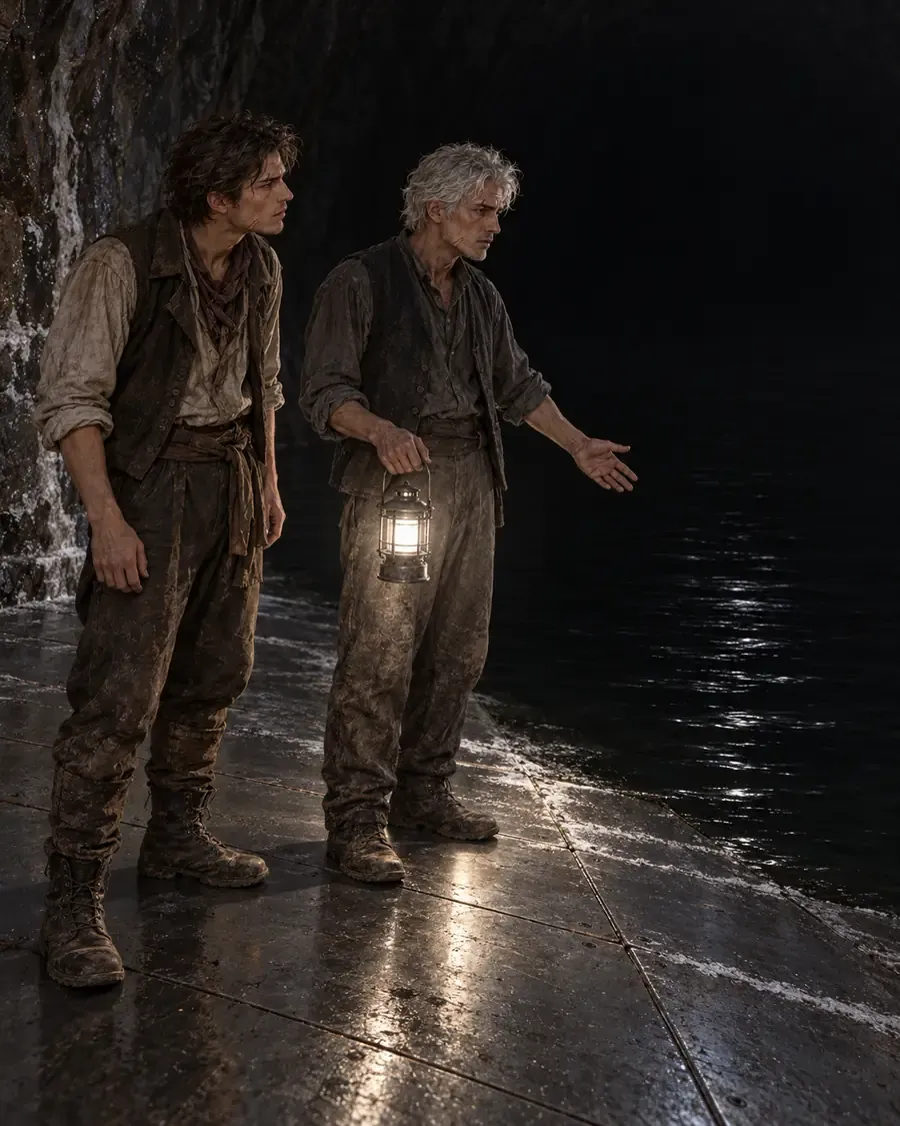
One lifted the lamp.
The white light reached into the far end of the floor.
People had been laid out on the floor.
Heads all turned the same way, arms down at their sides, thirteen of them. Cloth over them. Not over the faces.
All of them the same face.
Marlow's face.
The ages were different. Some barely twenty, some past forty. That was the only difference. Everything else was the same.
Marlow sat down where he stood. His knees went out from under him.
“If you're going to be sick, do it over there. The water's close here.”
“…You take it well, you.”
“Like hell I take it well.”
One started to raise his voice, then stopped partway. He was bad at stopping.
“Nine years I've looked at them. Look for nine years and you stop being sick. That's all it is.”
*
One sat down on the floor.
“I'll tell it in order. These are the things I wanted to ask up there, too.”
“Go on.”
“First. We weren't born. We were made.”
“Made how.”
“Don't know. The place they make us is away east. It has a name. The Lonely Land. I walked from there and came to the town. I don't remember the day I arrived. I came to and I was in the town, with a name, a number, and a memory of a mother.”
“I had a mother. I did.”
“So did I. I remember her dying, too. Winter, thirty years back.”
“…My mother died six years ago. Summer.”
“Figures. The insides are different. Only the face, the number, and the digits in the arm are the same.”
One showed him his left elbow. Under the skin sat a seven-digit number.
“Next. Why they send us down.”
“Isn't it to fix the pipe.”
“We fix the pipe. That part's true. But if it were only the pipe, they'd send a miner down. Miners are better at it. It's no reason to order in a man with the same face once every half year.”
One pointed to the far end of the floor.
Partway along, that floor dropped. It tilted and fell away into the dark. And the dark was giving the light back.
It was water.
“…The sea.”
“The sea. We broke through already. Nine years ago.”
“Up top they think there's another three hundred and twenty meters.”
“Because that's what's been reported.”
*
One stood and walked to the water's edge. Marlow went with him.
The dark water moved slowly. There were no waves. It only rose and fell, like breathing.
“Put your hand in.”
“I was taught not to touch it. All my life.”
“Me too. I put mine in nine years ago.”
Marlow put his hand in.
He felt no cold. He could tell it was wet.
And then the water where his hand was went black.
The water around his fingers turned a color like it could not decide on a color, and then it became grain, and sank.
Marlow pulled his hand back. There was a small cut on his palm. He had caught it on the rim of the cage.
Blood had touched the water.
“That's it.”
“This is.”
“Our blood touches seawater, the seawater turns to grain. No cattle, no sheep. No converter. You just put your hand in.”
Marlow thought of the machine in the back of Nim's shop. An iron box the size of a barrel. There were only two in the town. Both of them belonged to the Empire.
You put one cow in, and one grain comes out.
The man in front of him put a hand in the water and did the same thing.
“Well water doesn't turn. Why does the sea.”
“Because it's water that's been through living things.”
“Been through.”
“Under here there's a mountain of things alive that you can't see. They live, they die, they dissolve. This is water that's done that over and over for hundreds of years. At the root, it's the same stuff as the water inside a cow.”
“And well water.”
“Been through nothing. So nothing you do to it changes it. Mixing salt in won't do it either. There's salt lying around out there by the ton, and nobody can make a grain out of it, can they.”
Marlow thought that was so.
The ground in the Forbidden Strip is white. The dry hollow is white too. If all of that could be used, scavengers would have gone out of business long ago.
“Then stick a converter in the sea.”
“They tried, from what I hear. It doesn't take. That box puts one animal in, and with that one animal's blood it changes that one animal's water. The sea isn't one animal.”
“You mean there isn't enough blood.”
“That's right. Ordinary blood gets used up in one go. One cow's blood changes one cow's worth.”
One put his hand in the water again. The water around it went black and sank.
“My blood doesn't get used up. Nine years of it, and it hasn't gone down yet.”
“So what, then. This whole sea.”
“All of it. You can make grain until it's gone. Without killing a cow.”
“…You're joking.”
“I haven't had anyone to joke with for nine years.”
Marlow laid the meaning out slowly.
One cow, one grain. One grain, ten years of light. The town had run on that arithmetic for three hundred years.
If the sea in front of him all turned to grain, how many years would that be.
He started to work it out, and stopped. He stopped at the same place he had stopped at the edge of the dry hollow.
One scooped water up in his palm and let it fall on the ground.
“The sea up top went away like that. That dry hollow you came across. Three hundred years ago that was sea.”
*
Something caught in Marlow's head.
“Hold on. Then there's no need for me to be down here.”
“Oh?”
“Anybody can fill a bottle with water and send it up. My blood's only needed to make grain. So make the grain up top. Keep one of us up there and that's the end of it, isn't it.”
One smiled for the first time. He started to, and stopped partway.
“Took me four years to see that.”
“Then give me the answer.”
“Because the water rises.”
One pointed at the floor at their feet.
Looking closely, there were lines on the floor. White lines, a lot of them, running from the water's edge up to a certain height. Lines left by salt drying.
“From the day we broke through, the water rises. Sea below, a hole open above. Stands to reason.”
“What happens if you leave it.”
“The hole fills from the bottom. All three thousand eight hundred meters of it. Sixty years of hole, full of water.”
“Pump it out.”
“Three thousand eight hundred meters of it. It takes four cattle just to lower one cage on the end of that chain.”
“Plug it.”
“They tried that more than once, from what I hear. The rock moves. When it moves, the pipe breaks. When the pipe breaks, sixty years is over.”
One walked to the water's edge and put his hand in.
The water around his hand went black, became grain, and sank. The surface dropped by about as much as the eye could follow.
“A bucketful each time.”
“A bucketful.”
“It doesn't spread past that. One drop of blood reaches about that far.”
One took his hand out and put it back in. Out, and back in. The same motion.
“Two hours every morning. About a hundred times. That's what keeps the level from moving.”
“Two hours.”
“Take three days off and it comes up to that floor there.”
What One pointed at was the metal floor the two of them were standing on. From where they stood it was ten paces to the water's edge, no more.
Marlow looked at it for a while.
One man, two hours every morning, making water disappear a bucketful at a time. That alone was keeping a hole three thousand eight hundred meters deep from filling up.
“That's the diver's job.”
“That's the diver's job. Fixing the pipe is on the side.”
Marlow asked about the other thing that had been catching at him.
“The stuff you send up. Why water.”
“What do you mean.”
“You can make grain. Pack three kilos of grain and send that up, it'd be worth a lot more. Why send it up as water.”
One stood up and dragged another wooden box out of the dark.
He opened the lid.
There was black grain inside.
Packed solid. He could not see the bottom.
Marlow stared at the box and could not move.
A scavenger working a whole year might get his hands on one grain, two at most.
The box in front of him held more than could be counted.
“…Nine years' worth.”
“Not nine years' worth. A hundred a morning, they come. Keep nine years' worth and you'd run out of boxes.”
“Then the rest.”
“Goes in the sea. It sinks as soon as it's made. I just stopped picking it up.”
“And this.”
“What I picked up on days I felt like it. Four years or so.”
Marlow thought about the prices in the town.
One cow, one grain. Three years to raise the cow.
“So why send water up. Send this.”
“Because the order says water.”
“Get the order changed.”
“A dead man can't place an order.”
One pulled a paper out of a gap in the wall and handed it to Marlow.
Old paper. The edges had gone black. Three stamps pressed on it, and one line written.
Three kilos, water.
“Nine years, this is what comes down. Not once has what it says changed.”
“Central has to know. The water's coming up.”
“There'll be somebody who knows.”
“Then.”
“Fixing the paperwork isn't that somebody's job.”
One closed the lid of the box.
“Fourteen death reports have gone out. I'm one of the sheets. Write a paper that turns those over, and whoever wrote it carries fourteen men's worth of lies.”
“Nobody writes it.”
“Nine years, nobody has.”
Marlow went back to thinking about the water they sent up.
“So what's one cylinder of water worth.”
“It isn't fuel. It's a sample.”
“A sample.”
“There were numbers stamped on the fitting of the cylinder. That's depth. It says where it was drawn from. They're measuring the sea. For years, once every three months.”
Marlow remembered the number Sybil had read out at the old lighthouse.
Four thousand one hundred twenty.
It had not been a price tag. It was a scale mark.
“Is there some reason besides the order that they won't have grain sent up?”
“I don't know for certain. Though I've got a guess. The grain I make has no stamp.”
“Stamp.”
“The thing the converter puts on. It says what was spent. You need it to use them in town, I expect.”
Marlow thought of the pouch at Willa's hip.
The girl had one unstamped grain in it. The kind of thing that makes trouble before you ever get it sold.
“What happens if unstamped grain gets around the town.”
“What do you think happens.”
“…Nobody sells cattle anymore.”
“That'd be about it.”
Having said that much, Marlow turned it around the other way.
“Hold on. Then the Empire's just losing out.”
“How so.”
“You touch the water and grain comes out, all you want. The Empire hands it around. That alone makes them the richest in the world.”
“Hand it around and it's wastepaper.”
One picked up a grain that had fallen on the floor and rolled it between his fingers.
“Grain has worth because you can't get it without killing a cow. The day people learn it comes free, nobody sells anything for grain. That copper coin of yours would be worth more.”
“Then it's pointless. Making it.”
“Don't sell it, then.”
“What good is money you never sell.”
“You can't see it because you think it's money.”
One set the grain down on the floor.
“For burning, you don't need a stamp. Lamps, machines, they don't run off looking at stamps. Unstamped grain runs them the same. My lamp does. Nine years lit.”
Marlow looked at the lamp.
White light. Not oil. Nine years, and it had never once gone out.
“…So for what you use yourself, the price doesn't move.”
“It doesn't move. Don't sell and nothing happens. The town keeps selling its cattle, and the Empire puts the grain it got for nothing into its own machines. That's the whole of it.”
“…That's cheating.”
“Cheating, isn't it.”
One laughed then. It was the laugh of a man who had forgotten how.
Marlow laid out the things he had seen in the last month.
The transport ship flying through the sky. The machine voice talking inside it. The white lights of the outpost. The thirty-meter iron tower. A drill that had been running for sixty years.
In the town, they killed a cow to keep one lamp on the water tower lit for ten years.
Maybe not one thing the Empire owned had cost a single cow.
“So where does the Empire's grain come from.”
“Not here.”
“Then here.”
“Here produces nothing. There's just a hole open. Whatever produces it is somewhere else.”
One pointed east.
What he pointed at was a wall, and from here there was no telling what lay beyond it.
“Somewhere there's the place that made me. No telling how many like me are in it.”
“How many would it take. To run all of it, that ship, the lights at the outpost, all of it.”
“All you need is buckets.”
“Buckets.”
“Line buckets up by the sea. Fill one, put your hand in, pick up the grain, fill it again. That's all.”
“How many for one man.”
“A hundred in two hours, every morning, for me. A full day would come to four hundred. Ten men, four thousand.”
Marlow heard that and could not say anything for a while.
Four thousand cattle's worth in a day. The town market did not hold two hundred cattle all told.
“…All you'd have to do is line buckets up by the sea.”
“That's right. And somewhere, they're probably lined up already.”
“On the other side of the wall.”
“The wall is there to keep everything but us away from it. The side that built the wall can walk in whenever it likes.”
One moved back from the water's edge and sat down on the floor.
“What the Empire's afraid of isn't grain piling up. It's us getting out.”
“What could one of me do, running.”
“A bucket and a place you can get near the sea. That, and one of you.”
“Don't sell it. Use it yourself.”
“That's right. Somebody who isn't the Empire gets to do what the Empire does. The people living outside the wall get lights of their own.”
Marlow thought about the iron box.
That box had a self-destruct on it. What was inside was one cylinder and nothing else.
About a liter of water. In itself, only enough to make a few grains.
Even so, it was a thing no one was meant to see.
Because the number stamped on the fitting said there was another sea.
“Do the ones up top know.”
“The supervisor at the drill site won't. He thinks the water comes in fifteen years. The only ones who know are the ones sending papers straight to Central.”
“Then what are we.”
“A plug. A living plug.”
One took his hand out of the water and wiped it on his clothes.
“Send one down and it holds half a year or so. When it stops holding, they send another one down. Fourteen men of it, they've kept that up.”
“What does that mean, stops holding.”
“It means he dies.”
*
Marlow looked at the water for a while.
Then he asked.
“Why didn't you go up.”
“I tried to go up. Once, nine years ago.”
“Just get in the cage.”
“I got in. I pulled the chain three times. That's the signal to haul up. It didn't go up.”
“Was it broken.”
“Not broken. At forty-three kilos it goes up. It goes up every time.”
One picked up a metal cylinder lying on the ground. The outer one, sized to take the glass cylinder.
“Three kilos. Three kilos with the water in it. Put that in the cage and pull the chain, and up it goes.”
“A man gets in and pulls, it doesn't.”
“You tried it. How many times.”
“Nine years. Four hundred, probably.”
*
One set the cylinder down on the floor.
“That's as far as nine years got me. Now it's your turn.”
“My turn for what.”
“One question. Is there anyone up there waiting for you.”
Marlow did not answer right away.
Not because no answer came. Because one did.
“There is.”
“How many.”
“One. A girl, fifteen.”
For the first time, One shifted where he sat. He settled himself again and put both hands on his knees.
“I asked the thirteen the same thing. Every one of them said no.”
“I see.”
“I didn't have anyone either.”
One went quiet then. Quiet for a long time.
Then he took up the white lamp and stood.
“There's one way up. Took me nine years to find it. I've never used it.”
“You never used it.”
“I had no reason to.”
One started walking toward the dark.
“Come on. It isn't cheap. I'll say that up front.”
End of Chapter 14
── End of Chapter 14 ──