Chapter 9
The Dry Sea
From the twelfth day all told to the sixteenth, nothing happened.
With the oxen down to ten they went slowly. The distance covered in a day came to two thirds of what it had been. A loader's work is tying the load down again, oiling the wheels, and checking the oxen's legs. Marlow did it six times a day. Willa gave up after four.
One thing changed over those five days. Willa began writing by the fire every night.
*
“No. That is not a ‘g.’”
“Then what is it?”
“It is nothing. There is no such letter.”
“What! But that's how it was written in Nim's ledger!”
“The person named Nim writes it wrong.”
Willa stuck out her lip. Roslyn took the pen and wrote it once herself.
“You close the loop first. Close it, then bring it down.”
“Loop first.”
“Yes. Bring it down and then close it, and you get that shape.”
Willa wrote it three times in a row. On the fourth she looked up.
“This one?”
“That is a ‘g.’”
“Yesss!”
Willa got up and ran a lap around the fire. Two of the guards looked over as if wondering what had happened.
Marlow watched from the shadow of a wagon.
Four years ago Willa had spent a year learning her letters so she could read the cattle ledger. Only read them. Nobody had ever taught her the writing.
Roslyn came back and sat down beside him.
“That girl is quick. Forty characters in two nights.”
“How many have you taught?”
“Two.”
“So she's first out of two.”
“First is first.”
*
At midday on the seventeenth day all told, the ground ended.
To be exact, it began to drop. The flat plane of red earth ran into a shallow slope, and past that nothing could be seen.
They halted the wagons and Marlow walked to the edge.
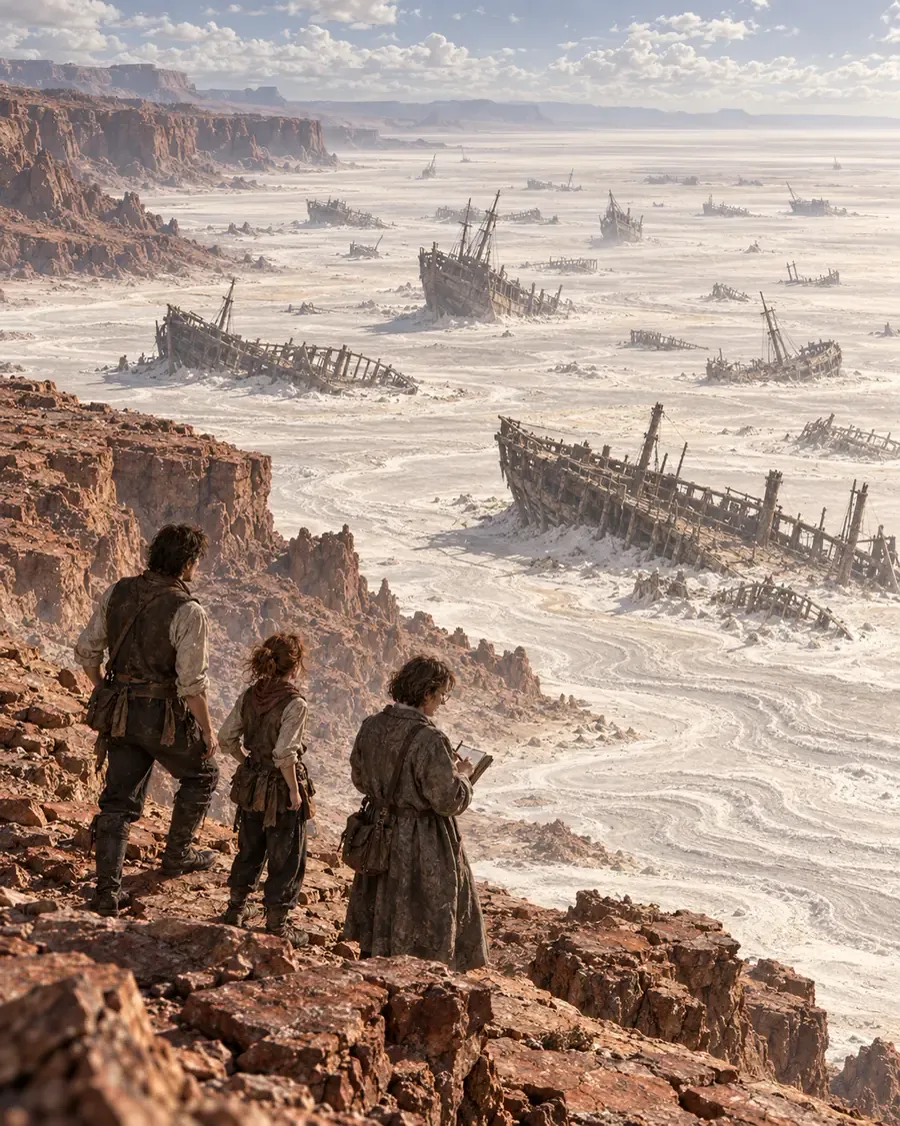
Beyond the edge it was white.
Several hundred meters deep. So wide that the far side was lost in haze. White all the way to the bottom, and here and there, streaks cut by the wind, left in the shape of waves.
There was a smell of salt. The same smell as the Forbidden Strip, coming at that scale.
And on the bottom there were ships.
Twenty-three of them just in sight. Some lying on their sides, some driven in bow up, some only frames. The largest of them was big enough to hold the whole market of that town.
“…This was the sea?”
“It's the sea. There are ships.”
“Where did the water go?”
“Turned into grain, I'd guess.”
Having said it, Marlow listened to his own words again.
One ox, one grain. Two sheep, one grain. If the whole hollow in front of him had been turned into grain, how many grains would that be.
“Hey. Who did it?”
“That I don't know. All I know is there was a sea here and there isn't now.”
Roslyn reached the edge behind them and dropped her board. She stood there a while without picking it up.
“A record from two hundred years ago says, the eastern hollow.”
“What about the ships.”
“It does not say. One word. Hollow.”
“Did the one who wrote it see this?”
“He must have. He saw it, and settled for one word.”
Roslyn picked up the board, brushed the sand off it and began to write. Her hand did not stop.
*
Drag held the wagons an hour.
He went down the slope and walked out alone onto the white floor. He grew small, went as far as the nearest ship, and crouched. It took him forty minutes to come back.
“What did you leave down there.”
“My brother's name tag.”
“Is his body here?”
“No. I don't know where it is either.”
“Then why leave it here.”
“I know he got this far. Past here I don't know. I left it at the farthest place I know.”
Drag said it while tightening the ropes on a wagon. His voice was the same as always.
“I'll stop on the way back. If it's still there, I'll take it home.”
*
The road did not cut across the bottom of the hollow. It followed the rim around to the north. Three days longer than going through the bottom. Nobody complained.
On the morning of the eighteenth day all told, the lead guard raised a hand and the column stopped.
A little below the rim stood six wagons.
Not toppled. Not broken. No oxen. The shafts had been lowered to the ground and propped up neatly with stones. It had the shape of something somebody had parked with care.
Drag went up to them first. Marlow followed.
The loads were still on. The barrels and the crates were still up there, roped down.
Drag pulled the plug on a water barrel. Water came out. He caught it in his palm, smelled it, and tasted a little.
“It has not gone bad.”
“It's been a month, hasn't it.”
“It has. Seventeen of the eighteen are full.”
Then Drag said it in a voice the guards around them could hear.
“Let's have it clear. This company was not attacked. If they had been attacked there would be no water left. Water-suckers go for the barrels first.”
“Nor did they run. Nobody on this road runs and leaves the water. Leave it and you die.”
“Which means every one of them left this place of his own will. Having decided he needed neither the load nor the water.”
One of the guards said something under his breath. Drag ignored it.
“Same as Otto and Sam.”
“The same. They were not taken. They walked.”
*
“Hey, look at this.”
Willa was crouched beside the fourth wagon, pointing at the ground.
There were footprints.
The white earth is hard. Walking over it normally leaves no mark. But in this one stretch there was a film of salt on the surface, and the shapes of boots had stayed in it as though burned there.
They ran straight east from the wagons. No disorder in them. No sign of running, no sign of stopping. Two abreast, the same length of stride, walking east.
“I will give you last month's numbers. Twelve guards, six drivers, two loaders, one captain. Twenty-one in all.”
“Count them.”
Roslyn knelt and began following the prints with a finger. Marlow counted from the other end, Willa from the middle.
They started over four times before the three counts agreed.
There were fifty-eight pairs.
“Twenty-one set out, and fifty-eight are walking east.”
“Couldn't someone have joined them on the way?”
“If they had joined, there would be prints coming in from another direction. There are none. The only prints from the west are last month's company and ours.”
“Then where did the other thirty-seven come from.”
“I do not know.”
Drag spoke up beside them.
“I'll lay out only what we know. There is something in the east that gathers people. The gathered walk on their own legs. The number that gathers is larger than the number that set out.”
“Why larger.”
“I don't know. But it's larger. By thirty-seven.”
Roslyn wrote a single line.
“Footprints, fifty-eight pairs, eastward. That is all.”
“That's all?”
“I write only what I saw. If I begin writing where the thirty-seven came from, this book becomes three hundred years of rumor.”
Roslyn's hands were shaking. The writing was not.
*
That night Willa did not sleep by the fire. Marlow did not sleep either.
He had noticed four days earlier that he never got sleepy. He had not told anyone yet.
“Hey.”
“Go to sleep.”
“I thought maybe I miscounted, so I went back just now.”
“Alone?”
“It's right there.”
Willa kept her arms around her knees and looked into the fire.
“Fifty-eight. Every time, fifty-eight.”
“Then that's that.”
“It isn't. Listen.”
There she stopped. It was the face she made when she could not decide whether to say something. Three years of watching had taught him that.
“Say it.”
“The smallest of the footprints. It was the same size as my boot.”
Marlow understood what that meant at once.
Last month's company had two loaders. On the roster Roslyn had read out, both were grown men. There was no child.
Say that, and Willa would feel her own footprints were being counted.
“Tomorrow I'll have Roslyn show me the roster again.”
“…Okay.”
“Don't go alone. From now on.”
“Okay.”
Willa fed a branch into the fire. Once she had, she said it in a small voice.
“Marlow, you're not sleepy.”
“…I'm not sleepy.”
“I knew it.”
“Since four days ago. I didn't say.”
“You should say things like that.”
“Say it and you won't sleep.”
“Of course I won't. Obviously.”
Willa put her arms around her knees again and rested her head on Marlow's shoulder.
“You can stay awake. Just be there till I fall asleep.”
Marlow was there.
End of Chapter 9
── End of Chapter 9 ──