Chapter 1
The Day It Fell
The sound came first.
A sound like thick cloth being torn open in one pull came down out of the northern sky.
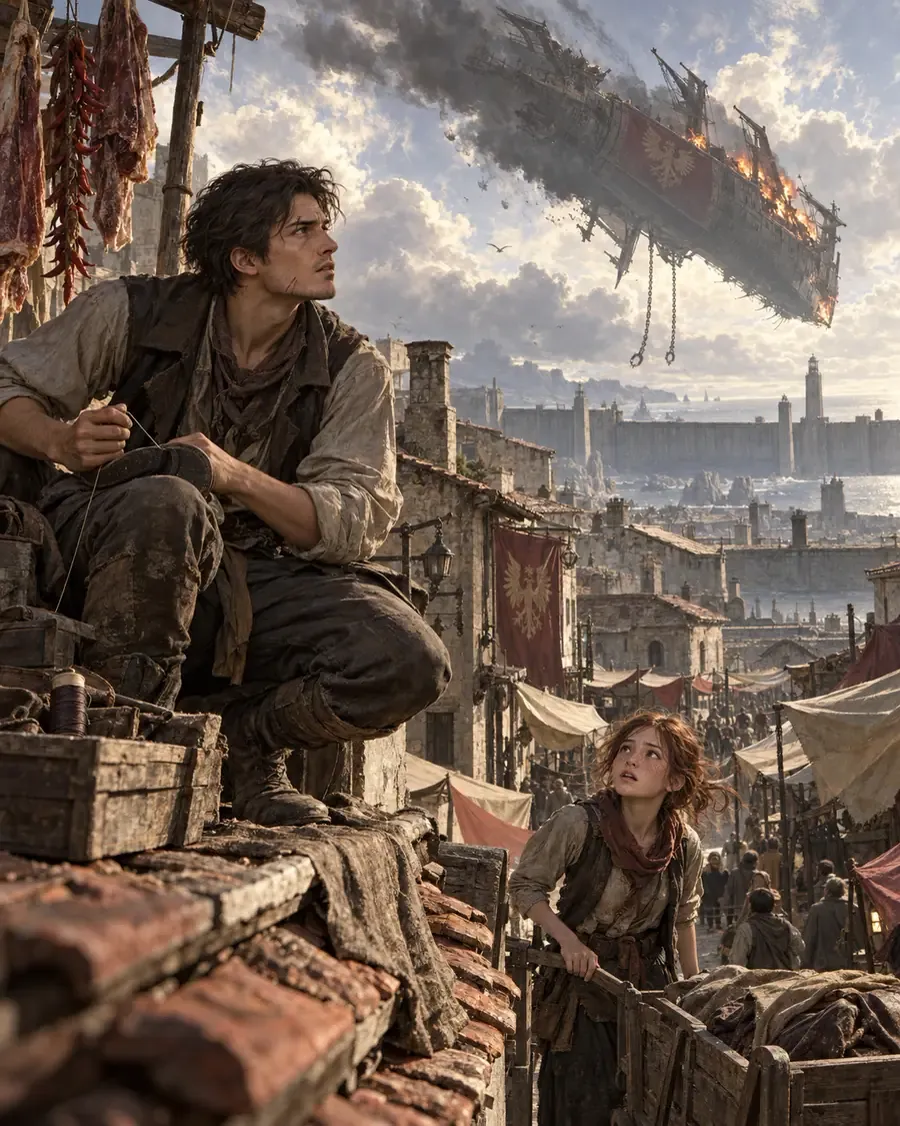
Marlow Kane was up on the roof of the jerky shop. The sole of his shoe was peeling away and he was halfway through stitching it. He looked up with the needle still stuck in it.
A line of black smoke was drawn across the northern sky. The end of the line was burning.
A transport ship. A big one. He could see the Empire's red mark on its flank.
Three of its wings were torn off. Two chains that had harnessed the griffins hung underneath, streaming in the wind. The griffins themselves were gone. Only the chains were left.
Marlow followed the fall with his eyes.
It would not hit the market. It would clear the market. Everyone in this town knew what lay past that.
“Willa! The cart. Out, now!”
He shouted down from the roof into the alley. Before any answer came, wooden wheels rattled on the cobblestones.
“I've already got it out! You're the slow one!”
Marlow ran across three roofs and jumped down onto a stack of barrels. The stack went over. Dried chilies scattered the length of the alley. The shopkeeper shouted something, but there was no time to listen.
Willa Dorset was waiting with the cart rope over her shoulder. Fifteen. The top of her head only reached Marlow's chest. She tied her red-brown hair up any which way, and half of it always fell out of the tie. Freckles across the bridge of her nose. One front tooth missing, so her breath leaked through the gap when she laughed. But put a load behind her and she was the third fastest in the market.
He had picked her up three years ago. More exactly, she had followed him on her own. Marlow still had not found a reason to chase her off.
“Hey, where's it going to land?”
“Other side of the wall.”
Willa's hands stopped.
“What?”
“I said, the other side of the wall.”
“I heard you! That's why I'm saying it! You go in there, you get shot!”
“I'm going.”
“Hold on, wai—”
A shadow passed over his head.
Hot wind came. Every awning in the market flipped up at once. Metal shrieking. Screams. A goat bleating. All of it at the same time. He tasted iron in his mouth. Too close.
The transport scraped the north edge of the market. It snapped off two of the bakery's chimneys. That was where the hull split down the middle.
The back half fell on the town. It plowed forty meters of cobblestone and stopped buried in the wholesaler's wall.
The front half flew.
It flew, and it cleared the Sea Wall.
*
The Sea Wall is twenty-two meters high and six meters thick. It is made of stone and iron. It closes off three kilometers of the town's western side, and watchtowers stand in a line along the top.
It is not a wall for stopping water. High waves never come to this town. It is a wall to keep people from going near the sea.
Past the wall there is a hundred meters of open ground. It is called the Forbidden Strip. Past that is sand, and past that is the sea. Anyone who goes into the Forbidden Strip is shot if he is seen. No one is ever punished for the shooting.
You must not touch seawater. Marlow had never once met a person who could explain why.
The market crowd had swarmed the back half, the one that fell in the town. Three hundred of them, roughly. The fighting had already started. Fifteen minutes at most before the army came.
Marlow ran the other way.
Willa dropped the cart and came after him.
“Everybody's over that way! There's nobody over here!”
“That's why I'm going. Over there it's three hundred people splitting one ship. That's half a sock each.”
“And over here we catch a bullet and die, thanks.”
“I'm the one who dies. You wait at the drain.”
“Huh? Just wait? Then what am I even following you for?”
“To stay alive.”
Willa started to say something back and did not get there in time.
The drain is an iron grate at the foot of the Sea Wall. It was built to carry the town's water out into the Forbidden Strip when it rains. In last year's earthquake the third bar came loose at the base. As far as Marlow knew, four people knew about it. Two of them were already dead.
He pulled off his jacket and wrapped it around the edge of the grate. He twisted his body and forced himself through. The skin of his shoulder tore and bled. The pain could come later.
On the other side, the first thing that reached him was not a sound but a smell.
Salt. The smell of dry salt.
The ground was white. Not one blade of grass. No insects. A hundred meters out, the sea was moving. In that place, it was the only thing moving.
Marlow kept himself from looking at the sea. It takes training, not looking.
*
The front half of the ship lay overturned, belly up. Sixty meters end to end. The plating had peeled off one side and the inside was wide open.
Bodies lay scattered. Six outside the ship. Eight he could see inside. Fourteen in all.
They were wearing army uniforms. Good tight-woven cloth; unravel it and you got fine thread back. One man's worth was ten days of meals in the market. Fourteen men's worth would feed you four months.
And he had to do it alone, inside the time he had.
Marlow pulled the iron hook from his belt.
No blades. Cut cloth loses its price.
Bend the elbow, slip the wrist out of the sleeve. Set the shoulder back, do the other side. Take the collar and pull hard toward the head. Eight seconds to here. The body was still warm, so the joints moved willingly.
Halfway through the third one, a shadow crossed over his head.
A griffin. Ten meters across with the wings out. An Imperial saddle on its back, two men astride it. One of them was leaning out, looking down at him.
Marlow pulled the stripped cloth over himself and went flat.
Three dry cracks. The rounds hit the ground twenty meters to his side and kicked up white sand.
They were not trying to hit him. They were trying to drive him out. If they decided to hit him, the next one would land.
Marlow gathered up the cloth and dove into the split in the hull.
*
Inside it was dark. The floor tilted at an angle. Something dripped from a pipe in the ceiling and ran toward the low end.
A voice spoke.
“Four minutes to self-destruct.”
A woman's voice. No rise or fall in it. It came from all over the walls at once.
“Hey. Who is that.”
“Three minutes fifty seconds to self-destruct.”
“Wait. Listen to me. What if there's still somebody inside?”
“Crew of fourteen, all deceased. The cargo is a military secret. Regulations require self-destruction.”
There are still a few machines in town that talk. One in the water tower, one in the market scales. All of them old, all of them only repeating the same words.
This voice was answering what he said.
“Where's the cargo?”
“You are not a member of the crew.”
“Anyone can see that. I asked you where.”
“Third room from the stern. Three minutes twenty seconds to self-destruct.”
It was going to tell him. By the time that thought landed, he was already running.
In that room, six iron boxes stood in a row. Five were chained to the floor, crumpled by the impact. Only the sixth had come off its chain and was leaning against the wall.
A person was sitting beside the box.
Not an army uniform. A gray coat, back against the wall, legs sprawled out. The head had fallen toward one shoulder. Dead.
Marlow put a hand on the coat.
After he did, he looked at the face.
The nose slightly crooked. The left eyebrow broken in the middle. Two thin scars on the right side of the jaw.
It was the face he looked at every morning in the water bucket.
His own face was sitting dead on the floor. Only the age looked four or five years older. Everything else was the same.
His hand would not come away. He did not know how to take it away.
“Two minutes to self-destruct.”
the voice said.
“Shut up.”
“One minute fifty-five seconds to self-destruct.”
Marlow slid his fingers behind the man's collar. A scavenger's habit. Anyone registered with the Empire has a metal name tag sewn into the back of the collar, stamped with a name and a number. A tag is not cloth, so it is not money. But leave it in and you get trouble at the buyer's.
He pulled it out and held it close to his eyes in the dark.
Marlow Kane.
Under that, a seven-digit number.
“Hey. Who is this?”
“I am not authorized to answer that question.”
“Then I'll change the question. Who am I?”
The voice went quiet. Two seconds.
Marlow had never in his life heard a machine go quiet.
“I am not authorized to answer that question either.”
*
He stripped the coat. Eight seconds was impossible. It took nineteen.
He got his arms around the iron box. One hand would not hold it. He tied it to his back with the cloth he had stripped.
When he got outside, forty seconds were left.
No griffin. The sky was empty. Men stood in a line in the watchtowers on top of the Sea Wall. Standing there, looking down at him. Not shooting.
He worked out why as he ran. No need to spend a bullet on something that would be gone in forty seconds.
Eighty meters to the drain.
Partway there, the sound went out.
The old people said sound goes out before an explosion. He had thought that was a lie.
Something hit him in the back.
By the moment he felt it, he was already sliding along the ground. Ten meters with his face dragging through white sand. A high tone rang inside his ears and he could hear nothing else.
He lifted his head.
The sea was standing up.
The blast had struck the surface. A hundred meters out, the sea was rising like a wall. The risen water broke and scattered toward him.
Not fire. Not debris. Water.
Marlow got up. He ran. He ran faster than he had ever run in his life. It caught him anyway. The front of the collapsing sea came down on him full, from his back to the top of his head.
The box bounced on his back. The wound in his shoulder opened. Blood fell on the white ground.
Beside that blood, one small black speck landed, a moment behind it.
He decided he had not seen it.
The iron grate came into sight. Willa's face was on the other side. Her mouth was moving. He could not hear what she was saying.
He forced his body through. The skin of his shoulder went again.
He came out and rolled onto the cobblestones on the town side.
On the far side of the grate, fine beads of water were falling on the white ground.
“Idiot! Idiot, idiot, idiot! I thought you were dead!”
“I'm not dead.”
“Blood! Your shoulder! It's pouring!”
“I'll tie it later.”
“Now! Do it now!”
*
Willa pulled the box all the way to the buyer's. Marlow could walk. Walking was all he could do.
Nim Callahan's shop is under the fallen aqueduct. Nim is a goblin, and the top of his head only reaches Marlow's waist. His skin is the color of moss and his head is bald and smooth. The rim of his left ear is split wide, and no one has ever asked why. His eyes are yellow, the pupils narrow and upright. He has seven fingers on one hand. He is past two hundred, but two hundred for a goblin is barely forty in human terms.
There were only two people in this town Marlow trusted. One was Willa. The other was this goblin.
Nim looked at the pile of cloth. Then at the iron box. Last, at Marlow's shoulder.
“I'll ask in order. Cloth first. Where'd you pick it up?”
“Far end of the north market. Back half of the ship.”
“In a place three hundred people swarmed, you stripped three uniforms and a coat clean on your own. That's what you're telling me.”
“I got lucky.”
“Luck. Oh, luck, was it.”
Nim began loading the cloth onto the scales. He talked while he loaded. Neither his hands nor his mouth stopped.
“Now, I've been in this trade since I was forty. A hundred and sixty years, this year. There's only two kinds of lucky scavenger. The kind that dies in two years and the kind that gets rich in twenty. You're neither. So it isn't luck.”
“Then what is it?”
“Stupidity.”
Then he raised one finger and pointed it at Marlow's shoulder.
“That cut was made by iron, wasn't it. A grate.”
“Caught it on a fence.”
“Is that so. A fence. Hmph.”
He asked nothing more. Not asking was how the shop had lasted a hundred and sixty years.
Payment was forty-two copper coins.
Partway through the count, the scale's light flickered once. Nim clicked his tongue, opened the panel in the scale's belly, and took spare grains out of a little box. There were three. A grain is about half the size of a grain of rice, and it is neither clear nor black. While you look at it, it holds a color that seems unable to decide what it is. Choosing which one to put in, Nim checked the stamp on the side of each. One cow. One cow. Two sheep.
Making a grain takes both water and blood. Water alone will not turn, and blood alone will not turn either.
What turns is only water that has passed through a living thing. The water inside a cow's body turns. Well water and rain never turn, whatever you do to them. Mixing salt in is useless. There is all the salt anyone could want in the Forbidden Strip and in the dry hollows, and no one has ever made a grain with it.
The size of a grain is always the same. Half a grain of rice. There are no large grains and no small ones.
One drop of blood touches water. With that, about a bucketful of the water around it disappears, and one grain is made.
It is the blood that decides the number. The blood of an ordinary creature is used up in one go. There is no second grain.
So a converter takes the whole cow. An iron box the size of a barrel; there are two in town. Both belong to the Empire. No one can make a new one.
One cow, one grain. Sheep have less blood, so it is two sheep for one grain.
The water you hand over never comes back. It does not become rain, and it does not go to the rivers or the sea. Turn a cow into a grain and that cow's worth of water is gone from the world.
The reason people make them anyway is simple.
Grains burn. They do not burn, exactly, but they do the same work.
The light in the water tower stays lit ten years on one grain. The market scales run on a grain. The old box in the back of Nim's shop that counts the weave of cloth runs on a grain. Every machine still running in town, every last one, runs on this. Nobody can repair them. Nobody can make them. But change the grain and they run again.
So a grain costs more than gold. Gold does not give light.
One cow, one grain. One grain, ten years of light.
Three hundred years of that arithmetic is the world we have now.
So a grain needs a stamp. What was spent.
The converter puts on the stamp. It is proof the grain was made in an Imperial machine. An unstamped grain means it was made outside the Empire. Just carrying one brings trouble.
Willa leaned in from the side.
“It doesn't say the cow's name.”
“Nobody gives a cow a name. What are you talking about.”
“Ours had one.”
Marlow opened his mouth and closed it again. There had been a cow at Willa's house until four years ago.
Nim cleared his throat and pressed a dried apricot into Willa's hand.
“Eat. You've got a face that's short on sugar.”
“You can tell from my face?”
“A hundred and sixty years. Of course I can tell from a face.”
*
The iron box would not open, not even with Nim's tools.
No line for a lid. No join. Nothing sounded inside when it was shaken. Only the weight said there was something in there.
“I'm not keeping it. The day that sits in my shop is the day my shop's the target.”
“I know.”
“A man who knows it doesn't haul the thing into a shop! Honestly. Take it home. Now. Not out the front, move the barrels in back and go that way.”
Marlow wrapped the box in cloth again. While he wrapped, he turned the tag from the collar over in his hand. He had not shown it to Willa. The moment he did, Willa would be carrying the same thing.
Just then the doorway went dark.
Drag Mortensen came into the shop with his head down. Even down, it scraped the ceiling.
An orc. Skin a grayish green. Two lower tusks out past his lips. Hair cropped so short it lay flat on his head. Eyes black and small, and he seldom blinked. The Empire's gray uniform, two stars on the shoulder. He was the captain of the unit that watched the Forbidden Strip.
Marlow had a hard time with this man. Because he did not shout. Most officials in this town shout. A man who shouts, you know what he is thinking.
Nim slid the cloth on the scales under his ledger, as if it were nothing.
“Which of you is Marlow Kane, the scavenger?”
“Me.”
“This morning, one human went down on the other side of the wall.”
“Hard work for you, then.”
“The watchtowers saw him. Not the face. People who go over the wall do not usually come back. There are nine cases in three hundred years of one coming back. All nine turned into trouble later.”
Drag put a hand into the pouch at his belt. Marlow thought it was a gun. It was not.
He set one metal name tag on the pan of the scales.
“It was in the collar of a body from the back half of the ship. The half that fell on the town side.”
Marlow looked at the pan.
Marlow Kane. Under that, a seven-digit number.
The same name as the one in his hand. The first four digits of the number were the same too. Only the last three were different.
“Does it mean anything to you?”
Nim looked up. Willa took a step back.
Marlow did not open his hand.
“No.”
“I see.”
Drag put the tag back in the pouch. Then, as if he had just remembered, he added one more thing.
“There were fourteen aboard the ship. The bodies collected on the town side are fourteen as well.”
The shadow in the doorway was gone.
For a while nobody moved.
Marlow was thinking back to the number of bodies he had counted on the other side of the wall. That had been fourteen too. He had managed to strip two of them, and part of a third.
The man in the gray coat was in neither fourteen.
End of Chapter 1
── End of Chapter 1 ──