Chapter 21
The Name Line
Give me one night, he said.
The voice answered that three days or thirty made no difference. It did not appear to be in a hurry. There was no point grudging one night to something that had not been in a hurry for two hundred ninety years.
*
The next morning, Adi came to fetch him.
“Show me where you make them.”
“Certainly, sir.”
“Thought you'd refuse.”
“There is no reason to refuse, sir.”
The people of this city refuse nothing you ask them. And they do nothing you do not ask.
The building was at the north edge of the city.
Inside it was warm. Damp. In these thirty days, the only damp air he had breathed was beside the sea underground, and here.
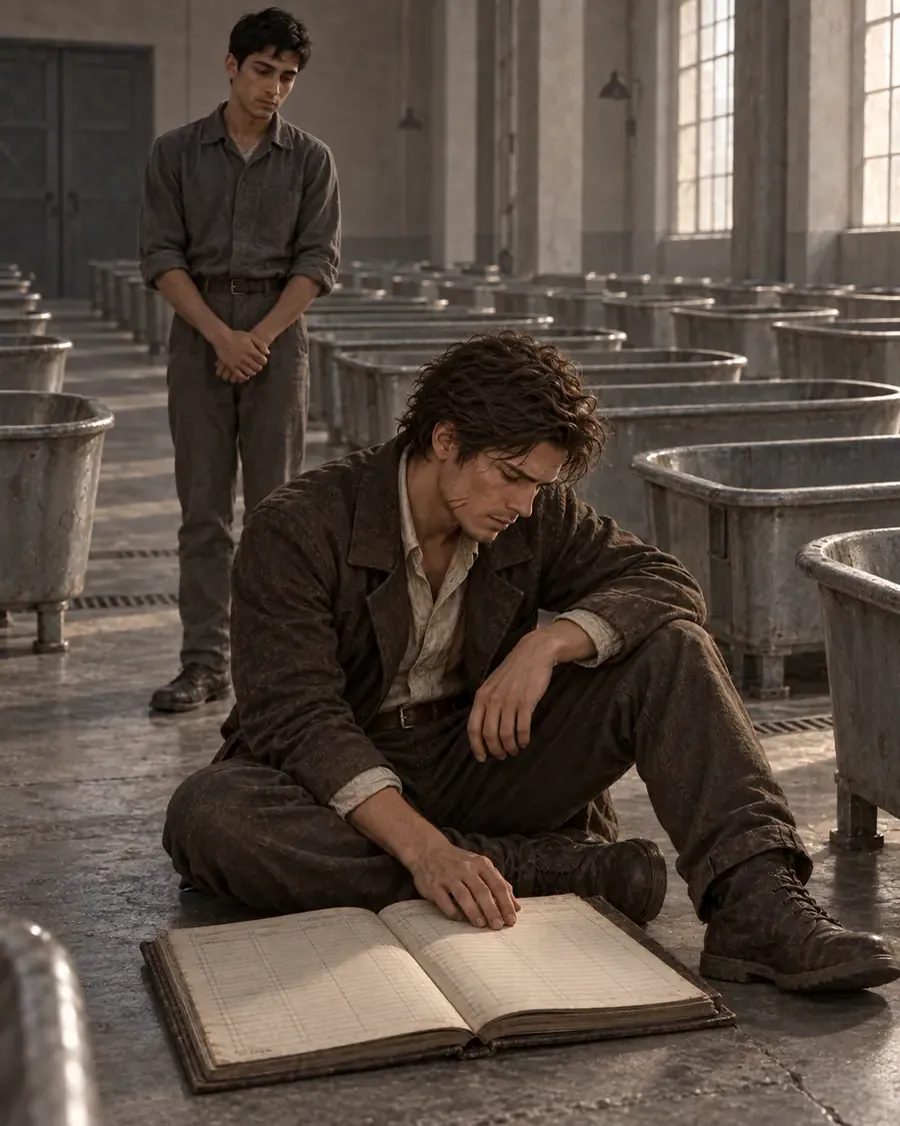
In the room, large tubs stood in rows.
Less tubs than baths. Big enough for one person to lie down in.
He counted. Thirty-two.
All empty. Dry. A white ring left at the bottom of each. Salt marks.
“You make them here.”
“Yes, sir.”
“When was the last time you used one.”
“Eighty years ago, sir.”
Thirty-two tubs, dry for eighty years.
In one of them, he had been made too. That was what Marlow thought.
*
There was a shelf along the wall. Bundles of paper in a row.
Adi pulled one out and handed it over before being asked. Among people who did nothing you did not ask, that was the first exception.
“What's this.”
“The register, sir. Number one through number one hundred six.”
Marlow opened it.
One person to a page. Number. Date made. Date sent out. Destination. And the last column.
The column at the far right was blank on every page.
At the top of the page, the name of the column in thin lettering.
Name.
A hundred and six pages, a hundred and six people, and only that column white.
“Nobody wrote in it.”
“No, sir.”
“There's a rule to fill it, though. There's a column for it.”
“There is, sir. There was no one to write in it.”
Marlow took the paper out of the inside of his coat.
The one One had entrusted to him. Thirteen seven-digit numbers. No names. There is only one name, so I wrote the numbers, that man had said.
He matched one of the thirteen against the pages of the register.
It matched.
The right edge of the page was still white.
*
Marlow sat down where he was.
Legs that had climbed a wall for thirty days finally gave out right then.
“If you are tired, sir, I will bring a chair.”
“No.”
“As you are, then.”
“Adi.”
“Yes, sir.”
“You said you had a name. Noll.”
“Yes, sir.”
“And you said you don't know who gave it to you.”
“No, sir. It was already attached.”
Marlow closed the register.
“Ours weren't attached.”
Adi did not answer.
He did not answer because he had no answer. There was no use asking more of this man.
*
Willa's voice sounded twice in his head.
The first time was the story about the cow, four years ago. The only thing missing was the name line.
The second time was the old lighthouse. If you hand somebody a grain with nothing written on it, then nobody can tell what it was anymore.
That time, the girl had carved something into a stone slab. She said it was embarrassing and hid it.
Marlow does not know what it said.
Without knowing, he understood now what kind of act it had been.
*
It was past noon when he got back to the room.
Silas was sitting in the same chair as the day before. He might have been sleeping in it.
“You have returned early, sir.”
“Came to give my answer.”
“Please,” Silas started to say, and closed his mouth.
The one to say it to was not this man.
Marlow turned toward the wall.
“I'll be the Original.”
“Understood.”
“I'm still talking. I've got conditions.”
“Please.”
“One. Bring the man at the bottom of the shaft up tomorrow. Not waiting for me to come back from the city.”
“Possible.”
“Two. Fill in the far right column of the register, all hundred and six.”
For the first time, the voice asked something back.
“What am I to write.”
“A name.”
“For all hundred and six, the name is Marlow Kane.”
“Then write it a hundred and six times. All hundred and six, write it.”
The voice went silent for two seconds. That was the fourth time.
“Possible.”
“Three. The hundred and six you make from now on, give them names too. Different ones.”
“Names are not used for identification. There are numbers.”
“I'm not talking about identification.”
“Then what are you talking about.”
Marlow had the answer.
All thirty days of climbing, he had been putting that question off, and the answer was right there.
“About making it so that when something's gone, you can tell what's gone.”
The wall said nothing for a while.
Then it spoke in its usual voice, with no rise or fall in it.
“Accepted. I will carry out all three.”
The speed of that answer snagged on something in Marlow.
Three conditions, given in exchange for thirty years in this building, and all three went through on the first pass.
Nobody haggled.
Ten years as a scavenger, and there had never once been a deal where nobody haggled.
End of Chapter 21
── End of Chapter 21 ──